
Fordson Model F tractor
The Fordson made tractor power smaller, lighter and affordable enough for many ordinary farms by building the machine as one strong mechanical unit.
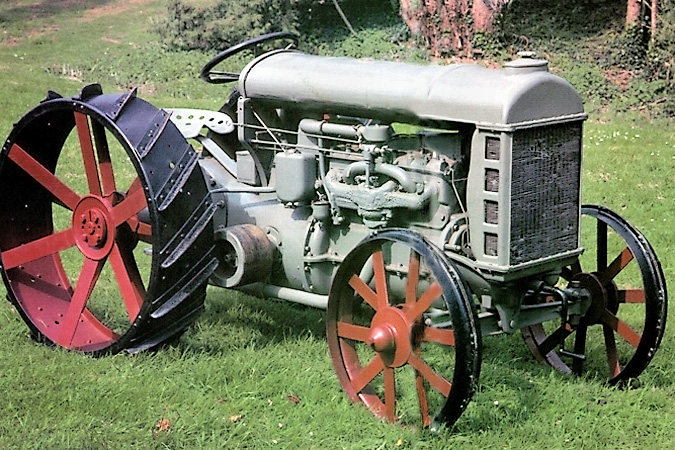
1917 Fordson Model F tractor · newhollandag · CC BY-SA 2.0
Research pending
A matching completed auction sale has not been verified for this exact year, body, trim, engine, transmission and market.
Joyride shows this gap instead of substituting an asking price, unsold bid or mismatched special vehicle.
More than a set of wheels.
Henry Ford wanted to reduce the heaviest farm labor with a tractor that could be mass-produced like a car. Henry Ford & Son organized in July 1917 and built the first Fordsons in Dearborn. Wartime Britain urgently needed machines to keep food production moving, so the first 7,000 went there; American distribution began in early 1918. The Henry Ford calls it the first lightweight, mass-produced tractor affordable to the average farmer. The frameless construction let the engine, gearbox and axle housings do double duty as the tractor's backbone.
Look a little closer.
The first 7,000 Fordsons went to Britain during World War I to help protect food production from labor shortages and disrupted imports.
Photos show an example of the model or generation. The pictured vehicle’s year, equipment, or modifications can differ from the specification described here.
The tractor's parts became its frame
Instead of mounting everything on a separate chassis, Fordson bolted the engine, transmission and axle housings into one structural unit. Fewer heavy frame rails meant less mass, fewer parts and assembly-line-friendly construction.
Source: Museums Victoria · The Fordson Tractor ↗Two horsepower numbers answer two jobs
Belt horsepower measures power delivered to a pulley for machines such as threshers. Drawbar horsepower measures useful pulling force. The Henry Ford's 20 and 12 hp figures are therefore complementary, not a contradiction.
Source: The Henry Ford · Fordson Tractor, 1917–1918 ↗Where these facts come from
- The Henry Ford · Fordson Tractor, 1917–1918
- The Henry Ford · Fordson Tractor No. 100,000
- Smithsonian National Museum of American History · Fordson Tractor
- Museums Victoria · The Fordson Tractor
Selected facts checked for this edition. Some source pages link to broader model families. Last reviewed 2026-10-02T10:12:59Z.