
GAZ M1
The sturdy M1 turned Ford-based ideas into a sedan rebuilt for Soviet factories, rough roads and cold weather.
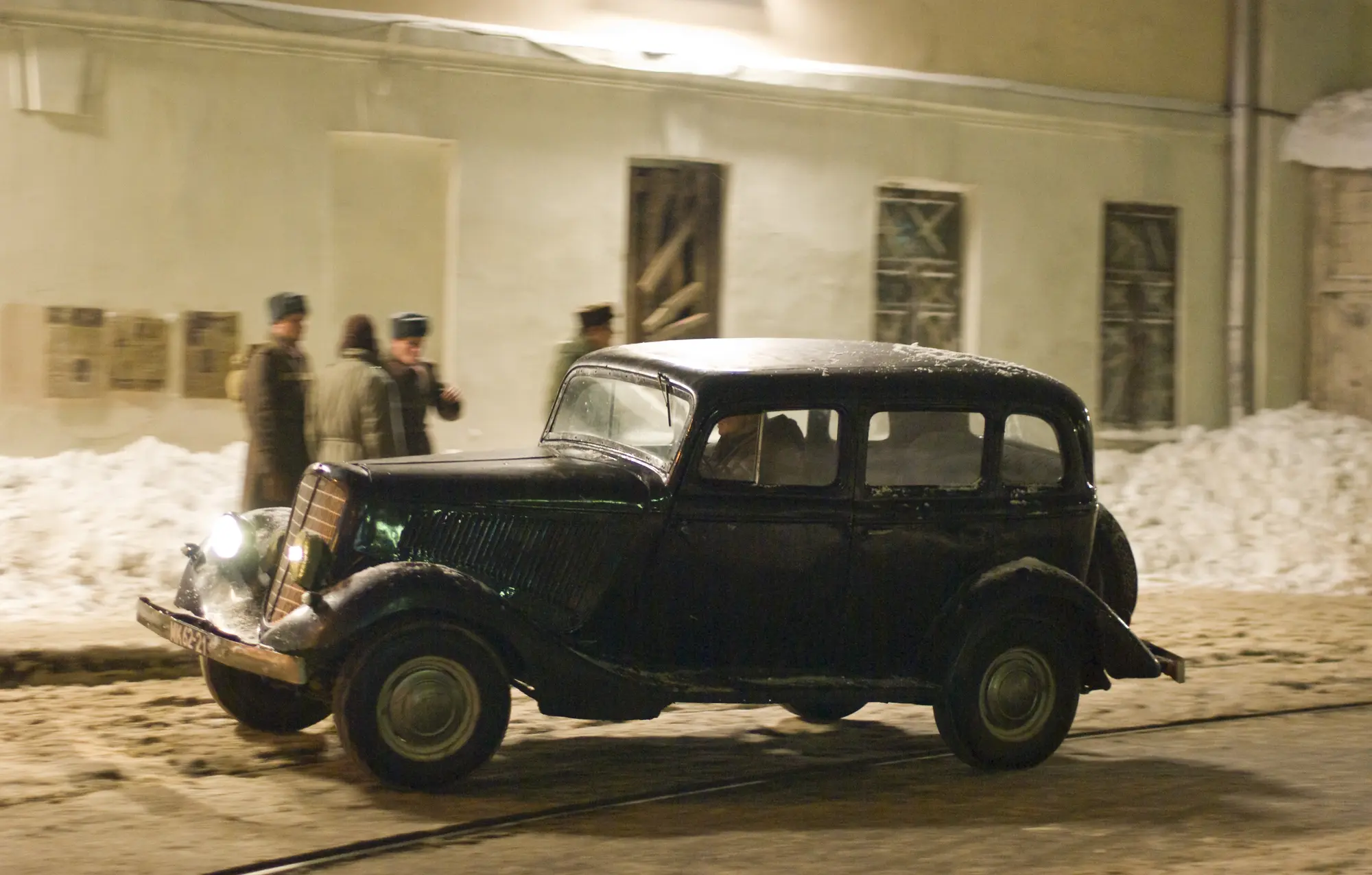
GAZ-M1 sedan · trolleway · CC BY 2.0
Research pending
A matching completed auction sale has not been verified for this exact year, body, trim, engine, transmission and market.
Joyride shows this gap instead of substituting an asking price, unsold bid or mismatched special vehicle.
More than a set of wheels.
The sturdy M1 was not simply a Ford with a new badge. GAZ began with 1934 Ford four-door engineering material, then strengthened and reworked the sedan for Soviet factories, cold weather and roads that could be muddy or broken. This profile is the regular four-cylinder car during 1937, while production improvements were still being completed—not the later six-cylinder, pickup or armoured relatives.
Look a little closer.
Its nickname was Emka, from the Russian sound of the letter M in the model name.
Photos show an example of the model or generation. The pictured vehicle’s year, equipment, or modifications can differ from the specification described here.
A Ford starting point, not a copied car
The M1 began with engineering material for Ford’s 1934 four-door line, but the Soviet production car was rebuilt around a different operating world. The museum account identifies the starting point as the Ford Model B 40A Fordor Sedan. GAZ engineers strengthened and reworked the frame, suspension, steering, wheels, cooling and other systems instead of simply changing the badge. That distinction matters: a 1937 M1 is best understood as a locally engineered relative of the 1934 Ford design, not as an American car assembled unchanged in Gorky. The Henry Ford’s preserved 1934 sales literature also helps fix the comparison year and shows that Ford itself offered both V-8 and cheaper four-cylinder Fordor sedans, so the M1’s four-cylinder ancestry should not be described as a later engine swap into a V-8-only body.
Source: Divny Museum · GAZ-M1 ↗Designed for rougher roads
The redesign concentrated on survival. Instead of the Ford arrangement, the M1 used four longitudinal leaf springs. The frame was strengthened, the steering was reworked, and pressed-steel wheels replaced wire-spoked wheels. Taller-section, lower-pressure tyres added another cushion between the car and rutted surfaces. Those choices did not turn a rear-wheel-drive sedan into an off-roader, but they gave its axles, wheels and structure more margin on mud, broken pavement and field roads. A generous 210 mm ground-clearance figure helps explain why the body sits visibly higher than many contemporary saloons. The car’s reported 1,370 kg mass also reminds young readers that every spring, brake and tyre was carrying a substantial steel machine.
Source: Divny Museum · GAZ-M1 ↗A low-revving four-cylinder explained
The 3,285 cc petrol engine is large by four-cylinder standards, yet its 50 hp maximum arrives at only 2,800 rpm. Imagine four big plungers pushing less often rather than many small pistons racing quickly: that is why the car’s character is better described as steady pull than high-speed sparkle. Power passes through a three-speed manual gearbox and a propeller shaft to the rear axle. The M1’s fuel tank sat low at the rear, so petrol could no longer flow to the carburettor only by gravity as it had on the older GAZ-A. A diaphragm pump had to lift and send fuel forward. The engine was mounted more softly to reduce how much vibration reached the frame and cabin. These systems worked together; the engine specification alone does not explain how the car felt.
Source: Tbilisi Auto Museum · GAZ-M1 ↗Speed figures with their limits kept visible
Museum data gives a top speed of about 105 km/h and says the car could accelerate from rest to 80 km/h in 24 seconds. Those are historical museum figures, not a modern instrumented road test, so they should be printed with that condition. They still make a useful comparison: the M1 was capable of ordinary inter-city travel for its era, but it gathered speed gradually. A quoted fuel-consumption figure of 14.5 litres per 100 km and a 60-litre tank imply roughly 414 km only by simple division. Real range would change with roads, weather, load and driving, so the encyclopedia should not turn that arithmetic into a promised range. The honest lesson is that its broad operating ability came with the appetite of a heavy, carburetted 1930s sedan.
Source: Divny Museum · GAZ-M1 ↗A modern steel body with one old-fashioned patch
For GAZ, the M1’s stamped body was a manufacturing leap. Thin steel sheet could be pressed into repeatable panels instead of hanging every outer panel on the older kind of framework. But “all steel” needs a footnote: the roof still used a wooden frame with a fabric-like covering stretched across it. This mixture makes the car a useful technology snapshot. The floor, doors and body sides point toward mass-production methods that would dominate later cars, while the roof shows that factories rarely replace every old process at the same moment. The fixed four-door body was also far better suited to a cold climate than the open GAZ-A it replaced.
Source: Tbilisi Auto Museum · GAZ-M1 ↗Comfort meant simple, practical controls
The M1’s cabin should be judged by 1930s expectations. The driver’s seat could slide fore and aft for different heights, and the front windscreen could hinge open for ventilation. A windscreen wiper was fitted, but the car did not have a heater. Metal trim could be painted to imitate richer wood, while cloth covered the seating surfaces. The large steering wheel provided leverage for unassisted steering, and the three-speed gear lever managed a driveline without today’s electronic help. The restored-interior Commons view is useful here, but it is evidence of a restored museum car, not proof that every 1937 car left the factory with that exact upholstery colour or every visible switch.
Source: Tbilisi Auto Museum · GAZ-M1 ↗From two first cars to mass production
The Tbilisi museum dates the first two production M1s to March 16, 1936 and their presentation in the Kremlin to the following day. Mass production began on May 20. That does not mean the design instantly stopped changing: early construction and assembly problems were investigated while production continued, and the museum says the model was brought to maturity only toward the end of 1937. That is especially important for this profile, which uses 1937 as its precise reference year. It represents the regular four-cylinder sedan during the period when the factory was still improving the production car, not an imaginary specification frozen forever on launch day.
Source: Tbilisi Auto Museum · GAZ-M1 ↗What the name “M1” meant
The letter M referred to Molotov because the Gorky factory carried Vyacheslav Molotov’s name; the number marked this as its first model in that naming sequence. Spoken aloud, the letter produced the affectionate nickname “Emka.” The badge therefore carries industrial and political history at the same time. A child does not need that context turned into a slogan: it is enough to explain that factories in the Soviet Union were often named for public figures, and those names could become part of the machines’ model codes. The nickname outlived the political naming system.
Source: Divny Museum · GAZ-M1 ↗Who used it
The M1 was not an ordinary showroom purchase for most Soviet families. The Tbilisi museum says cars were allocated to organisations and officials; private use was exceptional and could be awarded for special achievement. The type became a taxi and a staff car, and many served the Red Army during the war. That broad service explains why surviving examples do not all look alike. Restorations, military paint, later grilles, tyres and interior materials can differ. The profile should use those survivors to teach shape and engineering, while every caption must say when a car’s exact build year, original equipment or service history is unknown.
Source: Tbilisi Auto Museum · GAZ-M1 ↗Production totals and the war-era boundary
The museums agree on 62,888 cars of the type. One account describes regular manufacture through 1942, followed by a small number assembled from remaining parts; another gives the model span through 1943. Both can be true if “production” means regular line manufacture in one sentence and final assembly from inventory in another. The clean encyclopedia wording is therefore: regular production family from 1936 through 1942, with limited parts-based assembly into 1943. The 1937 profile must also exclude later six-cylinder GAZ-11-73 cars, pickups and armoured relatives. They share ancestry and sometimes body details, but they are not evidence for this car’s four-cylinder specification.
Source: Tbilisi Auto Museum · GAZ-M1 ↗How the old four-cylinder found ten more horsepower
The M1 did not gain its extra power by becoming a much bigger engine. Za Rulem's technical comparison gives the familiar 98.4 × 108 mm bore and stroke, but says the compression ratio rose from the GAZ-A's 4.2:1 to 4.6:1. Engineers also revised the carburettor and added automatic ignition advance. Compression is how firmly the piston squeezes the fuel-air mixture before the spark; a little more squeeze can help release more useful work when the fuel and cooling allow it. Ignition advance changes when the spark occurs as engine speed changes, so the burning mixture can push at the useful moment instead of making the driver adjust a lever. Together, those changes lifted output from 40 to 50 hp at 2,800 rpm without turning the M1 into a high-revving engine.
Source: Za Rulem · GAZ-M1 technical comparison ↗Three gearbox steps, each with a different job
The three-speed manual used ratios of 2.82:1, 1.604:1 and 1.00:1 according to Za Rulem's technical comparison. In first gear, the gearbox turns its output fewer times than the engine, trading road speed for the extra twisting force needed to start a 1,370 kg car moving. Second is the bridge between launch and cruising. Third is direct drive: its 1.00:1 ratio means the gearbox input and output turn at the same nominal speed before the final drive changes it again. These ratios are not acceleration test results, and they do not say how quickly a driver shifted. They explain why three carefully spaced steps could cover starting, gathering speed and steady travel with a low-revving engine.
Source: Za Rulem · GAZ-M1 technical comparison ↗Braking by linkage instead of brake fluid
The regular M1 kept mechanically operated brakes rather than a hydraulic system. Pressing the pedal moved linkage and cables that pulled the brakes at the wheels; no pressurised brake fluid carried the driver's force. That arrangement demanded careful adjustment so the wheels shared the work evenly, but it matched a design brief that valued straightforward production and service. Za Rulem notes that hydraulic brakes required more complicated manufacture and more specialised maintenance in the period. The existing rights-cleared cable-brake photograph is especially useful because it shows the exposed hardware on a representative survivor. It demonstrates the mechanism's layout, but a restored display chassis cannot prove that every nut, cable or adjustment matches a particular 1937 car exactly.
Source: Za Rulem · GAZ-M1 technical comparison ↗How the carburettor stayed calmer on hills
The M1's carburettor had to meter fuel while the whole car pitched up and down on rough roads. A 1940 technical book explains that its float moved across the car rather than fore and aft. That made the fuel level less sensitive when the nose pointed uphill or downhill. Two metering paths—the main jet and a compensating jet—helped keep the mixture steadier as engine speed changed. A separate power jet joined in only when the throttle opened beyond roughly two-thirds, enriching the mixture when the driver asked for maximum effort. At lighter loads it stayed out of the way, so the engine could use a leaner mixture. That is why the book also calls this power jet an economizer. The account describes the regular production M1 family in 1940; it is strong evidence for the mature four-cylinder design, but it does not itemize every running change made to an individual 1937 car.
Source: Rodionov and Chumakov · Automobile GAZ-M-1 technical book (1940 scan) ↗A cooling system that could move with the frame
Cooling was more than a radiator full of water. The 1940 technical book gives the system a capacity of about 12 litres and says the radiator leaned five degrees rearward to fit the nose. More important for rough roads, the radiator assembly sat on rubber pads instead of being clamped rigidly to the flexing frame. The book explains that this let the frame and radiator vibrate at different rates, reducing the chance that their movements would build on each other like two children pumping the same swing. Airflow came from a belt-driven fan with either two or four blades; the four-blade version was recommended for southern and mountain regions. These details show how durability came from allowing controlled movement, not merely making every part stiffer. Because the source is a 1940 family-level technical description, Joyride should not pretend it proves the exact fan fitted to one 1937 specimen.
Source: Rodionov and Chumakov · Automobile GAZ-M-1 technical book (1940 scan) ↗Oil took two routes through the engine
The M1 did not send oil to every moving part in exactly the same way. Its technical book describes a combined system: a pump pushed oil under low pressure to the crankshaft's main bearings, the camshaft bearings and the timing gears, while oil thrown from the moving connecting rods formed a mist and splashed the other rubbing surfaces. Think of one route as a small pipeline for the hardest-working bearings and the other as a sprinkler for the surrounding parts. The listed oil capacity is about five litres, and the driver had both a dipstick for level and a pressure gauge on the instrument panel. Pressure and quantity answer different questions: the gauge can show whether the pump is circulating oil, while the dipstick shows how much remains in the sump. Neither one alone describes the whole lubrication system.
Source: Rodionov and Chumakov · Automobile GAZ-M-1 technical book (1940 scan) ↗Why second and third were easier to select
A three-speed gearbox sounds simple, but the upper two ratios included an important aid. The period engineering description says second gear used helical teeth for quieter running, while a synchronizer helped match the speeds of the parts before second or third engaged. Without that matching step, a driver could hear a graunch if the gear teeth met while turning at different speeds. First gear still supplied the biggest multiplication for starting, second bridged the gap, and third remained direct drive. The same source gives reverse a 3.383:1 ratio. These numbers describe gear reduction, not vehicle speed: the final drive, tyre size, engine speed and road load still determine how fast the car travels.
Source: Za Rulem archive · New model of the Gorky M-1 automobile (November 1934) ↗A taxi rank photographed in the M1's own era
Most surviving M1 photographs show restored cars one at a time. Boris Ignatovich's 1939 photograph for Moscow's archive is different: rows of GAZ-M1 taxis wait beside a sign at the All-Union Agricultural Exhibition. The picture supports the museum accounts that the type worked as a taxi and shows several cars together in ordinary service-era form. It is still a one-year-later comparison for this 1937 profile, not proof that every visible lamp, tyre or marking belongs to the precise reference-year specification. Its real value is historical context: the M1 was not only a preserved official sedan but also part of an organized passenger-transport fleet. The image is released by Moscow's archive through Commons under CC BY 4.0, with Mos.ru attribution retained.
Source: Wikimedia Commons · Boris Ignatovich, Taxis on VSKhV (1939), Moscow Main Archive ↗What a 1937 fuel trial really measured
A museum's single consumption figure cannot show how traffic, warm-up, maintenance and road surface changed an M1's appetite. A period Za Rulem report from October 1937 examined fifteen cars at a Moscow government motor pool and found a broad 11.29–21.25 litres per 100 kilometres. Their mean was 15.2. The article connected the lower figures with longer runs and fewer forced stops, while short central-Moscow trips raised consumption through repeated starting, idling and engine warm-up. It then described a more controlled 25-kilometre city circuit in a 1936-built M1 that had already covered 22,075 kilometres and undergone repair. At an average 35–40 km/h, that car used 14.68 L/100 km; two companion cars returned 15.28 and 14.97. Separate factory trials on flat asphalt produced 12–13 L/100 km, but the author explicitly warned that such nearly ideal conditions were not representative of everyday fleet work. The report's practical conclusion was a temporary ceiling of about 15 L/100 km and an economical-speed region around 35–45 km/h for a correctly operating engine. These are period operating observations, not modern standardized economy ratings or promises for every surviving car.
Source: Za Rulem archive · Fuel consumption of M-1 automobiles (October 1937) ↗The engine was still being improved in 1937
An April 1937 article by engineer S. Pristup is unusually valuable because it records running production work during this profile's exact reference year. Reports from service had shown that the tapered pin retaining the water-pump impeller could fall out, allowing the shaft to damage the radiator; the factory replaced the pin with a rivet. Valve clearances were revised to reduce clatter, with separate inlet and exhaust ranges. Machining was also tightened where oil escaped: the rear main-bearing cover face and the full sump flange were ground, and the cylinder-block deck was ground while a defined head-nut tightening sequence was introduced to combat failed head gaskets. The article also says a redesigned flywheel housing had been accepted for production. Its two halves were to be cast iron, assembled after preliminary machining and then finish-machined together so the housing behaved like one accurate part and reduced gearbox misalignment. The author distinguishes changes already introduced from designs still approaching production, so Joyride should do the same. These notes describe factory countermeasures and April 1937 production intent; they do not prove the build state of an unidentified survivor or establish a chassis-number cutoff for every change.
Source: Za Rulem archive · Some changes to the M-1 engine (April 1937) ↗A staff-car display, with restoration limits visible
The olive museum car photographed at the Sapun Mountain memorial adds a different kind of evidence from the polished civilian survivors already in the gallery. Commons identifies the display as Army General Ivan Petrov's company car and categorizes the subject as a GAZ-M1; the photograph clearly shows a regular M1 body in military presentation. A Victory Museum branch separately explains that M1s served divisional, army and front command staffs during the war. Together they support the type's staff-car role, but not every detail of this display's paint, tyres, lamps or placard history. The exact build year and originality of the exhibited car are not established on the Commons record, so the caption must call it a museum display and never use it as proof of 1937 factory finish.
Source: Victory Museum G.O.R.A. branch · GAZ-M1 passenger car ↗The air cleaner used oil to trap road dust
A January 1937 technical note describes the M1's air cleaner as an oil-bath design. Incoming air first travelled downward and then changed direction sharply above an oil reservoir. Larger dust particles were meant to fall into the oil at that turn. The air then passed through a cylindrical mesh coated with an oil film, where smaller particles could stick before the cleaned air continued to the carburettor. Oil draining back from the mesh carried dirt toward the bottom of the reservoir. This was not a disposable paper filter: its effectiveness depended on keeping the oil and mesh clean. The connecting pipe did a second job as an intake silencer. The article describes an inner perforated pipe surrounded by an outer pipe, with cotton packing between them to absorb sound. In other words, the same assembly protected the engine from dust and softened the intake noise heard by passengers. The source is unusually valuable because it appeared in the profile's exact reference year and reports contemporary NAMI/NATI test work, rather than describing only a modern restoration. It still documents the production design at family level; it does not identify the air cleaner fitted to any one surviving 1937 chassis.
Source: Za Rulem archive · Air cleaner of the M-1 automobile (January 1937) ↗Dust changed the service interval, and testing exposed a leaky joint
The same period article makes the maintenance burden concrete. It says the normal instruction was to wash the air cleaner after about 1,500 km, but on dusty roads inspection could be needed after only 100–200 km, with the oil changed according to how dirty it had become. That wide difference is a reminder that a single service interval cannot describe every 1930s Soviet road. The article reports that NAMI/NATI testing found the M1 cleaner worked well and that piston-group wear was markedly lower than on the GAZ-A tested by the institute; the author attributed the improvement mainly to the M1's air cleaner. Testing also found a weakness at the carburettor connection. A short hose held by one clamp did not make a reliably airtight joint, partly because the pipe and carburettor stub were difficult to align precisely. The institute's revised arrangement used a longer hose and two ordinary clamps, so each end could be secured separately. This is a useful counterweight to a simple progress story: the basic filtration idea performed well, while a small connection detail still needed correction. Joyride should present the wear comparison as the period author's test interpretation, not as a modern independently repeated durability result.
Source: Za Rulem archive · Air cleaner of the M-1 automobile (January 1937) ↗Rubber engine mounts needed a copper electrical bridge
The M1's soft engine mounting did two jobs at once: it reduced the vibration passed into the frame, but the rubber cushions also separated the engine electrically from the rest of the car. An exact-period April 1937 service note explains the fix. A flat braid made from tinned copper wires connected the powertrain assembly to a frame cross-member, providing a low-resistance path for ignition and electrical equipment mounted on the engine. Think of the strap as a little bridge around the rubber: the rubber could keep doing its vibration-isolating job while electric current still had a dependable way back to the battery. The note places one end at the torque-tube cup and the other beneath a hand-brake-lever bracket bolt on the cross-member. It also records an arrangement that looks reversed to many modern readers: the battery's positive terminal was bonded to the car's metal mass, while its negative terminal fed the starter. The author warned that loose or dirty connections could interrupt the ignition circuit, overheat or damage the generator, burn out lamps or harm the condenser, and therefore called for periodic inspection of both the battery-to-frame bond and the engine-to-frame strap. This is family-level service evidence published during the profile's exact year, not proof of the untouched hardware on one surviving car.
Source: Za Rulem archive · From M-1 operating practice (April 1937) ↗Fleets were still learning when an M1 really needed repair
A second exact-year report shows why a single maintenance number can be misleading. In October 1937, the author said there was still no unified nationwide M1 mileage schedule between major workshop visits, so individual fleets had developed their own rules from experience. Simply copying the older GAZ-A schedule was rejected: that earlier rule had called for repair number 2 at 10,000 km and repair number 3 at 30,000 km, but the writer considered those thresholds obsolete for the newer M1. One central Narcomsovkhoz fleet had initially planned repair number 2 after 10,000 km, then found that 25,000 km or more was practical. The article also records named-driver examples, including a 1936-built car that covered 41,000 km before repair number 1; an unrelated crash stopped that particular run, so it must not be presented as a guaranteed durability limit. Two other cars are reported at 25,000 km and 30,000 km, the latter before repair number 2. The period author's conclusion was that driver skill, regular care and technical supervision could matter more than odometer distance alone. That is a valuable historical lesson, but it is not a modern reliability test: fleet definitions of repair levels varied, road and load conditions differed, and the article itself was arguing for a common standard because practice was inconsistent. Joyride should keep those conditions beside the figures rather than turning the best example into a promise about every 1937 M1.
Source: Za Rulem archive · On inter-repair mileage norms for M-1 automobiles (October 1937) ↗Wheel balance was treated as a two-direction workshop problem
The May 1937 workshop article on M1 wheel balancing goes beyond the simple idea that a wheel is either round or not. Its diagrams separate an unbalanced force acting in the wheel's vertical plane from one acting across the horizontal plane. A child-friendly way to picture the difference is a spinning top that both hops and wobbles: adding mass in the right place can calm one motion without automatically correcting the other. The article illustrates small dedicated balance weights marked 60 g and 120 g, shows how a weight could be retained at the rim, and includes both a simple wheel-balancing fixture and a GARO service stand. Those drawings document the repair equipment and reasoning available to M1 workshops in the car's exact reference year. They do not prove that every M1 left the factory carrying a particular number or size of weight, nor do they make a restored wheel original. The useful story is that mechanics were expected to diagnose rotating mass, choose a counterweight and verify the result rather than dismissing shake as an unavoidable trait of an old car. This adds genuine service-history depth without transferring a workshop example into a false factory specification.
Source: Za Rulem archive · Balancing the wheels of the M-1 automobile (May 1937) ↗Mechanical brakes depended on free movement, dry linings and cold adjustment
An April 1937 workshop article describes the M1's brakes as a fully mechanical four-wheel system. Both the foot pedal and hand lever turned a central distribution shaft; rods carried force toward the rear brakes, while rods, intermediate levers and sheathed flexible cables operated the fronts. The rear linkage geometry placed the forward end of each rear pull rod near the axle's centre of movement so spring travel would not tighten the brakes by itself. At the front, the cable mechanism was enclosed to retain lubricant and exclude dirt while still allowing equal action as the wheels steered. The article is especially useful about failure modes. It says a sticking cam or tight linkage pin could weaken operation, oil on a lining could make the brake ineffective, water reduced friction, and adjusting hot drums could leave the brakes dragging after they cooled. It therefore called for every linkage joint to move freely, the system to be cleaned of dust and dirt, and shoe adjustment to be made only with fully cooled drums. Its prescribed final check was a dry, smooth asphalt or concrete road test: sharp braking from 40 km/h should make all four wheels skid together. That is period workshop guidance, not a modern stopping-distance result, and it should not be turned into a claim that every surviving M1 still performs that way.
Source: Za Rulem archive · Brakes of the M-1 automobile (April 1937) ↗Where these facts come from
- GAZ Factory Museum · Company history
- Divny Museum · GAZ-M1
- 360 Car Museum · GAZ-M1
- Tbilisi Auto Museum · GAZ-M1
- The Henry Ford · 1934 Ford brochure
- Wikimedia Commons · GAZ-M1 category
- Wikimedia Commons · GAZ-M1 in museums
- Za Rulem · GAZ-M1 technical comparison
- State Military-Technical Museum · 1939 GAZ-M1 exhibit
- Rodionov and Chumakov · Automobile GAZ-M-1 technical book (1940 scan)
- Za Rulem archive · New model of the Gorky M-1 automobile (November 1934)
- Wikimedia Commons · Boris Ignatovich, Taxis on VSKhV (1939), Moscow Main Archive
- Za Rulem archive · Fuel consumption of M-1 automobiles (October 1937)
- Za Rulem archive · Some changes to the M-1 engine (April 1937)
- Victory Museum G.O.R.A. branch · GAZ-M1 passenger car
- Wikimedia Commons · GAZ-M1 rear-window detail at Khabarovsk City Day
- Wikimedia Commons · Company car, Army General Petrov I.E.
- Za Rulem archive · Air cleaner of the M-1 automobile (January 1937)
- Za Rulem archive · From M-1 operating practice (April 1937)
- Za Rulem archive · On inter-repair mileage norms for M-1 automobiles (October 1937)
- Za Rulem archive · Balancing the wheels of the M-1 automobile (May 1937)
- Za Rulem archive · Brakes of the M-1 automobile (April 1937)
Selected facts checked for this edition. Some source pages link to broader model families. Last reviewed October 1, 2026.