
Harley-Davidson Model 5-D
Harley-Davidson's first production V-twin arrived in 1909, adding a second cylinder to make more power—but also teaching the young company hard lessons about reliability.
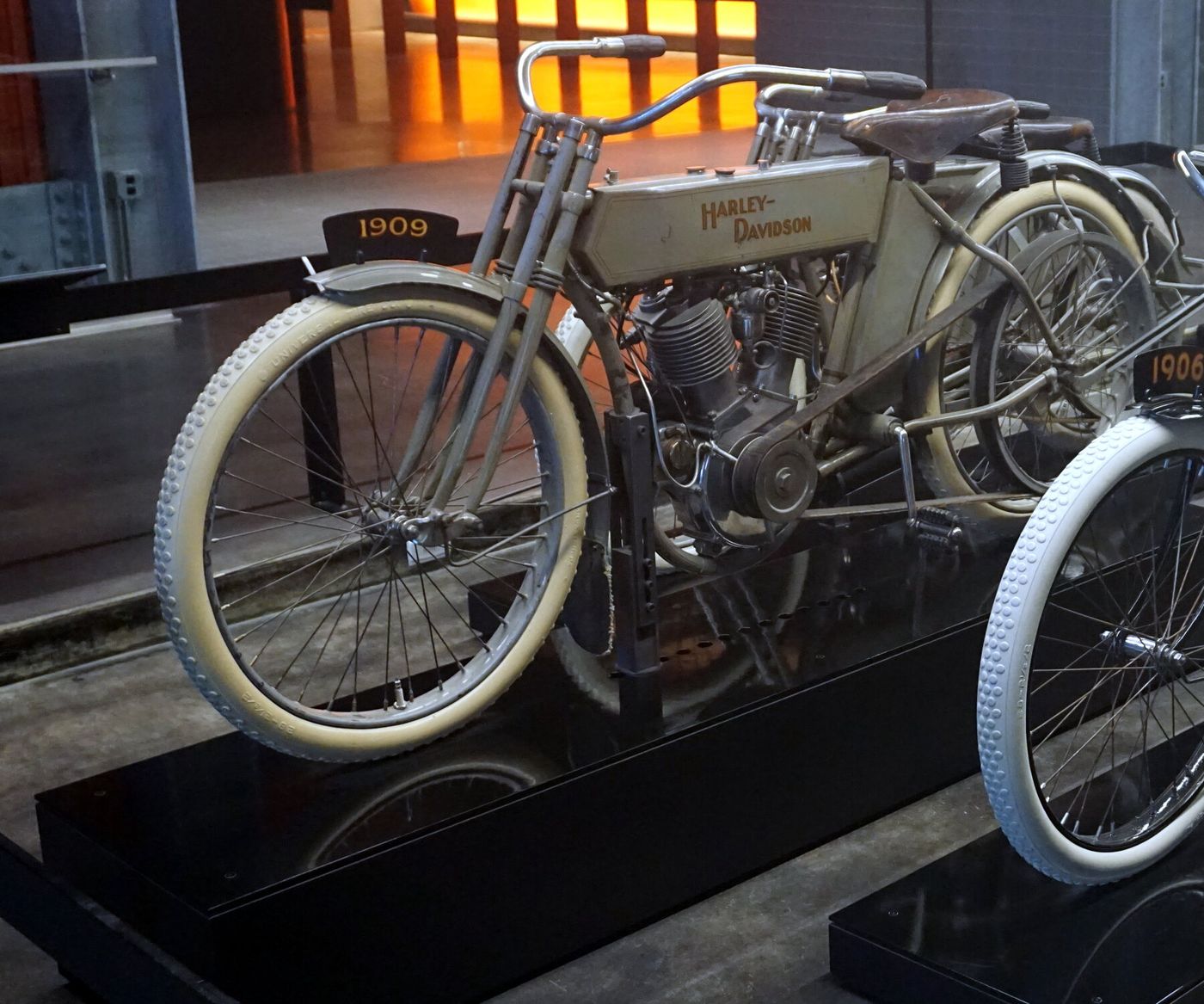
1909 Harley-Davidson Model 5-D at the Harley-Davidson Museum · Michael Barera · CC BY-SA 4.0
Research pending
A matching completed auction sale has not been verified for this exact year, body, trim, engine, transmission and market.
Joyride shows this gap instead of substituting an asking price, unsold bid or mismatched special vehicle.
More than a set of wheels.
Only 27 Model 5-D motorcycles were built in 1909. This page follows that first 45-degree V-twin with automatic intake valves, not the improved mechanically operated V-twins that followed after a one-year pause.
Look a little closer.
Its uneven 315-degree and 405-degree firing gaps helped create the loping rhythm people later associated with Harley V-twins.
Photos show an example of the model or generation. The pictured vehicle’s year, equipment, or modifications can differ from the specification described here.
A bold first try that needed a rethink
The 5-D roughly doubled the company's single-cylinder power, but its automatic intake valves and direct belt drive were difficult to start and control. Harley-Davidson withdrew the design after 1909 and returned with a much better V-twin in 1911.
Source: Harley-Davidson · Engine types through history ↗The 45-degree idea stayed
Although the first engine was short-lived, its narrow V angle made the twin fit a bicycle-like frame. Later Harley engines kept the basic 45-degree arrangement while replacing the troublesome valve and drive details.
Source: Harley-Davidson Insurance · Motorcycles that changed Harley-Davidson ↗Where these facts come from
- Harley-Davidson · Engine types through history
- Harley-Davidson Insurance · Motorcycles that changed Harley-Davidson
- Harley Clásica · 1909 Model 5 technical history
Selected facts checked for this edition. Some source pages link to broader model families. Last reviewed September 30, 2026.