Honda Benly CB92 Super Sport
Small enough to be a 125, but engineered like a racer, the CB92 began Honda's longest-running road-sport name.
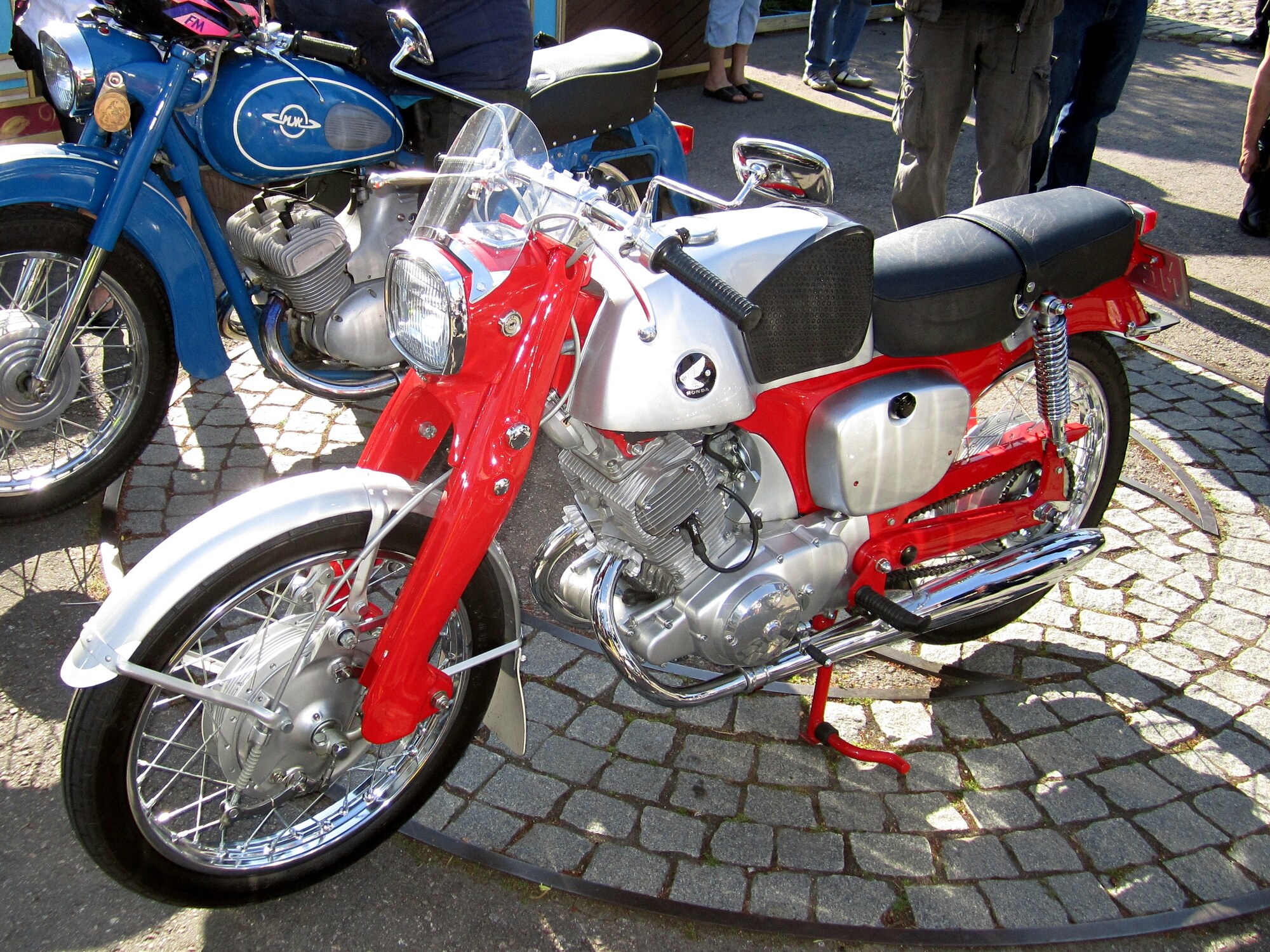
Honda CB92 Benly Supersport 125cc.JPG · Khaosaming · CC BY-SA 3.0
Research pending
A matching completed auction sale has not been verified for this exact year, body, trim, engine, transmission and market.
Joyride shows this gap instead of substituting an asking price, unsold bid or mismatched special vehicle.
More than a set of wheels.
Honda announced the Benly CB92 Super Sport in Japan in February 1959. It was the first mass-production model to wear the CB name and turned the everyday Benly idea toward club racing: a 124 cc twin, low bars, larger wheels and a serious front brake. Honda sent CB92s to Isle of Man TT riders for course inspection and practice, then Moto Kitano won both the 125 cc Clubman race and the companion endurance race at Mount Asama. That result made the little machine a convincing bridge between Honda's racing ambition and motorcycles ordinary buyers could own.
Look a little closer.
Its 44 mm bore and 41 mm stroke matched Honda's RC142 factory racer, even though the CB92 was a road-legal production motorcycle.
Photos show an example of the model or generation. The pictured vehicle’s year, equipment, or modifications can differ from the specification described here.
A road bike built around race-sized breathing
The CB92 shared its 44.0 × 41.0 mm cylinder dimensions with Honda's 1959 Isle of Man RC142. Honda combined that oversquare geometry with an overhead camshaft and a 10,500 rpm power peak. The production bike was not the TT racer, but the shared proportions explain how racing taught Honda to use small, light moving parts and high engine speed rather than simply adding displacement.
Source: Honda CB Stories · CB: Honda's Longest Road Sports Brand ↗The chassis advertised its purpose before the engine started
Compared with ordinary Benlys, the CB92 used 18-inch wheels, exposed rear springs, a shorter seat, low tubular handlebar and an eight-inch double-leading-shoe front drum. Early bikes even used magnesium in the brake backing plate. Those choices made the machine look and stop like a miniature racer, while Honda's optional competition parts let owners move still closer to closed-course use.
Source: Motorcycle Classics · 1962 Honda CB92 Benly Super Sport ↗Where these facts come from
- Honda CB Stories · CB: Honda's Longest Road Sports Brand
- Honda · 1959 Benly CB92 Super Sport model page
- Honda product archive · Benly CB92 Super Sport
- Motorcycle Classics · 1962 Honda CB92 Benly Super Sport
Selected facts checked for this edition. Some source pages link to broader model families. Last reviewed October 2, 2026.