
Honda Civic 2-door Deluxe
The first Civic was short, wide and unusually roomy for its footprint. Honda turned the engine sideways, drove the front wheels and removed the traditional trunk so more of the car could be used for people.
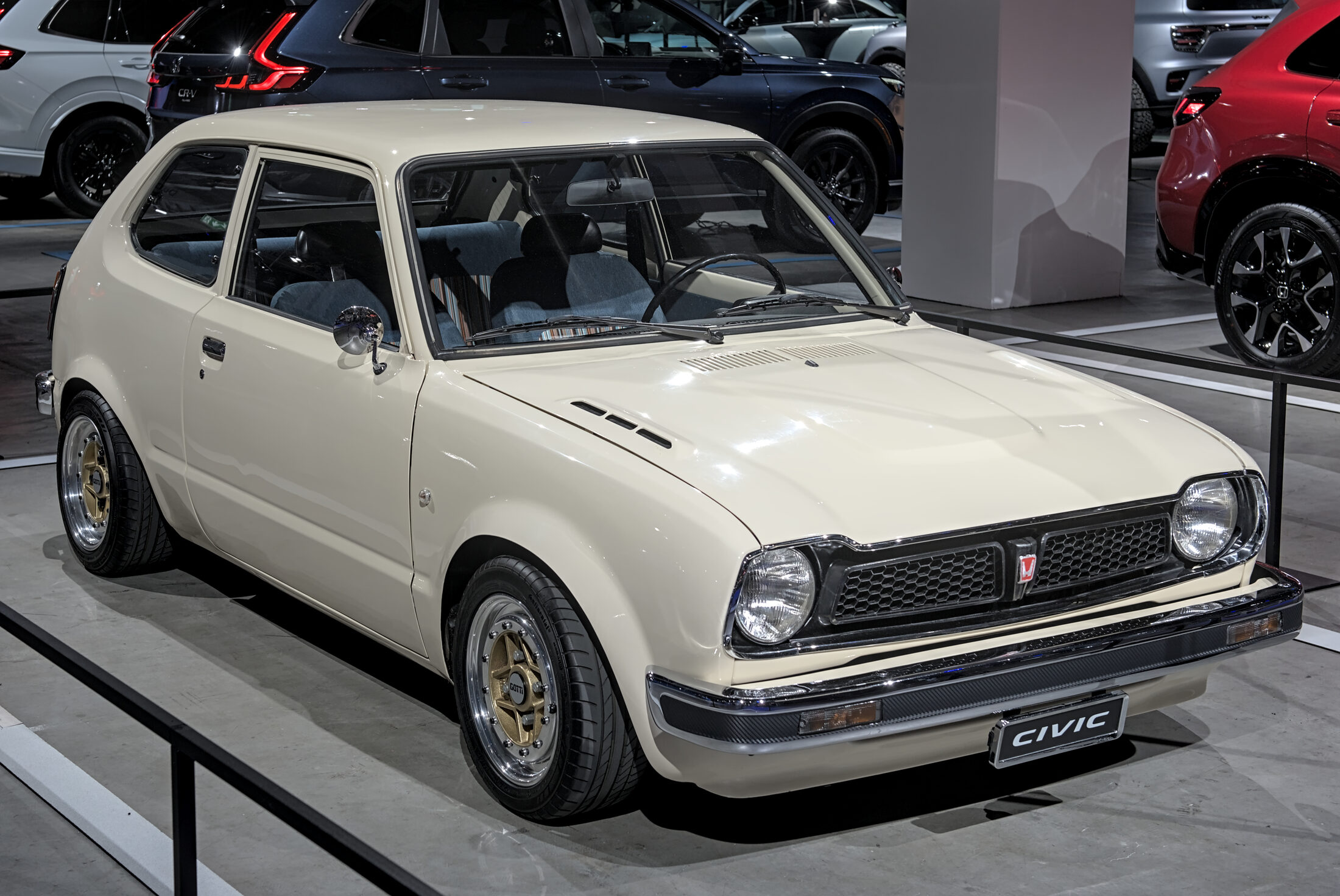
Honda Civic (1972) Auto Zuerich 2024 DSC 6508.jpg · Alexander-93 · CC BY-SA 4.0
Research pending
A matching completed auction sale has not been verified for this exact year, body, trim, engine, transmission and market.
Joyride shows this gap instead of substituting an asking price, unsold bid or mismatched special vehicle.
More than a set of wheels.
Honda announced the Civic on July 11, 1972 and put the Japanese two-door range on sale July 12. The three-door series and GL followed in September, so this profile stays with the original SB1 two-door Deluxe. Honda developed the Civic in only two years around a world-car brief: light, quick, compact and useful. Its front-drive, two-box layout and transverse water-cooled engine broke with the rear-drive, three-box norm among Japanese small cars. The later CVCC version became famous for emissions control, but it did not arrive until December 1973 and is outside this launch-car profile.
Look a little closer.
Honda sales staff were so unfamiliar with the new hatchback idea that one famously asked which side held the third door. The answer was the rear hatch.
Photos show an example of the model or generation. The pictured vehicle’s year, equipment, or modifications can differ from the specification described here.
Twenty-five millimetres that made the cabin possible
Honda's transverse engine still had to be shortened before the front wheels could steer through their full range. Engineers moved the water pump into the block, reworked the oil-pump drive and routed oil through its shaft, trimming 25 mm from the engine package. That invisible engineering helped the compact nose protect passenger space.
Source: Honda 75 Years — The Civic ↗Independent suspension was a space decision too
Most front-drive cars of the period used a rigid rear axle, but Honda chose struts and independent suspension at all four wheels. The development team argued that removing the axle could improve cabin space, balance, handling and weight. Honda's launch specifications confirm strut-type independent suspension front and rear.
Source: Honda Global — Announcing the Civic / 1972 ↗Where these facts come from
- Honda — HONDA CIVIC New Release (July 11, 1972)
- Honda Fact Book — CIVIC 1972.07 specifications
- Honda Global — Announcing the Civic / 1972
- Honda 75 Years — The Civic
Selected facts checked for this edition. Some source pages link to broader model families. Last reviewed October 1, 2026.