
Honda Dream Type D
Honda's first complete motorcycle paired a maroon pressed-steel frame with a clever clutch that let the rider change gear using one foot.
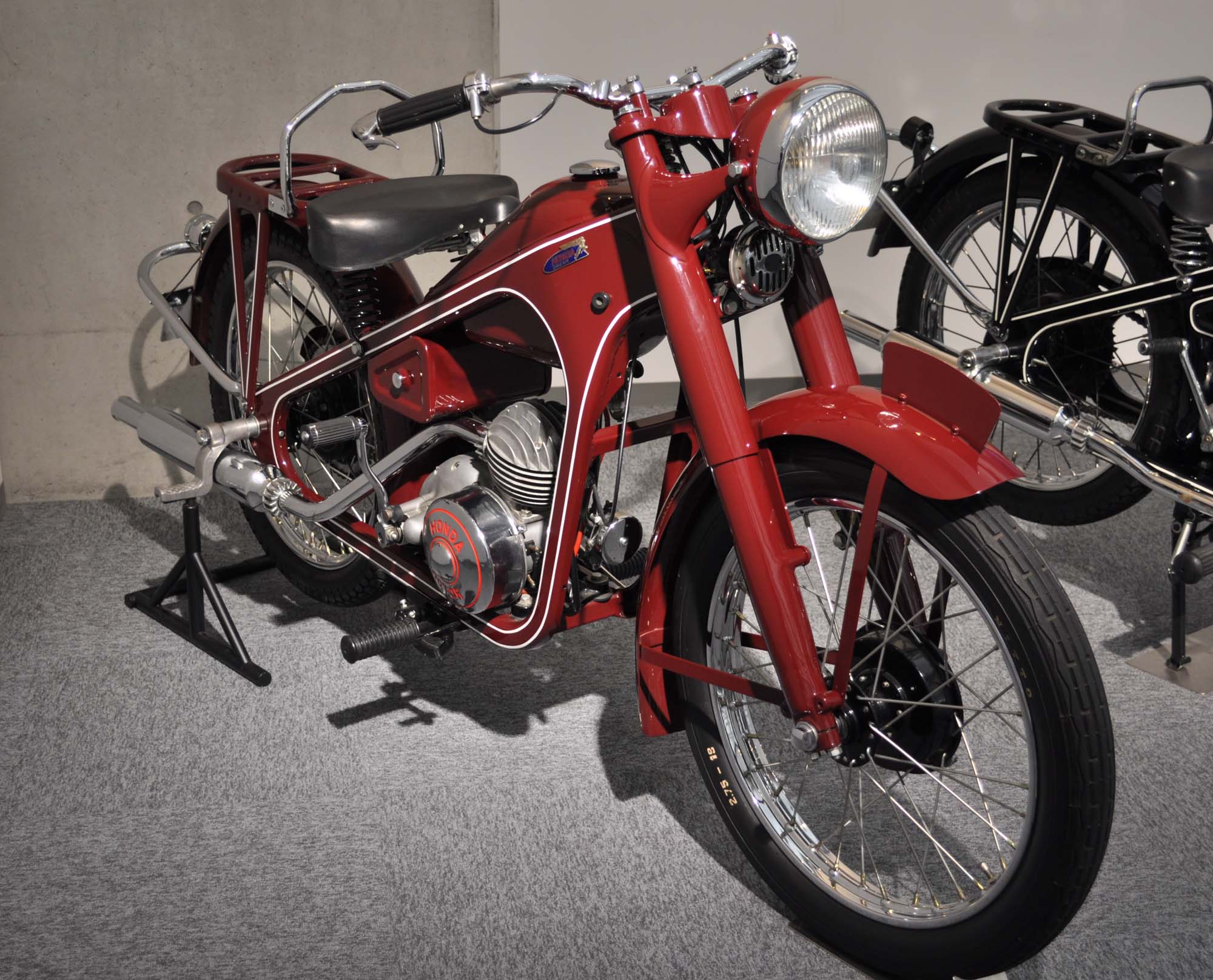
Honda Dream D.jpg · Rikita · CC BY-SA 3.0
Research pending
A matching completed auction sale has not been verified for this exact year, body, trim, engine, transmission and market.
Joyride shows this gap instead of substituting an asking price, unsold bid or mismatched special vehicle.
More than a set of wheels.
Honda launched the Dream D-Type in August 1949, only a year after Honda Motor Co. was founded. Unlike the firm's earlier auxiliary bicycle engines, the D-Type was conceived as a full motorcycle, with its own engine and pressed-steel frame. Honda also experimented with a powered assembly conveyor. The easy clutch initially won buyers, but holding the pedal down to stay in low gear tired riders on hills; combined with recession in Japan, that weakness helped cause Honda's first business crisis. The lessons mattered: Honda learned that an ingenious idea still had to be comfortable in everyday use.
Look a little closer.
The lever where riders expected a clutch was actually the front brake—the D-Type had no hand-operated clutch at all.
Photos show an example of the model or generation. The pictured vehicle’s year, equipment, or modifications can differ from the specification described here.
Easy to start riding, tiring to keep climbing
Honda connected a wet cone clutch to the gear-change pedal so a beginner did not have to coordinate a hand lever. Pressing the pedal one way selected low and the other way selected high, but the mechanism returned to neutral when the rider released it. That meant a long hill demanded constant foot pressure. The idea made the motorcycle approachable, yet the awkward hill behavior showed why ease of operation must be tested over a whole journey.
Source: Honda Heritage · The Appearance of a Full-fledged Motorcycle, the Dream D-Type ↗Pressed steel was a manufacturing decision
Most Japanese motorcycles then used tubular frames. Honda formed the D-Type's open channel from sheet steel, reducing welding and helping keep parts consistent when good steel tube was difficult to obtain. The same production-minded approach included die-cast engine parts and a step-moving conveyor. The D-Type therefore records not only a new motorcycle but Honda's early attempt to design the factory and the product together.
Source: Honda Heritage · The Appearance of a Full-fledged Motorcycle, the Dream D-Type ↗Where these facts come from
- Honda · Dream D-Type 1949 period-catalogue facsimile
- Honda Heritage · The Appearance of a Full-fledged Motorcycle, the Dream D-Type
- Society of Automotive Engineers of Japan · Honda Dream D-Type
Selected facts checked for this edition. Some source pages link to broader model families. Last reviewed October 2, 2026.