
Lancia Rally 037 Stradale
Lancia wrapped a road-legal two-seat coupé around a rally skeleton: a central cabin, bolt-on tube frames and a supercharger that answered quickly.
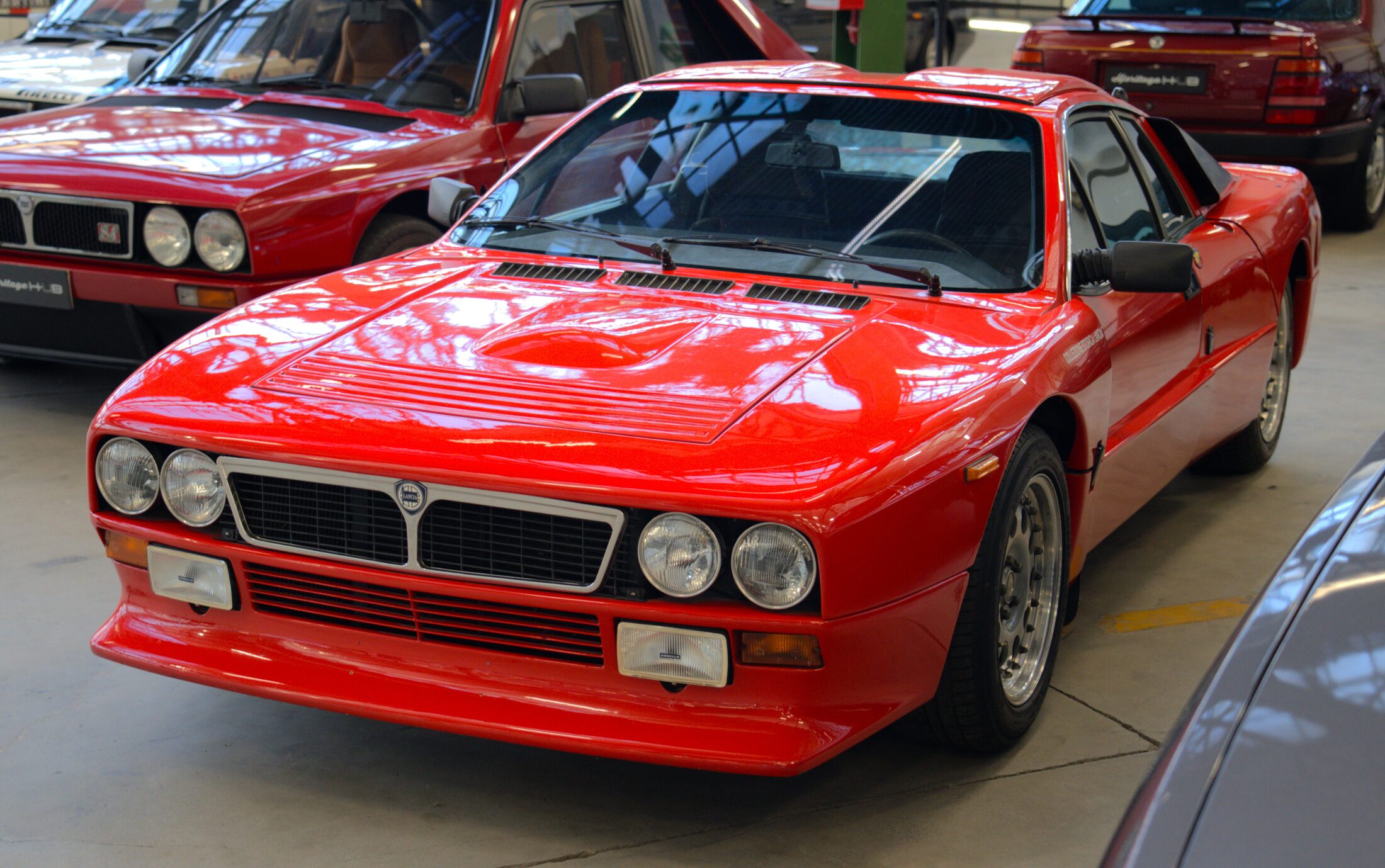
1982 Italy Lancia Rally 037 Stradale · MrWalkr · CC BY-SA 4.0
Research pending
A matching completed auction sale has not been verified for this exact year, body, trim, engine, transmission and market.
Joyride shows this gap instead of substituting an asking price, unsold bid or mismatched special vehicle.
More than a set of wheels.
Lancia unveiled the road-going Rally at the 1982 Turin Motor Show and produced the 200 examples needed to homologate its Group B competition car. Project SE037 began from the Beta Montecarlo's central structure, but tubular frames carried the suspension, engine and gearbox, while Pininfarina created removable fiberglass-reinforced body panels. The racing 037 went on to win Lancia the 1983 World Manufacturers' Championship and became the last two-wheel-drive car to win that title against four-wheel-drive rivals.
Look a little closer.
Lancia says a complete competition gearbox could be changed in only 12 minutes—an example of why those removable body sections and tube-frame mounting points mattered to a rally team.
Photos show an example of the model or generation. The pictured vehicle’s year, equipment, or modifications can differ from the specification described here.
Built as three connected structures
The passenger cell came from the Beta Montecarlo's central section. A front tubular frame held radiators and double-wishbone suspension, while a rear tubular frame supported the engine, gearbox, differential and more double wishbones. Mechanics could remove the front and rear body sections quickly to reach those assemblies.
Source: Stellantis Heritage · Lancia Rally 037 ↗Why Lancia chose a supercharger
Engineer Aurelio Lampredi's team preferred the lobe-type Abarth Volumex to a turbo because it delivered better response and power from low engine speeds, even though a turbo could offer more peak output. That trade made sense for a rally car that repeatedly slows and accelerates between corners.
Source: Stellantis Heritage · Lancia Rally 037 ↗Where these facts come from
- Stellantis Heritage · Lancia Rally 037
- Lancia/Stellantis Media · Rétromobile 2023 and the 037
- LanciaRally037.com · Stradale technical data
Selected facts checked for this edition. Some source pages link to broader model families. Last reviewed 2026-10-02.