
Mazda Cosmo Sport 110S
Mazda's first production rotary car used two compact rotors instead of pistons and arrived only after years of work on the tiny seals that kept its combustion chambers tight.
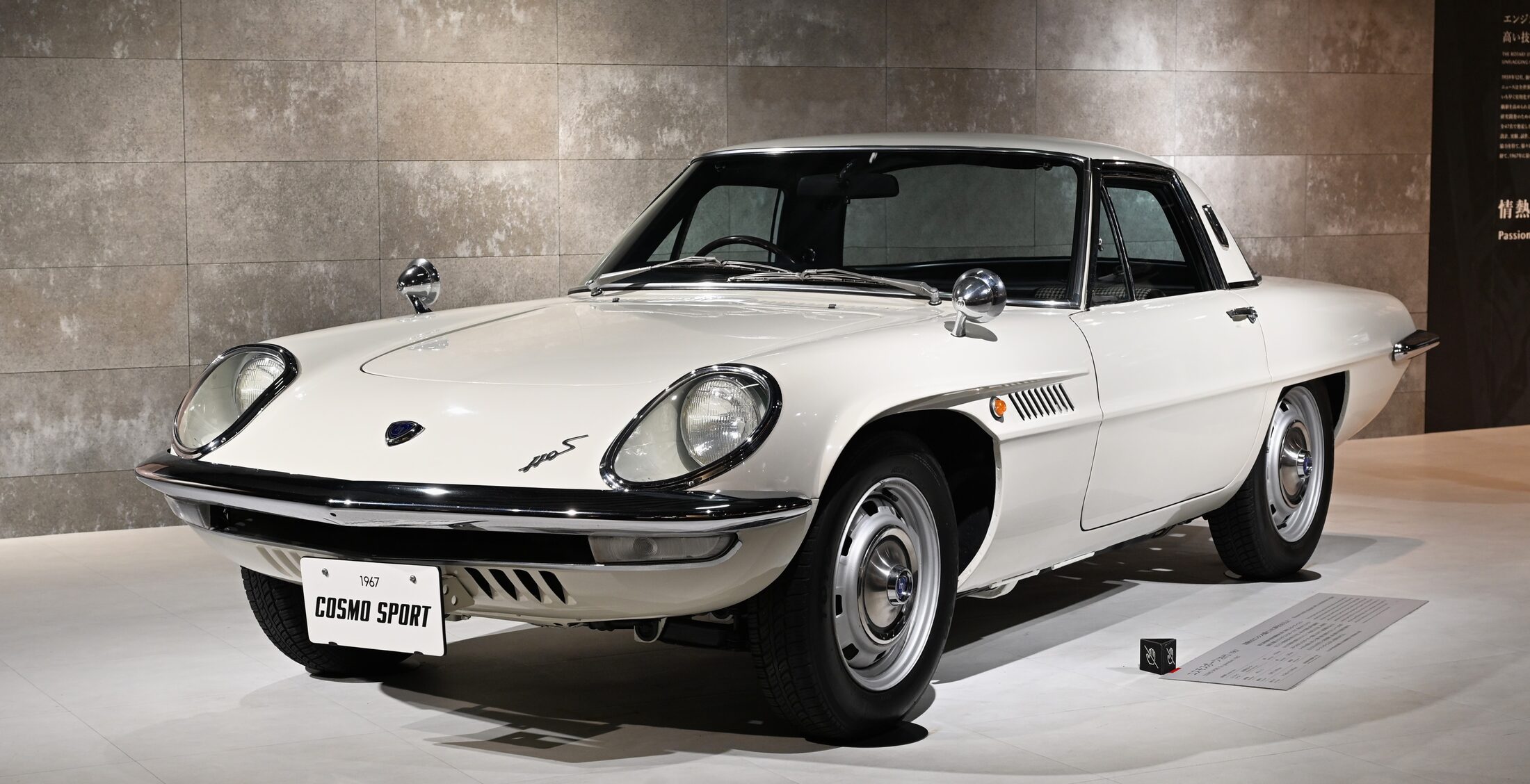
1967 Mazda 110S.jpg · TTTNIS · CC0
Research pending
A matching completed auction sale has not been verified for this exact year, body, trim, engine, transmission and market.
Joyride shows this gap instead of substituting an asking price, unsold bid or mismatched special vehicle.
More than a set of wheels.
Mazda showed the first Cosmo prototype in 1963, formally announced the car in 1964 and spent years solving rotary-engine durability problems. Engineers completed about 700,000 km of high-speed endurance testing before the production Cosmo Sport launched on May 30, 1967. It became Mazda's first rotary-powered production car and the world's first volume-production sports car with a two-rotor rotary engine.
Look a little closer.
Mazda's engineers completed about 700,000 km of high-speed endurance testing before the production Cosmo Sport launched.
Photos show an example of the model or generation. The pictured vehicle’s year, equipment, or modifications can differ from the specification described here.
The tiny seal that made the dream engine possible
A rotary engine's rotor tips must stay sealed against the housing as they sweep around. Early test engines scratched repeated chatter marks into the housing, ruining durability. Mazda's aluminum-infused carbon apex seals were a small component with an enormous job: maintaining the moving seal well enough for the engine to become a production reality.
Source: Mazda · Cosmo Sport ↗Why L10A and L10B figures must stay separate
The 1967 L10A launch car had the shorter 2,200 mm wheelbase and 110 PS tune. Mazda revised the model in 1968 as the longer L10B, raising output to 128 PS and claimed top speed to 200 km/h. Combining those later numbers with a 1967 label would create a faster car that Mazda did not yet sell.
Source: Mazda · company history 1920–1979 ↗Where these facts come from
- Mazda · Cosmo Sport
- Mazda · company history 1920–1979
- Hiroshima City Transportation Museum · Cosmo Sport
- Toyota Automobile Museum · Mazda Cosmo Sport
- Mazda 100th anniversary · Cosmo Sport
- 360 Car Museum · Mazda Cosmo Sport L10A
Selected facts checked for this edition. Some source pages link to broader model families. Last reviewed October 1, 2026.