
Mazda K360
The tiny 1959 K360 looked friendlier and more car-like than many work tricycles. It put two people behind a circular steering wheel inside a weather-protected steel cabin, with a compact V-twin engine tucked behind them and a useful cargo bed over the rear wheels.
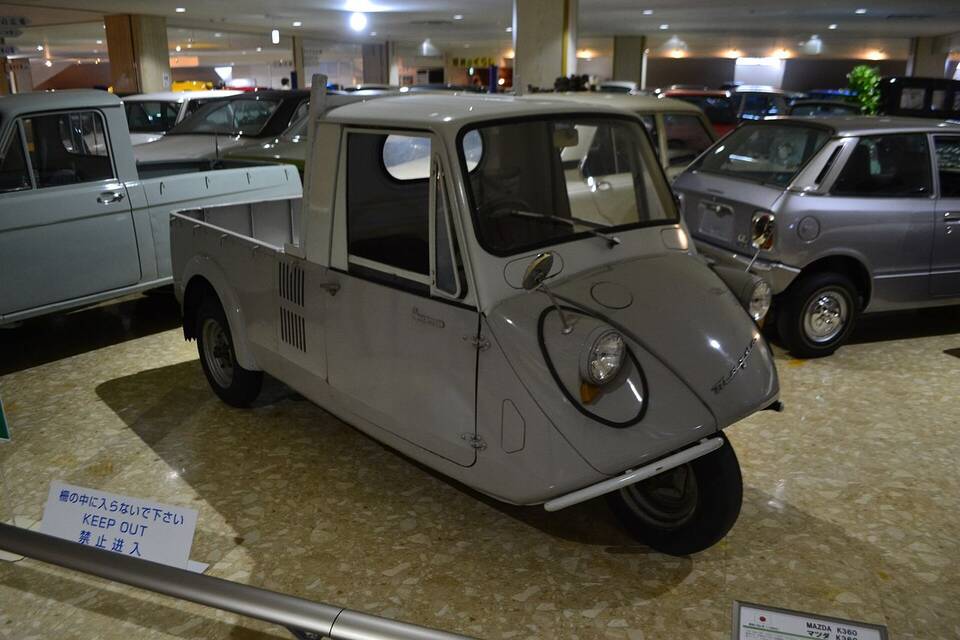
Mazda K360 (23110312584).jpg · 先従隗始 · CC0
Research pending
A matching completed auction sale has not been verified for this exact year, body, trim, engine, transmission and market.
Joyride shows this gap instead of substituting an asking price, unsold bid or mismatched special vehicle.
More than a set of wheels.
Mazda's K360 was developed quietly because its engineers wanted to surprise a crowded three-wheel-truck market. Launched in May 1959, it paired an enclosed steel cab with a steering wheel and a four-stroke V-twin. Mazda reports that more than 170,000 were built in three years and that the K360 helped lift the company's share of Japan's light three-wheel market from about 30 percent in its launch year toward roughly 40 to 50 percent afterward.
Look a little closer.
People nicknamed the K360 “Kesaburo,” a playful Japanese reading of the letter K and the number 360.
Photos show an example of the model or generation. The pictured vehicle’s year, equipment, or modifications can differ from the specification described here.
A secret project with a very visible cab
The team hid development from competitors, then made the finished truck stand out with a rounded steel cabin and a circular steering wheel. Those choices mattered to working drivers: the cab offered better weather protection and the wheel felt more familiar than motorcycle handlebars.
Source: Mazda Virtual Museum — The K360's Secret Project ↗Small engine, carefully placed
The 356 cc V-twin sat behind the cabin in a rear-mid position. That made the power path to the rear wheels compact and left the nose free for its single steering wheel. A dry-sump lubrication system stored oil outside the crankcase, useful in a tightly packaged work vehicle.
Source: Web Motor Magazine — Fukuyama Auto & Clock Museum K360 ↗Where these facts come from
- Mazda Virtual Museum — The K360's Secret Project
- Web Motor Magazine — Mazda K360 at Fukuyama Auto & Clock Museum
- Nostalgic Patrol Car — Mazda K360 technical history
Selected facts checked for this edition. Some source pages link to broader model families. Last reviewed 2026-10-01.