
Mazda Savanna RX-7 GT Limited
The second-generation RX-7 arrived in Japan in October 1985 with smoother bodywork and a stronger turbo rotary. The GT Limited combined the 185 PS 13B, five-speed manual, four seats and comfort equipment in a balanced front-engine, rear-drive coupe.
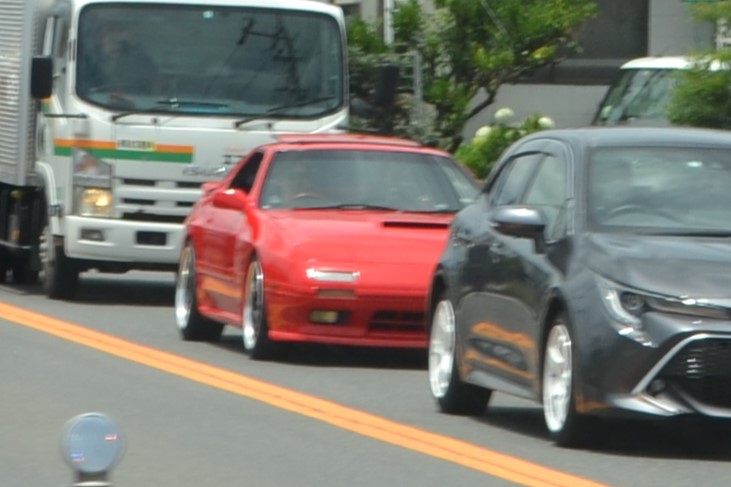
Mazda E-FC3S Savanna RX-7 GT-LIMITED (23062411284).jpg · 先従隗始 · CC0
Research pending
A matching completed auction sale has not been verified for this exact year, body, trim, engine, transmission and market.
Joyride shows this gap instead of substituting an asking price, unsold bid or mismatched special vehicle.
More than a set of wheels.
Mazda released the FC-generation Savanna RX-7 in October 1985. Engineers placed its compact 13B behind the front axle line, used an air-cooled intercooler and twin-scroll turbo, and achieved a nearly even 50.5:49.5 front/rear distribution for the model family. The rear suspension added a toe-control hub that subtly changed wheel angle under load. Mazda raised output to 205 PS in the 1989 update, so that later figure does not belong to this launch-year GT Limited.
Look a little closer.
Mazda's official figure put the FC's balance at 50.5 percent front and 49.5 percent rear—almost like a seesaw with equal riders.
Photos show an example of the model or generation. The pictured vehicle’s year, equipment, or modifications can differ from the specification described here.
A turbo system designed for response
A turbo can feel sleepy if exhaust pulses interfere with one another. Mazda's twin-scroll layout separated the flow paths, while the intercooler reduced the temperature of compressed intake air. Together they helped the 13B make 185 PS net without pretending that the later 205 PS facelift engine was already present.
Source: Mazda Great Cars — Second-generation RX-7 ↗Rear wheels that helped steer—passively
The independent rear suspension used a toe-control hub. As cornering forces loaded the suspension, the geometry adjusted rear-wheel toe by a small amount to improve stability and response. It was a mechanical effect, not a driver-controlled four-wheel-steering system.
Source: Mazda Great Cars — Second-generation RX-7 ↗Where these facts come from
- Mazda Great Cars — Second-generation RX-7
- MOTA — 1985 Savanna RX-7 GT Limited 5MT specifications
- CarSensor — 1985 Savanna RX-7 model catalog
Selected facts checked for this edition. Some source pages link to broader model families. Last reviewed 2026-10-01.