
McLaren F1
A three-seat road car built around its driver, with a carbon-fibre chassis and a naturally aspirated V12.
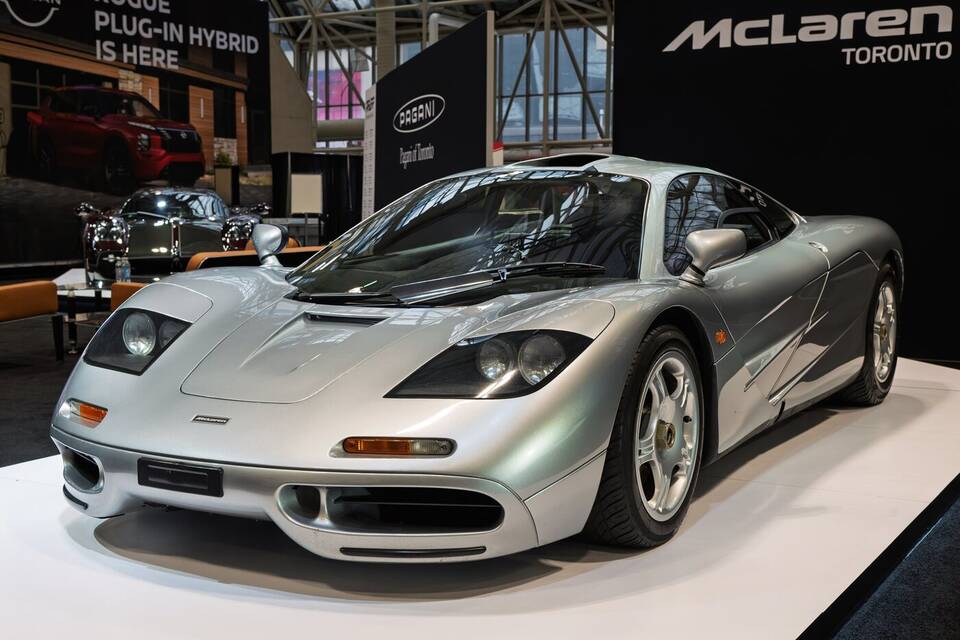
1992 McLaren F1 (55108055586).jpg · Mustang Joe · CC0 1.0
Research pending
A matching completed auction sale has not been verified for this exact year, body, trim, engine, transmission and market.
Joyride shows this gap instead of substituting an asking price, unsold bid or mismatched special vehicle.
More than a set of wheels.
McLaren conceived the F1 in 1988 and revealed the finished road-car idea in Monaco in 1992. This profile follows that original road specification, not the later GTR racer, LM or long-tail GT. The driver sits in the middle with two passengers slightly behind, giving a clear view and balanced controls. A carbon-fibre composite monocoque, very low mass and a specially developed BMW V12 made it a landmark supercar.
Look a little closer.
The driver's seat is in the middle, so the two passengers sit like wingmates on either side.
Photos show an example of the model or generation. The pictured vehicle’s year, equipment, or modifications can differ from the specification described here.
The first carbon-fibre road-car chassis
McLaren applied racing-car composite construction to a road car. The carbon-fibre monocoque was light and strong, and carbon composite also formed the body panels.
Source: McLaren Automotive · the McLaren F1 ↗One driver, two passengers
The central seat gave the driver equal sightlines over both front corners. Passenger seats were offset rearward on both sides so the car could carry three people without becoming unusually wide.
Source: McLaren F1 Road Car · original 1992 press release ↗Road car numbers are not race-car numbers
The original F1 road car used the 6,064 cc BMW V12 at 627 PS. Later GTR, LM and GT derivatives had different power, bodywork, mass and purpose, so their specifications are not mixed into this page.
Source: McLaren F1 Road Car · specifications ↗Where these facts come from
- McLaren Automotive · McLaren F1 legacy
- McLaren F1 Road Car · original 1992 press release
- McLaren F1 Road Car · technical specifications
Selected facts checked for this edition. Some source pages link to broader model families. Last reviewed September 29, 2026.