
McLaren F1
The McLaren F1 put its driver in the center, with one passenger seat slightly behind on each side. Its light carbon-fiber structure and naturally aspirated BMW V12 made it one of the defining road cars of the 1990s.
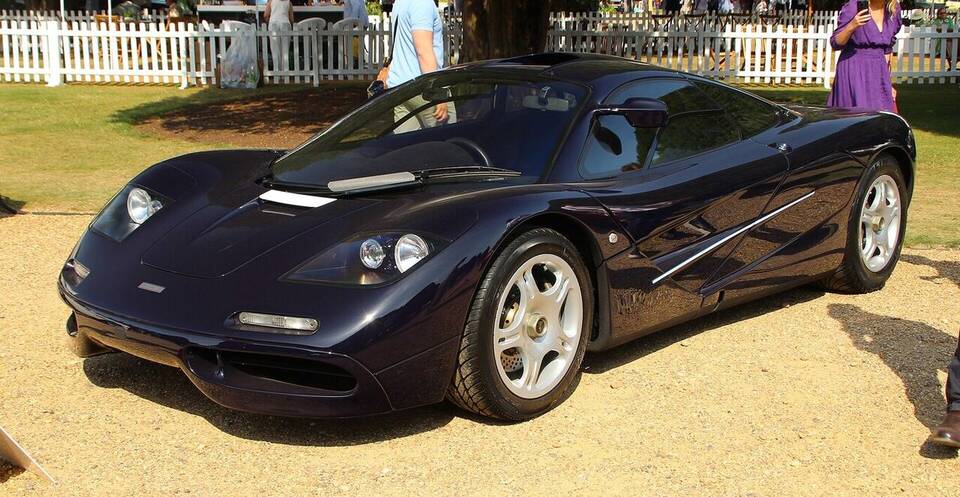
1995 McLaren F1 road car · MrWalkr · CC BY-SA 4.0
Research pending
A matching completed auction sale has not been verified for this exact year, body, trim, engine, transmission and market.
Joyride shows this gap instead of substituting an asking price, unsold bid or mismatched special vehicle.
More than a set of wheels.
McLaren conceived the idea in 1988, revealed the finished road car in 1992 and began building production cars in 1993. Designer Gordon Murray's team treated low weight and a clear view from the center seat as more important than adding unnecessary equipment. The F1 became McLaren's first road car and the first production road car built around a carbon-fiber monocoque.
Look a little closer.
Open the F1's upward-swinging doors and the steering wheel is neither left nor right: it is in the middle. The two passengers sit a little behind the driver, like wingmates.
Photos show an example of the model or generation. The pictured vehicle’s year, equipment, or modifications can differ from the specification described here.
The carbon tub mattered
McLaren describes the F1 as the first road car with a lightweight carbon-fiber monocoque. That central shell carried the seats and suspension loads while keeping mass low and stiffness high. The same materials-first thinking also appeared in magnesium wheels and a carbon clutch, though those component claims come from the archived launch material rather than a current McLaren specification page.
Source: McLaren Automotive — McLaren F1 legacy ↗A V12 built for one job
BMW's 6,064 cc S70/2 used an aluminium-silicon block, light-alloy heads, four valves per cylinder, electronic injection with two jets per cylinder, twelve individual throttle valves and dry-sump lubrication. BMW records 627 hp at 7,500 rpm and 651 N·m. Later speed runs reached 391 km/h (243 mph); that is a later achieved record, not a claim that every 1993 car was tested at that speed.
Source: BMW M — Legendary BMW M engines ↗Three seats, one clear line of sight
The original launch material describes a central driver seat with two passenger seats offset behind it, dihedral doors, a right-hand six-speed manual gear lever and luggage spaces adding up to about eight cubic feet. The source is an independent archive reproducing the 1992 press kit, so these packaging details are labeled as archived launch claims rather than newly verified factory data.
Source: F1RoadCar.com — 1992 F1 road-car press release archive ↗Where these facts come from
- McLaren Automotive — McLaren F1 legacy
- BMW M — Legendary BMW M engines
- McLaren Racing — 50 interesting facts
- F1RoadCar.com — 1992 F1 road-car press release archive
Selected facts checked for this edition. Some source pages link to broader model families. Last reviewed September 30, 2026.