
Peugeot 203 Berline
Peugeot's first new post-war car wrapped a roomy family cabin around a light self-supporting body and an unusually lively little engine.
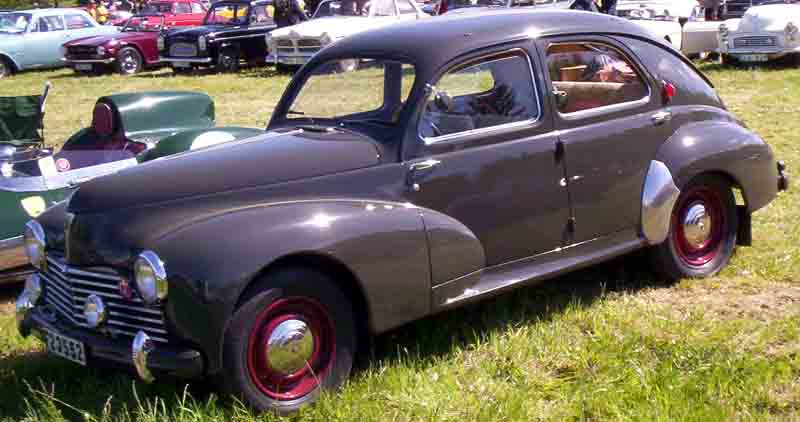
Peugeot 203 Berline.jpg · Lars-Goran Lindgren Sweden · CC BY-SA 3.0
Research pending
A matching completed auction sale has not been verified for this exact year, body, trim, engine, transmission and market.
Joyride shows this gap instead of substituting an asking price, unsold bid or mismatched special vehicle.
More than a set of wheels.
Peugeot developed the 203 in secrecy from 1943, while war still surrounded the Sochaux works. It appeared at the Paris Motor Show in October 1948 as a new middle-class Berline rather than a warmed-over pre-war model. The steel body carried itself without a separate heavy chassis, while hydraulic brakes, independent front suspension and rack-and-pinion steering modernized the running gear. The 203 became Peugeot's rebuilding car and stayed in production until 1960.
Look a little closer.
Until 1954 the 203 was Peugeot's only passenger-car model, so one basic car had to support a remarkably wide family of bodies.
Photos show an example of the model or generation. The pictured vehicle’s year, equipment, or modifications can differ from the specification described here.
Designed around scarce steel and fuel
The museum history says Peugeot rejected an expensive front-wheel-drive layout and worked toward a light, economical conventional car for post-war conditions. A self-supporting body removed the separate heavy chassis, while the overdrive fourth gear reduced engine speed on open roads.
Source: L'Aventure Peugeot · Peugeot 203 ↗Do not give the 1948 car the later 45 CV tune
Peugeot's launch retrospective gives 1,293 cc and 42 CV. Later 203s gained power, and retrospective pages sometimes describe 120 km/h. For the 1948 launch page, the safer pairing is the original 42 CV and Peugeot's 115 km/h launch-era figure, not the later tune.
Source: Peugeot/Stellantis · History of the 20-series ↗Where these facts come from
- L'Aventure Peugeot · Peugeot 203
- Peugeot/Stellantis · 203 and post-war revival
- Peugeot/Stellantis · History of the 20-series
Selected facts checked for this edition. Some source pages link to broader model families. Last reviewed October 1, 2026.