
Renault Type K Paris–Vienna
A light little Renault beat much bigger machines across mountains—and introduced the company’s first four-cylinder engine.
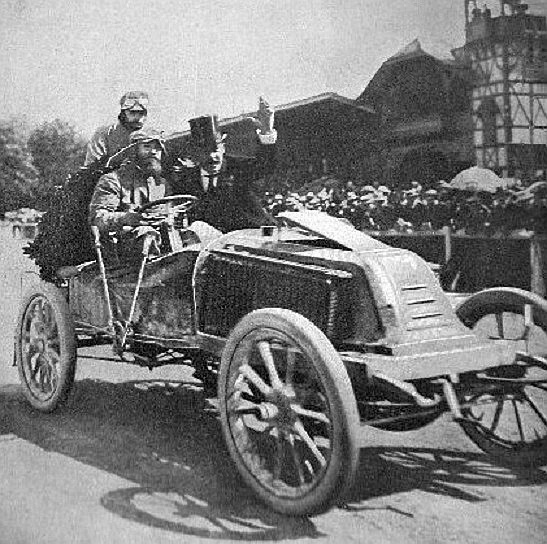
Marcel Renault, winner of Paris–Vienna 1902, on Renault Type K · Unknown photographer; La Vie au grand air, 3 July 1902 · Public domain (PD-old-70-expired; pre-1931 U.S. public domain)
Research pending
A matching completed auction sale has not been verified for this exact year, body, trim, engine, transmission and market.
Joyride shows this gap instead of substituting an asking price, unsold bid or mismatched special vehicle.
More than a set of wheels.
Renault built the Type K for the 1902 Paris–Vienna road race. Marcel Renault won overall after a route that crossed the Alps, giving the young company a spectacular advertisement. This is the competition Type K, not the lower-powered road cars that Renault offered from 1903 using lessons from the racer.
Look a little closer.
Its engine made roughly as much power as a modern ride-on mower, yet the Type K won one of 1902’s toughest international races.
Photos show an example of the model or generation. The pictured vehicle’s year, equipment, or modifications can differ from the specification described here.
A race became a moving advertisement
The Renault brothers deliberately used competition to prove their cars. The company’s museum explains that the victory and newspaper coverage were so valuable that production models derived from the winning Type K were promoted the next year.
Source: Renault The Originals · Type K ↗Why four cylinders mattered
Earlier Renaults used De Dion-Bouton engines. For the Type K, Renault created a 3,770 cc four-cylinder of its own. That step helped turn Renault from a car assembler into a company developing important powertrain technology itself.
Source: Renault Germany · 110 years of Renault engines ↗Where these facts come from
- Renault The Originals · Type K
- Renault Germany · 110 years of Renault engines
- The Motor Museum in Miniature · 1902 Renault K type
Selected facts checked for this edition. Some source pages link to broader model families. Last reviewed September 30, 2026.