
Rover 3-Litre (P5 Mk I)
Rover wrapped old-fashioned quietness and a smooth six-cylinder engine inside its first large unitary-body saloon.
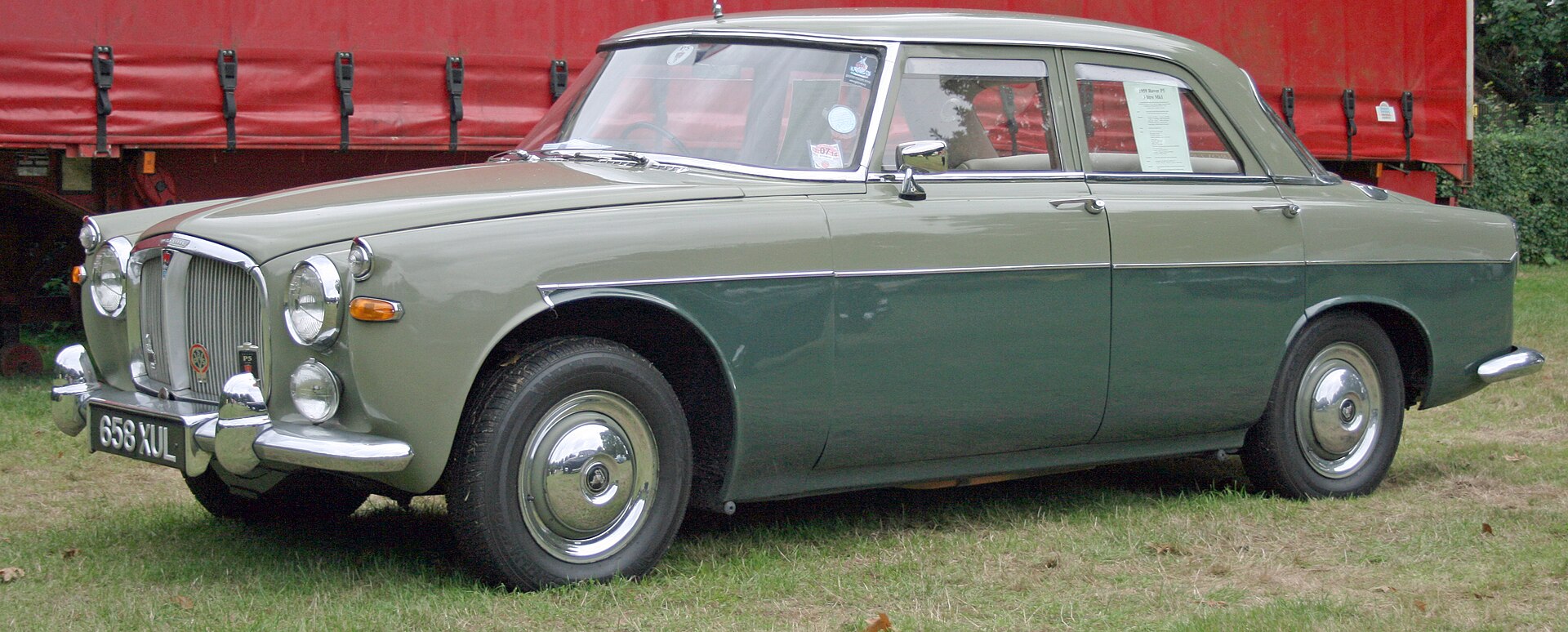
1959 Rover 3-Litre P5 Mk I saloon · davocano · CC BY-SA 2.5
Research pending
A matching completed auction sale has not been verified for this exact year, body, trim, engine, transmission and market.
Joyride shows this gap instead of substituting an asking price, unsold bid or mismatched special vehicle.
More than a set of wheels.
Rover introduced the P5 in September 1958 as the 3-Litre. It was larger and more modern than the P4 but deliberately dignified rather than sporty. The 2,995 cc six used Rover's inlet-over-exhaust valve layout and was tuned for quiet pulling power. The first cars had drum brakes all round; front discs arrived during 1959, so this profile does not backdate that important improvement.
Look a little closer.
The P5 became closely associated with British ministers and royalty, but the very first 1958 car began with less glamorous all-drum brakes.
Photos show an example of the model or generation. The pictured vehicle’s year, equipment, or modifications can differ from the specification described here.
A new body, a familiar kind of engine
The P5 was Rover's first production car with a unitary body, yet it kept the company's smooth IOE six-cylinder thinking. That mixture made it structurally modern while still feeling recognisably like a Rover to established buyers.
Source: British Motor Museum · P5 collection history ↗Do not give a 1958 car 1959 brakes
Later P5s are often pictured and described with front discs, but the first cars used Girling drums on all four wheels. Front discs were announced during 1959. Keeping that date boundary avoids turning a later safety upgrade into a launch feature.
Source: Rover Club de France · P5 chronology ↗Where these facts come from
- British Motor Museum · Rover P5 history
- Automobile-Catalog · 1958 Rover P5 Mk I
- Motor Sport · The 3-Litre Rover
- Rover Club de France · P5 chronology
Selected facts checked for this edition. Some source pages link to broader model families. Last reviewed 2026-10-02.