
Rover 2000
The first Rover 2000 hid some clever engineering beneath a calm-looking four-door body. Its front wheels steered, its rear wheels drove, and unusual suspension helped the tires stay neatly planted on bumpy roads.
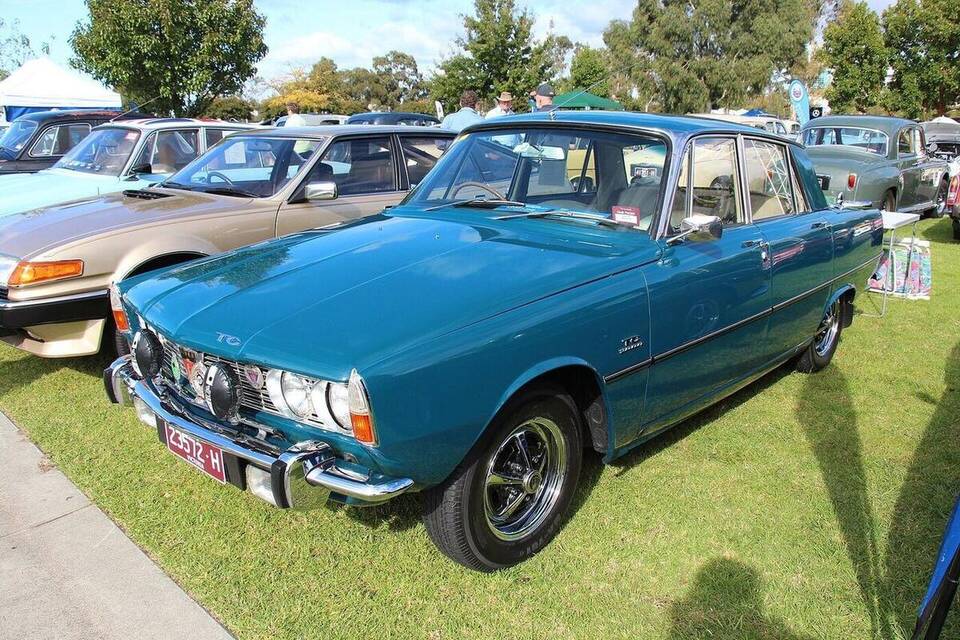
1968 Rover P6 Series I 2000TC Saloon (25836687394).jpg · Sicnag · CC BY 2.0
Research pending
A matching completed auction sale has not been verified for this exact year, body, trim, engine, transmission and market.
Joyride shows this gap instead of substituting an asking price, unsold bid or mismatched special vehicle.
More than a set of wheels.
Rover introduced the P6 on October 9, 1963 after more than five years of design work. The basic structure and suspension had been shaped partly by Rover's gas-turbine experiments, but the production car used a new 2.0-liter gasoline engine. Its blend of safety-minded construction, ride comfort and precise handling earned it the first European Car of the Year award for 1964.
Look a little closer.
The outer body panels were bolted to a strong base unit. That meant Rover could test a driveable skeleton before fitting the panels—and damaged outer panels could be replaced without cutting apart the main structure.
Photos show an example of the model or generation. The pictured vehicle’s year, equipment, or modifications can differ from the specification described here.
A body built around a strong skeleton
Instead of asking every outer panel to carry loads, Rover built a rigid base unit and bolted on the visible panels. During assembly, suspension, brakes and final-drive parts went into the upside-down base unit before it was turned over. The engine and gearbox followed, and the car could be roller-tested before its outer skin was fitted.
Source: Motor Sport — A fine British sports saloon: the Rover 2000 ↗Suspension that separated jobs
At the rear, a de Dion tube kept the wheels upright while the heavy differential stayed attached to the car rather than bouncing with the wheels. The rear disc brakes were also mounted inboard beside the differential to reduce unsprung mass. Up front, the suspension redirected spring loads into the body so the engine bay could leave room for future powertrains.
Source: Motor Sport — A fine British sports saloon: the Rover 2000 ↗The first European Car of the Year
The 1964 award page gives the Rover 2000 76 points and highlights its independent front suspension, de Dion rear axle and rear-wheel drive. The later 2000 TC's twin carburetors and the still later 3500's V8 improved performance, but the award belongs to the original 91-PS two-liter idea profiled here.
Source: Car of the Year — 1964 Rover 2000 ↗The combustion chamber moves into the piston
The launch road test describes a hollow in each piston crown forming the combustion chamber, beneath a nearly flat cylinder-head face. The overhead camshaft operates vertical valves through inverted tappets with shim adjustment. This helps explain why “overhead camshaft” alone does not describe the engine’s unusual architecture. These details apply to the 1963 single-carburetor 1,978 cc engine; they do not import a later TC tune or V8 specification.
Source: Motor Sport — A fine British sports saloon: the Rover 2000 ↗Where these facts come from
- Motor Sport — A fine British sports saloon: the Rover 2000
- Car of the Year — 1964 Rover 2000
- Rover Owners Club NSW & ACT — P6 50th anniversary and period brochure archive
Selected facts checked for this edition. Some source pages link to broader model families. Last reviewed October 1, 2026.