
Subaru 360 K111
A tiny four-seat car used aircraft-style lightness to help ordinary Japanese families start driving.
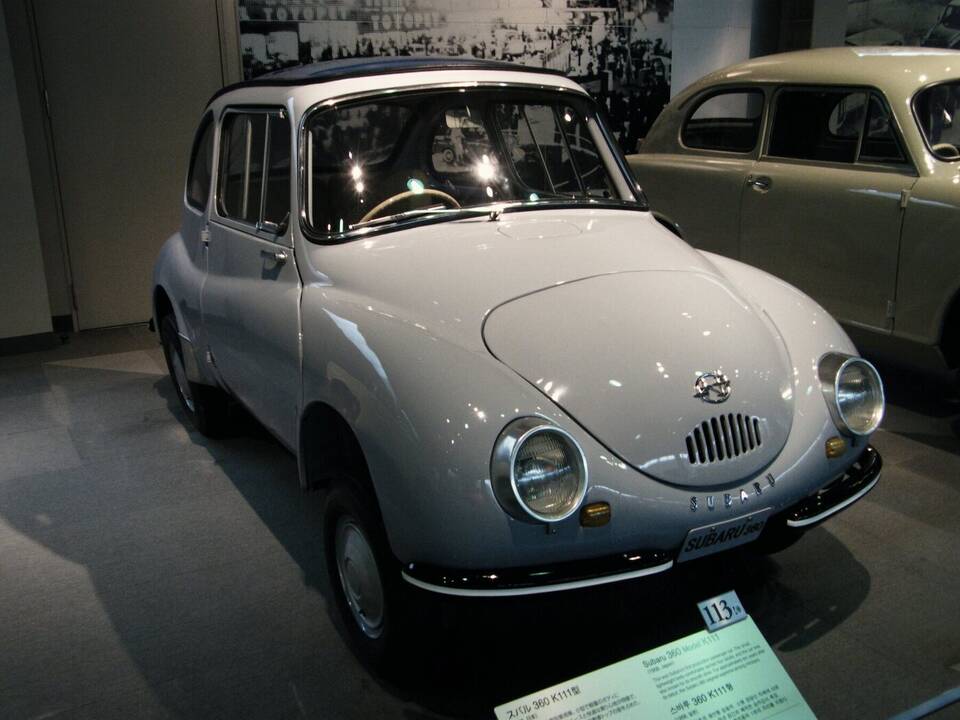
1958 Subaru 360 museum car · Emran Kassim · CC BY 2.0 Generic
Research pending
A matching completed auction sale has not been verified for this exact year, body, trim, engine, transmission and market.
Joyride shows this gap instead of substituting an asking price, unsold bid or mismatched special vehicle.
More than a set of wheels.
Subaru launched the 360 in May 1958 as its first mass-produced automobile. It was designed inside Japan's kei-car limits, yet the rounded body made room for four people. Subaru used a light monocoque shell and fiberglass-reinforced plastic parts instead of simply shrinking a heavy conventional car. The model became known as the 'ladybug' and stayed in production for more than a decade. The cover is an exact 1958 Subaru 360 museum car; its original sale market and trim are not independently documented.
Look a little closer.
At 2,990 mm long, the first 360 was shorter than many modern city cars are wide plus tall—and it still offered four seats.
Photos show an example of the model or generation. The pictured vehicle’s year, equipment, or modifications can differ from the specification described here.
An eggshell idea
Subaru compared the rounded monocoque body to an eggshell: the outer skin helped carry loads, saving the weight of a separate frame while leaving more room inside.
Source: JSAE · Subaru 360 monocoque body ↗Four independent wheels
The front wheels use trailing arms and the rear uses swing axles. All four wheels are independently suspended, an unusually thoughtful comfort feature for an inexpensive microcar in 1958.
Source: JSAE · Subaru 360 K111 ↗Where these facts come from
Selected facts checked for this edition. Some source pages link to broader model families. Last reviewed September 29, 2026.