
Trabant P50
The first Trabant combined front-wheel drive, room for four and moulded Duroplast outer panels in a tiny East German family car.
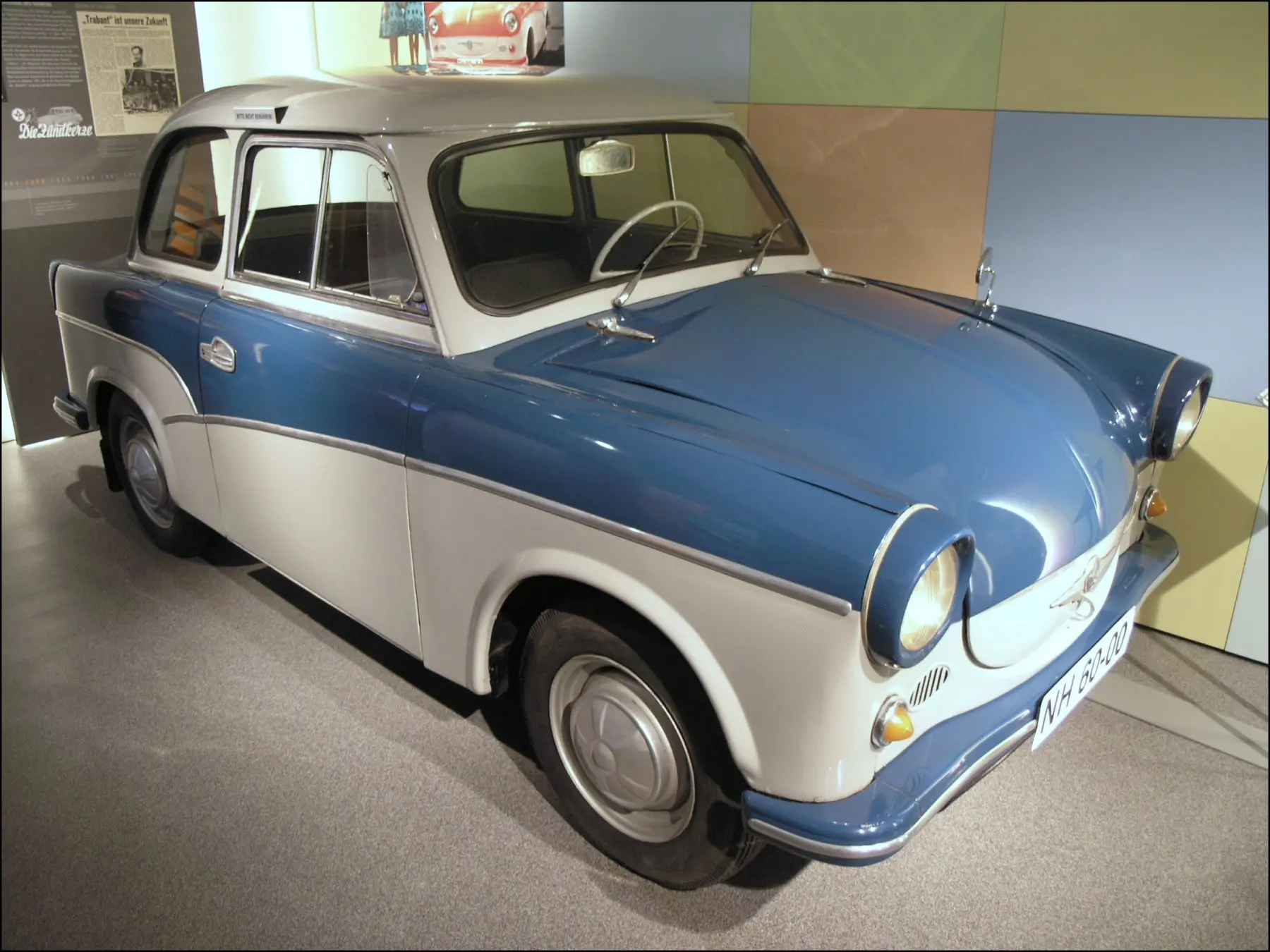
1959 Trabant P50 Sonderwunsch · Matěj Baťha · CC BY-SA 2.5
Research pending
A matching completed auction sale has not been verified for this exact year, body, trim, engine, transmission and market.
Joyride shows this gap instead of substituting an asking price, unsold bid or mismatched special vehicle.
More than a set of wheels.
The first 50 P50s formed a zero series beginning on November 7, 1957; full-scale production followed in 1958. The name Trabant—meaning companion or satellite—arrived just after Sputnik made satellites famous. This profile stays with that first 1957 version, not the stronger P50 updates or the later boxier 601.
Look a little closer.
Duroplast was not cardboard: it was a tough moulded material reinforced with short cotton fibres and fitted over a steel structure.
Photos show an example of the model or generation. The pictured vehicle’s year, equipment, or modifications can differ from the specification described here.
Plastic panels answered a materials problem
Post-war East Germany had limited sheet steel. Engineers created replaceable Duroplast exterior panels and built special presses and trimming equipment to make them in series. The August Horch Museum says the method suited local production and made body repairs simpler.
Source: August Horch Museum Zwickau · Trabant exhibition ↗Advanced packaging in a very simple car
The museum calls the P50 one of the more forward-looking small-car designs of its time because front-wheel drive and a roomy cabin were combined in a compact body. The 1957 zero series numbered just 50 cars before larger production began.
Source: Chemnitz Museum of Industry · Trabant production history ↗Where these facts come from
- August Horch Museum Zwickau · Trabant exhibition
- Chemnitz Museum of Industry · Trabant production history
- WELT · 70 years of the P70 and Trabant
Selected facts checked for this edition. Some source pages link to broader model families. Last reviewed September 30, 2026.