
Venturi 400 GT
A tiny-production French road supercar developed directly from Venturi's one-make Trophy racer.
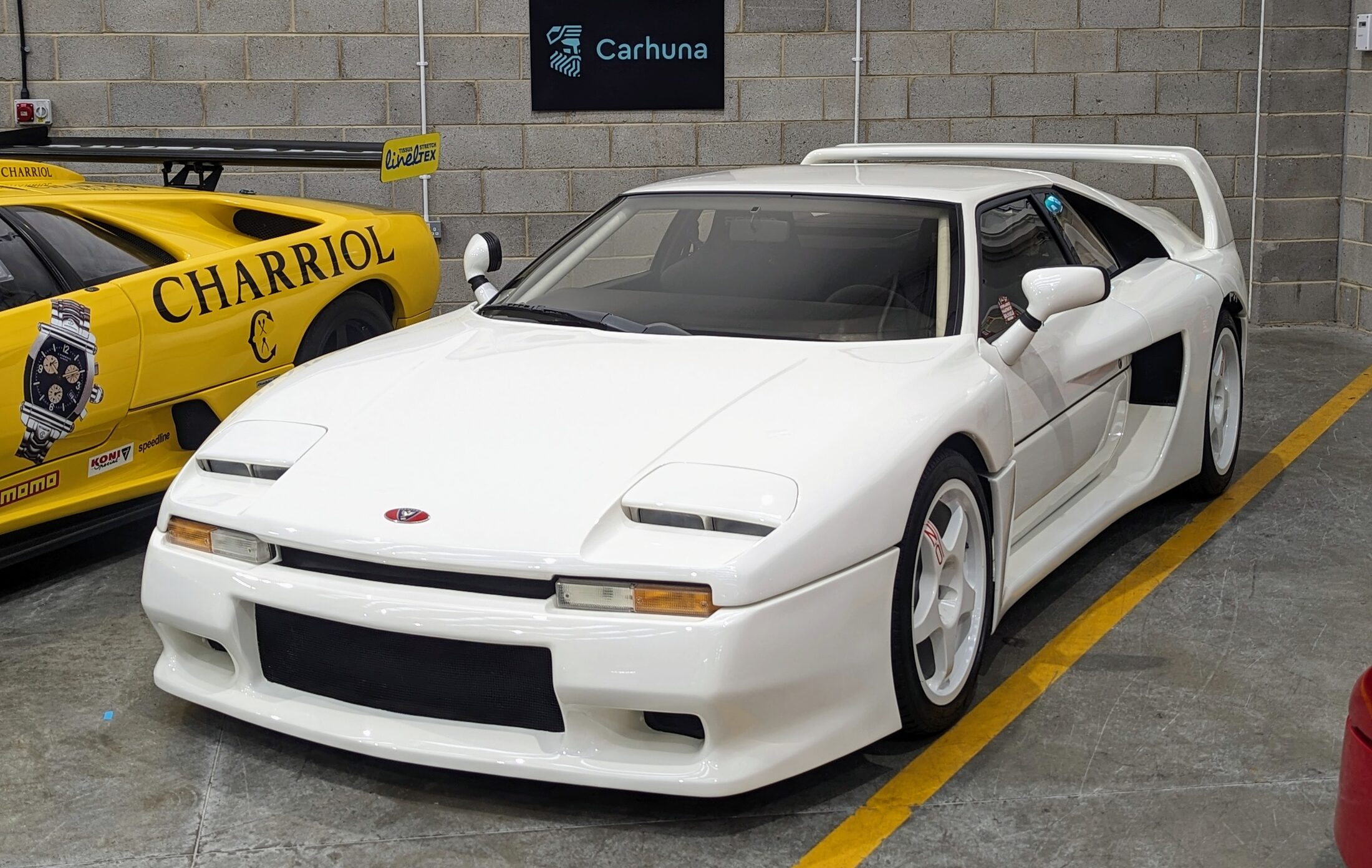
1992 France Venturi 400 GT · Calreyn88 · CC BY 4.0
Research pending
A matching completed auction sale has not been verified for this exact year, body, trim, engine, transmission and market.
Joyride shows this gap instead of substituting an asking price, unsold bid or mismatched special vehicle.
More than a set of wheels.
Venturi created the 400 Trophy for a one-make racing series in 1992. The road-going 400 GT grew from that competition car and was officially presented at Couëron on June 8, 1994, with racer Henri Pescarolo as its patron. Catalytic converters, a silencer, altered engine management and a richly trimmed cabin helped civilize it, but the mid-engine chassis, enormous tires and carbon brakes kept its racing roots close to the surface.
Look a little closer.
Buyers could ask for either carbon trim or precious wood inside a car whose giant rear wing looked ready for a starting grid.
Photos show an example of the model or generation. The pictured vehicle’s year, equipment, or modifications can differ from the specification described here.
Road legality changed details, not the basic character
The GT kept the Trophy-derived twin-turbo engine and chassis, then added two catalytic converters, a silencer and revised electronics. Its mirrors were raised for a view past the widened rear body, while leather, Recaro seats and a 260-derived dashboard made the cabin more suitable for road customers.
Source: L'Automobile Sportive · Venturi 400 GT dossier ↗Carbon brakes brought a racing compromise
Carbone Industrie helped Venturi adapt carbon discs for the road, an application the sources describe as a production-car first. Carbon saves unsprung mass and endures hard use, but it can feel weak when cold. Later customers could choose steel brakes, so a photograph of a late car cannot prove the brake material underneath.
Source: Ultimatecarpage · Venturi 400 GT history and specification ↗Where these facts come from
- L'Automobile Sportive · Venturi 400 GT dossier
- Ultimatecarpage · Venturi 400 GT history and specification
- Gazette Drouot · 1995 Venturi 400 GT catalog record
Selected facts checked for this edition. Some source pages link to broader model families. Last reviewed 2026-10-02.