
Hildebrand & Wolfmüller Motorrad
Before motorcycles had chains, gears or kick-starters, this strange two-wheeler used its rear wheel almost like part of the engine.
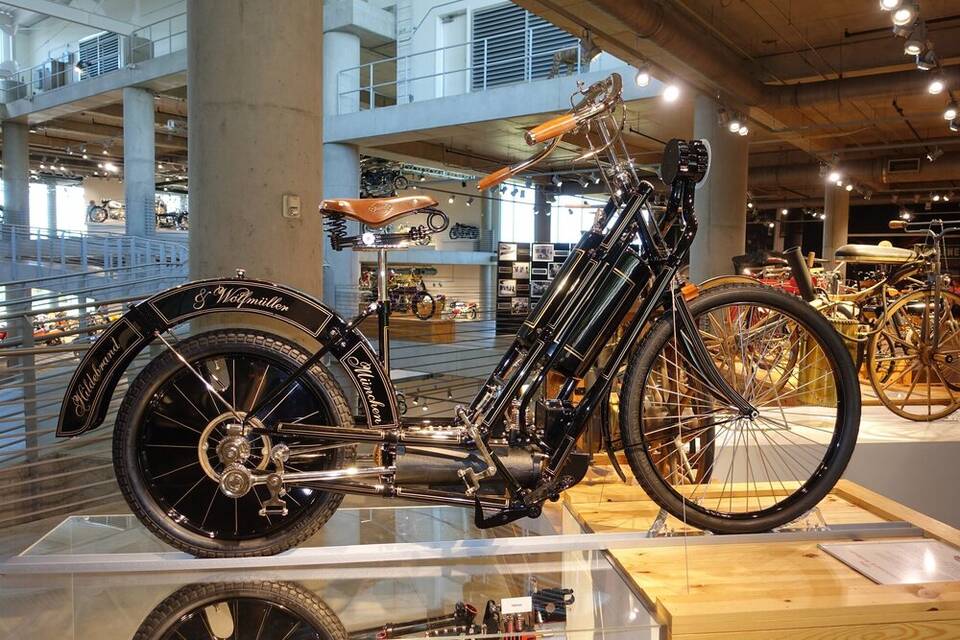
1894HildebrandWolfmuller-Barber.jpg · DrReload · CC BY-SA 4.0
What did this one sell for?
Make a guess, then reveal one identity-matched completed auction result. It is a comparison point, not a price promise.
Reveal the auction result
Based on a completed sale at Bonhams, an estimated value for this vehicle is €195,500.
Why this sale: Exact 1894 Munich-built Hildebrand & Wolfmüller series-production motorcycle. Bonhams identifies frame 619 and engine 69, with the model's water-cooled 1,488 cc four-stroke parallel-twin and direct rear-wheel drive architecture. Bonhams described it as reputedly the earliest numbered surviving example and in wonderfully untouched condition. Secondary reporting based on the catalogue notes replaced tyres/drive bands and one perished band, so recommissioning risk is material.
Bonhams' displayed result is €195,500 including the buyer's fee (premium). The sale catalogue states a 15% buyer's premium for motor cars and motorcycles; VAT and any other taxes are not treated as part of this comparable. One auction result is a reference, not an appraisal; condition, history, options, location and market timing can change value. Accepted as an exact production-model and year match. Its early serial identity and unusually untouched state are value-positive differences and must remain visible.
More than a set of wheels.
Steam engineers Heinrich and Wilhelm Hildebrand joined inventor Alois Wolfmüller and mechanic Hans Geisenhof to build a gasoline-powered two-wheeler in Munich. Their 1894 machine was patented and offered to buyers in series, making it one of the most important starting points in motorcycle history. The company also used the German word “Motorrad”—motorcycle—for the new machine.
Look a little closer.
Its water tank is shaped like the rear mudguard, and the rear wheel also does the flywheel’s job.
Photos show an example of the model or generation. The pictured vehicle’s year, equipment, or modifications can differ from the specification described here.
A motorcycle before the rulebook existed
The Henry Ford calls it the first motorized two-wheeler sold to the public on a series-production basis. The Science Museum Group records German patent No. 78553, dated January 20, 1894, and says many were built in Germany and France. That matters because Daimler’s earlier Reitwagen was an experimental one-off, not a public production model.
Source: The Henry Ford · Hildebrand & Wolfmuller collection record ↗The rear wheel is part of the engine
The Science Museum Group describes pistons linked to parallel cranks on the rear axle. Barber Museum explains the odd return system: strong rubber bands help bring the pistons back for compression and exhaust. It is closer to watching a tiny steam locomotive mechanism than a modern motorcycle chain drive.
Source: Science Museum Group · Wolfmuller petrol motor bicycle ↗Where these facts come from
- Science Museum Group · Wolfmuller Petrol Motor Bicycle, 1894
- The Henry Ford · Hildebrand & Wolfmuller Motorcycle
- Barber Vintage Motorsports Museum · 1894 Hildebrand & Wolfmüller
Selected facts checked for this edition. Some source pages link to broader model families. Last reviewed October 1, 2026.