
Egger-Lohner C.2 Phaeton
Before Porsche sports cars existed, a young Ferdinand Porsche helped an electric carriage glide through Vienna with twelve controller positions and an eight-sided motor.
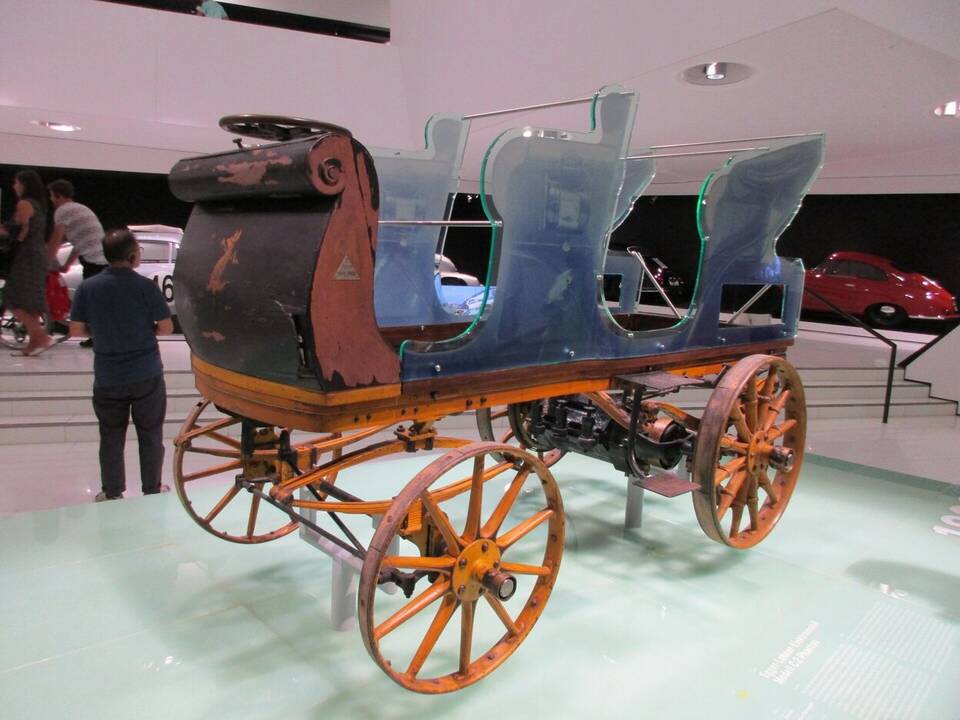
1898 Egger-Lohner C.2 Phaeton at the Porsche Museum · Arnaud 25 · CC BY-SA 4.0
Research pending
A matching completed auction sale has not been verified for this exact year, body, trim, engine, transmission and market.
Joyride shows this gap instead of substituting an asking price, unsold bid or mismatched special vehicle.
More than a set of wheels.
Ferdinand Porsche worked for Vienna electrical company Béla Egger before joining carriage maker Ludwig Lohner in 1899. In 1898 he worked on this C.2 electric phaeton, combining a Lohner carriage body with an Egger electric system and the compact ‘Octagon’ motor. Four chassis-based vehicles received different bodies. The preserved C.2 is now the opening exhibit in the Porsche Museum, but it predates both the Porsche company and the later Lohner-Porsche hub-motor car.
Look a little closer.
One of the four C.2-based vehicles won first prize in a 40-kilometre event at Berlin's 1899 International Motor Show.
Photos show an example of the model or generation. The pictured vehicle’s year, equipment, or modifications can differ from the specification described here.
Why this is Egger-Lohner, not yet Lohner-Porsche
Porsche's own history places the C.2 in 1898 while Ferdinand Porsche was still at Béla Egger, and says he joined Ludwig Lohner in 1899. The first Lohner-Porsche wheel-hub vehicle followed in 1900. Calling this exact survivor ‘Egger-Lohner C.2’ preserves that sequence instead of borrowing the later car's identity.
Source: Porsche Newsroom · The history of Porsche begins electrically ↗A gearbox made of electrical choices
The twelve-position controller did more than choose speed: six positions moved the car forward, two moved it backward and four slowed it electrically. The 130-kilogram motor housing was damped and allowed to oscillate around the rear axle, an inventive way to package heavy early-electric hardware under a carriage-like body.
Source: Porsche Museum · Egger-Lohner C.2 Phaeton ↗What the gallery can—and cannot—prove
The gallery separates the 1898 Porsche Museum C.2 chassis from a related 1899 Egger-Lohner preserved in Vienna. The Vienna car supplies useful family-level electrical, accumulator and chassis context, but it is not evidence that every component or finish matches the 1898 survivor. The Porsche Museum’s transparent panels visualize a body volume; they are not surviving production bodywork.
Source: Wikimedia Commons · Egger-Lohner vehicle categories ↗Where these facts come from
- Porsche Museum · Egger-Lohner C.2 Phaeton
- Porsche Newsroom · The history of Porsche begins electrically
- Porsche Museum · New addition to the permanent exhibition
- Porsche Museum · Future Heritage Portal
Selected facts checked for this edition. Some source pages link to broader model families. Last reviewed October 3, 2026.