
Jenatzy La Jamais Contente
A silver electric torpedo shot across a road outside Paris and became the first automobile to break 100 km/h.
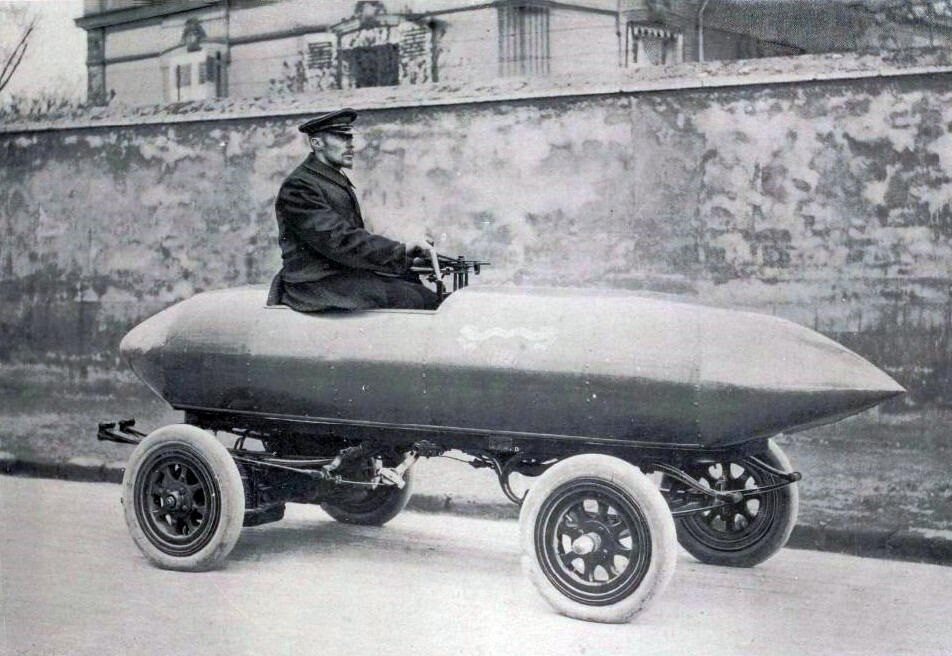
Camille Jenatzy in La Jamais Contente on the April 29, 1899 record day · La Vie au Grand Air · Public Domain Mark 1.0 (PD-old-70-expired; U.S. pre-1931 publication)
Research pending
A matching completed auction sale has not been verified for this exact year, body, trim, engine, transmission and market.
Joyride shows this gap instead of substituting an asking price, unsold bid or mismatched special vehicle.
More than a set of wheels.
Camille Jenatzy was locked in a speed-record duel with Count Gaston de Chasseloup-Laubat and his Jeantaud electric cars. Jenatzy answered with an entirely new machine: equal-size wheels, a light aluminium body and a pointed shell intended to cut the air. On April 29, 1899, at Achères, La Jamais Contente reached 105.879 km/h over the timed kilometre and made the 100 km/h barrier automobile history.
Look a little closer.
The original car survives at the Château de Compiègne; the Fulmen company and Camille Jenatzy's widow gave it to the museum in 1933.
Photos show an example of the model or generation. The pictured vehicle’s year, equipment, or modifications can differ from the specification described here.
A rivalry built the 100 km/h car
The Château de Compiègne records that La France automobile organized the competition and that Jenatzy created the new car after three duels won by Chasseloup-Laubat in Jeantaud electrics. The record was therefore more than a one-off stunt: it was the engineering answer to a public contest between rival electric-car builders.
Source: Château de Compiègne · La Jamais Contente collection record ↗Streamlined, but not completely
The museum credits coachbuilders Léon Auscher and Edmond Rheims with the light aluminium body and highlights the equal-size wheels and aerodynamic thinking. MAUTO's museum story adds the useful caution that the exposed driver was not included in the smooth torpedo shape, so this was a pioneering experiment rather than a modern wind-tunnel design.
Source: MAUTO · The car and the beginnings ↗The conserved car has a documented livery, not a bare-metal shell
Compiègne's catalogue of emblematic works describes the conserved La Jamais Contente as a single-seat car with a torpedo-shaped aluminium-alloy body painted grey. A red band runs along both sides and the name is lettered in gold. Under the body, the catalogue transcribes a white-painted inscription attributing the 1899 world record at 105 km/h to Camille Jenatzy and Fulmen accumulators. The museum's object record inventories painted aluminium, copper, brass, painted metal, metal, moleskin, wood and rubber. These are descriptions of the surviving collection object: they document the finish, markings and material mix the museum preserves, but they do not prove that every coating or trim component remained untouched from the April 1899 run.
Source: Château de Compiègne · Œuvres emblématiques: La Jamais Contente ↗The chassis ideas extended beyond the torpedo outline
When Le Véhicule électrique covered the car's 1933 entry into the Musée de la Voiture, it called out equal, removable, small-diameter wheels, balanced brakes, compensated steering and a body profiled particularly at the rear. The editors explicitly linked the rear taper to aerodynamic work showing that the tail could matter more than the nose to resistance. That preservation-era description gives the record car much more mechanical definition than the familiar silhouette alone: its wheel format, braking layout and steering geometry were all presented as forward-looking. It is still a retrospective account published 34 years after the record, not an 1899 homologation sheet, and it does not resolve the disputed battery count, system voltage or original running mass.
Source: Cnam/Cnum · Le Véhicule électrique, September 1933, p. 99 ↗The 100 km/h breakthrough came from a timed-record ladder
Two Cnam digitizations preserve the shape of the contest without pretending that every Jenatzy time belonged to this car. Le Véhicule électrique summarizes the late-1890s progression from de Knyff's 51 km/h petroleum-car mark through Chasseloup-Laubat's electric records and Jenatzy's replies. Louis Bonneville's 1935 chronology gives flying-kilometre times of 54 seconds, 51.2 seconds, 44.8 seconds and 38.8 seconds before the final 34-second kilometre. The earlier Jenatzy runs predate La Jamais Contente and must stay attached to his preceding record cars, not be imported into this variant's results. Their value here is developmental context: the purpose-built torpedo answered a record that had already fallen repeatedly, and a 34-second kilometre corresponds to about 105.88 km/h.
Source: Cnam/Cnum · Les locomotions mécaniques: origines, dates et faits ↗Three archives disagree on the calendar date
The Château de Compiègne and the Bibliothèque nationale de France support April 29, 1899 and approximately 105.88 km/h, so April 29 should remain the profile's canonical record date. Two later technical retrospectives disagree: Le Véhicule électrique (1933) prints May 9 and 105.904 km/h, while Bonneville's 1935 chronology prints May 1, a 34-second kilometre and 105.850 km/h. The differences should be exposed as archival disagreement, not silently combined into additional runs. The few hundredths of a kilometre per hour separating the printed speeds are too small, by themselves, to prove that the sources describe distinct tests. This section therefore preserves the museum-and-BnF date while recording the later variants rather than rewriting history around one retrospective table.
Source: Bibliothèque nationale de France · La Jamais Contente, 1899 ↗Its museum handoff can be dated to the day
The current museum record says Fulmen and Jenatzy's widow donated the car jointly in 1933. The September 1933 issue of Le Véhicule électrique tightens that provenance: it reports an April 9 ceremony at Compiègne and says the Société de l'Accumulateur Fulmen acted both in its own name and on behalf of Madame Jenatzy. A BnF photograph catalogued in 1932 shows the car on display at the Touring Club de France, 65 avenue de la Grande-Armée, before the museum handoff. That display is evidence of public presentation, not proof of legal ownership; the donor statement remains the better source for the transfer itself.
Source: Cnam/Cnum · Le Véhicule électrique, September 1933, p. 99 ↗Before the stopwatch: what a reporter actually saw
Nearly a month before the record, Le Figaro described a gray-blue torpedo on four unusually small wheels, with only a small central place for the driver. The reporter also wrote that the rear dynamo drove the wheels directly, with neither chain nor belt. That is valuable record-day-era testimony, but not a blueprint. Modern replicas show exposed chain hardware, and later hardware cannot be projected backward onto the original. Preserve the witness account while leaving the original transmission arrangement open wherever sources disagree.
Source: Le Figaro, 1 April 1899, p. 5 ↗Achères became an outdoor grandstand
Gil Blas announced the attempt for 2 p.m. on Saturday, April 29, on the central road through the Achères agricultural park. The next day's La Petite Gironde called the road a remarkably straight, smooth line and described spectators' automobiles pushed to the sides like improvised grandstands. Jenatzy needed a measured straight, room to build speed before the timed kilometre and a clear course. The scene also shows how public the rivalry with Chasseloup-Laubat had become: engineering, sport and advertising watched by the motoring community it was meant to impress.
Source: Gil Blas, 27 April 1899, p. 4 ↗One run, two kilometre measurements
The next-day newspaper separated a flying kilometre of 34 seconds from a standing kilometre of 48.8 seconds. Dividing 3,600 by 34 gives 105.882 km/h, effectively the Château de Compiègne's canonical 105.879 km/h. The same newspaper rounded the result to about 108 km/h. That mismatch is not evidence of a second faster official run; it shows that period arithmetic and later catalogues rounded differently. Keep April 29 and 105.879 km/h as the headline, while using both timed measurements to teach how record testing worked.
Source: La Petite Gironde, 30 April 1899, p. 4 ↗The shell was light, but the whole car was not hidden from the air
Compiègne credits Léon Auscher and Edmond Rheims of Rothschild & fils with the aluminium body and points to equal-size wheels and deliberate aerodynamic thinking. A near-period handbook captions a longitudinal section specifically as the Jenatzy-system La Jamais Contente racing car. The same page explains the broader partinium coachwork method: sheets cold-hammered over a skeleton, joined by small copper rivets and gussets, then primed and painted. That general paragraph should not become an exact sheet-thickness claim. The shell reduced frontal disturbance, but the exposed driver, wheels and chassis still met the air directly: an early experiment, not a sealed modern streamliner.
Source: Château de Compiègne — Automobile électrique La Jamais Contente ↗How two motors could replace a gearbox and differential
A 1900 technical report explains the wider Jenatzy system: a separate motor for each driven wheel could avoid the differential needed when one motor turned both wheels. Speed could be changed electrically by reconnecting battery groups, armatures and field windings in series or parallel instead of selecting mechanical gear ratios. The report describes a multi-drum controller around the steering shaft on Jenatzy road vehicles. This is useful system context, not proof of La Jamais Contente's exact levers. For children: batteries supplied current, the controller changed how it reached the motors, and the motors turned the rear wheels without a petrol engine or conventional gearbox. The record-car switching sequence remains unresolved.
Source: Revue technique de l'Exposition universelle de 1900 — Jenatzy electric system ↗A cockpit with almost nothing to hide behind
The period report says the little central framework admitted only the driver. The museum inventory adds moleskin, wood, metals and rubber to the preserved object's material story, but it does not publish an authenticated record-day instrument layout. A rights-cleared 2008 photograph in this packet shows the seat, steering post and levers on a Musée de l'Air display replica. It helps visitors see how exposed and minimal such a recreation feels, but its lineage has not been established. It cannot prove the original's lever count, pedal arrangement, braking hardware or transmission.
Source: Le Figaro, 1 April 1899, p. 5 ↗The survivor's trail did not jump straight to the museum
A 1907 Automobile-Club de France retrospective catalogue displayed the aluminium-bodied car and attributed it to Camille Jenatzy in Brussels. This gives the survivor a waypoint between the 1899 run and later Touring Club photographs. The current Compiègne record says Fulmen and Jenatzy's widow donated the car jointly in 1933. The catalogue also repeats an unofficial 140 km/h anecdote. With no timed corroboration, that number belongs in quarantine, not the performance table. Provenance evidence can be strong even when a dramatic speed claim on the same page is not.
Source: Automobile-Club de France — La rétrospective de la voiture automobile, 1907, p. 69 ↗Original, survivor, restoration state and replica are four labels
The original 1899 identity, the museum survivor's present conservation state, later restoration or repainting, and modern replicas must remain separate labels. The new Compiègne photograph is an exact-survivor view and may document today's body seams, wheels and finish. The controls photograph is a replica view and documents only that replica. The existing Sketchfab model is a recognizable artist reconstruction, not a museum scan or dimensional reference. No vehicle-specific recording with clear reuse rights was found; any future working-replica recording would need a related-replica label.
Source: Château de Compiègne — Automobile électrique La Jamais Contente ↗Partinium was a trade name, not one recipe
The familiar label partinium does not justify a precise aluminium–tungsten–magnesium formula for this car. In a 2005 conservation-science study, David Bourgarit and Jean Plateau reported that the Partinium name covered many different, confidential compositions. They analyzed two medals made by the Partinium works—not a body sample from La Jamais Contente—and found different, otherwise unexceptional compositions. The paper identifies one Partinium alloy as the car's streamlined shell, but its medal results could not reveal which recipe was used for the car. That is a useful correction to simplified retellings: the museum supports an aluminium or aluminium-alloy body, while the exact elemental recipe remains unresolved unless the car itself or an authenticated offcut is analyzed. Partinium should therefore be shown as a period trade-family label, not converted into exact percentages or assumed tungsten content.
Source: ArchéoSciences · Quand l'aluminium valait de l'or ↗The working replica has its own electrical identity
A 2011 Automobile Magazine report inspected the museum survivor and then drove the working replica at Le Bourget. The survivor was described as missing some electrical equipment, so gaps in its present display cannot be read as a complete 1899 circuit. The replica, completed in 1994 after fabrication by a technical university in Compiègne, instead used thirteen lead-acid batteries supplying 52-volt direct current to twin Leroy-Somer motors. Its tiller, power pedal, direction switch, relay clicks, electrical buzz and motor tones describe that reconstruction's operating experience—not Jenatzy's original controls or sound. The article reports that the replica reached 58 mph during a Montlhéry demonstration, making it a serious running reconstruction while still leaving its drivetrain historically separate from the 1899 record car. For Joyride, the evidence split is clean: the survivor supports original identity and preservation history; the working replica offers a clearly labeled experience of motion and sound.
Source: Automobile Magazine / MotorTrend · First to Sixty: La Jamais Contente ↗Before Achères, a winning climb
FIA's historical archive dates a hill-climb contest at Chanteloup-les-Vignes, near Paris, to November 27, 1898. It says Paul Meyan, editor-in-chief of La France Automobile, organized the event and that Camille Jenatzy won in an electric car of his own design. That winner was not La Jamais Contente, which came later, so its result and construction must not be imported into the 1899 torpedo's record. The event still adds useful developmental context: before the purpose-built streamliner and the Achères kilometre, Jenatzy was already competing successfully with his own electric machinery. It also connects him to the motoring-press world that helped turn early speed contests into public events.
Source: FIA · Deep dive into the history of the European Hill Climb Championship ↗A record car that still travels—on museum loans
The original museum survivor has periodically left Compiègne for documented exhibitions. The FIA recorded it on loan for the 2014 Paris Motor Show, where it was displayed beside a Spark-Renault SRT_01E Formula E racer—a deliberate comparison across more than a century of electric competition. In 2023, the Château de Compiègne said the car had spent several months at the Design Museum in 's-Hertogenbosch before moving to Venturi's centre in Monaco beside the VBB-3 electric streamliner; the museum then described a planned return by the end of that year. These are loan and display records, not proof that the car ran at either venue or confirmation that the proposed return occurred. They help explain changing gallery backgrounds in modern photographs, but venue alone never identifies an original or replica.
Source: Château de Compiègne · Nos voitures voyagent ↗What 100 km/h felt like from the open seat
A 2011 magazine article reproduces a recollection attributed to Jenatzy about the record drive. In that account, the car seemed to lift and ricochet, the force of the air tensed his neck and body, and he fixed his gaze roughly 200 yards ahead. It is an attributed recollection repeated by a later secondary source, not instrument data or a newly authenticated period interview, so it belongs in the human story rather than the specification table. The description nevertheless makes the exposed cockpit easier to understand: the shell could guide some air around the chassis, but the driver still met the airflow directly, without a windscreen, roof or enclosed safety cell.
Source: Automobile Magazine / MotorTrend · First to Sixty: La Jamais Contente ↗What a 1900 engineering congress said about the drive
A year after the Achères record, the official proceedings of the 1900 International Automobile Congress captured a debate about electric motors mounted close to the wheels. Engineer Rechniewski singled out Jenatzy's La Jamais Contente as a small-wheel, high-speed example and described the arrangement as direct drive. He said its enclosed motor casing was made possible by an ingenious coupling between motor and wheel, then called the solution gearless. That is valuable near-period, exact-car evidence, but it remains a participant's technical account rather than a factory drawing or modern dismantling report. It supports an attributed direct-drive and coupling statement; it does not settle the parts' exact shape, materials, service procedure or whether every component now on the museum survivor is record-day original. For younger readers: instead of a normal gearbox with several ratios, this design tried to pass electric power to the driven wheel with fewer gears in between.
Source: Cnum/Cnam · Congrès international de l'automobile, 1900 ↗The preserved body is not a sealed 1899 time capsule
A Maison Autrique exhibition dossier says La Jamais Contente remained with the Jenatzy family company, became a Fulmen advertising display in Clichy from 1931 and moved to Compiègne in 1933 after deterioration. It also says the bodywork was partially renewed there. That history matters when reading modern museum photographs: they document the survivor's present conservation state, not necessarily every panel, surface or finish as it appeared during the record runs. The dossier does not identify which parts were renewed or distinguish repair, replacement and repainting, so it cannot support more specific restoration claims.
Source: Maison Autrique · Camille Jenatzy, inventor and automobile pioneer ↗Auscher explained why the shell material appealed to racers
In May 1899, coachbuilder Léon Auscher discussed contemporary aluminium-alloy bodywork in La Nature and illustrated Jenatzy's car with a caption identifying its Partinium body. Auscher described the broader construction method as rolled Partinium sheet fitted to an angle-frame structure and said a metal body of this type could be 50–60 percent lighter than wood at equal resistance. The article helps explain the engineering objective: reducing passive body mass while retaining a streamlined enclosure. Its figures describe the material and coachwork practice generally, however, not a weighed build sheet for La Jamais Contente. The profile's existing peer-reviewed caveat therefore remains essential: Partinium covered multiple proprietary formulations, and no cited laboratory study sampled this car's surviving shell.
Source: Cnam/Cnum · Léon Auscher, Les emplois actuels de l'aluminium, 1899 ↗Where these facts come from
- Château de Compiègne · La Jamais Contente collection record
- MAUTO · The car and the beginnings
- Cnum/Cnam · Congrès international de l'automobile, 1900
- Venturi · Mission 01: Jamais Contente
- L'Automobile Ancienne · La Jamais Contente (1899)
- Château de Compiègne · Œuvres emblématiques: La Jamais Contente
- Bibliothèque nationale de France · La Jamais Contente, 1899
- Cnam/Cnum · Le Véhicule électrique, September 1933, p. 99
- Cnam/Cnum · Les locomotions mécaniques: origines, dates et faits
- BnF/Gallica · La Jamais Contente displayed at the Touring Club de France
- Le Figaro, 1 April 1899, p. 5
- Gil Blas, 27 April 1899, p. 4
- La Petite Gironde, 30 April 1899, p. 4
- Baudry de Saunier — automobile coachwork handbook, fig. 19, p. 39
- Automobile-Club de France — La rétrospective de la voiture automobile, 1907, p. 69
- Revue technique de l'Exposition universelle de 1900 — Jenatzy electric system
- Michelin — Taking up the challenge of electromobility
- Bourgarit and Plateau · Quand l'aluminium valait de l'or
- Don Sherman · First to Sixty: La Jamais Contente
- FIA · Deep dive into the history of the European Hill Climb Championship
- FIA · 110 years driving change
- Château de Compiègne · Nos voitures voyagent
Selected facts checked for this edition. Some source pages link to broader model families. Last reviewed October 4, 2026.