
Opel Patentmotorwagen System Lutzmann
Opel's first Rüsselsheim car looked like a carriage, but its hidden single cylinder began a new chapter for the company.
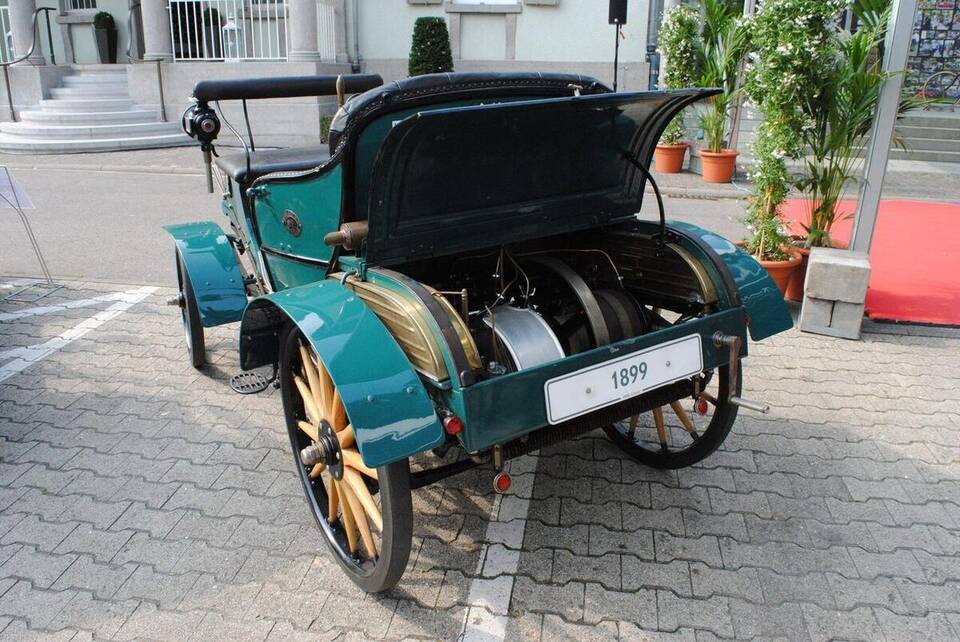
Opel Patentmotorwagen 5.jpg · Torana · CC BY-SA 3.0
Research pending
A matching completed auction sale has not been verified for this exact year, body, trim, engine, transmission and market.
Joyride shows this gap instead of substituting an asking price, unsold bid or mismatched special vehicle.
More than a set of wheels.
After the Opel family bought Friedrich Lutzmann's motor-car factory, the first Opel Patentmotorwagen System Lutzmann left the Rüsselsheim works in spring 1899. Its tall wheels, open body and engine beneath the seat still belonged to the carriage age, yet it gave Opel practical experience with engines, transmissions and complete vehicles. Opel says 65 were hand-built. The design quickly fell behind newer French ideas, so the Lutzmann era ended in summer 1901, but those short production years established the Rüsselsheim automobile operation from which Opel's later mass-market cars grew.
Look a little closer.
Its top speed was only about 20 km/h, roughly a brisk bicycle pace, yet it was Opel's first automobile built in Rüsselsheim.
Photos show an example of the model or generation. The pictured vehicle’s year, equipment, or modifications can differ from the specification described here.
Why the first Opel still resembled a carriage
Lutzmann began with familiar coachbuilding ideas: high wheels, an upright open body and the engine placed under the seat. That made the machine understandable to craftspeople used to carriages, but it also limited how far the layout could develop. Opel's own history says cooling, power transmission and new bodies could not keep it competitive after the turn of the century, so the company looked to newer French designs.
Source: Opel · Rüsselsheim's First: The Opel Patentmotorwagen System Lutzmann ↗A planetary gearbox between engine and chains
The drive line had more layers than the short phrase ‘belt drive’ suggests. Opel’s 1995 model-program sheet describes a two-speed planetary gearbox, with the selector beneath the steering crank. A belt then carried power to a countershaft, and chains completed the journey to the rear wheels. The planetary set supplied two ratios without the familiar sliding gear lever of a later manual transmission. Read together with the open-rear photographs, the sheet explains why the display car shows belts, shafts and chains packed into a small space behind and beneath the seat. The data sheet covers the 1899–1901 model program, so it is strong family-level evidence; it should not be used to certify the untouched originality of the photographed survivor or every detail of a particular spring-1899 chassis.
Source: Adam Opel AG Public Relations · Pkw-Modellprogramm 1899–1995, p. 6 ↗How to read its driver controls
Do not expect a modern instrument cluster. The surviving Patentmotorwagen photographed at Rüsselsheim has exposed pedals, a prominent hand control and a compact mounting beside the driver. The photographer explicitly identifies the larger brass identification plate as a later addition. Its dates and technical figures therefore cannot authenticate the spring-1899 specification. The photographs establish visible shape and placement, while functional claims remain limited to Opel’s documented two-speed transmission and belt-and-chain drive.
Source: Wikimedia Commons · Opel Patentmotorwagen 16 ↗Opel bought more than a design
Opel's January 21, 1899 agreement did not simply license a drawing. Opel says the 116,887-mark purchase covered Lutzmann's production operation, including its land, building and workshop equipment. The employees and machinery moved from Dessau to Rüsselsheim, while Lutzmann became sales manager of the new motor-vehicle works. For young readers, that is a useful reminder that building a car needs a whole team and workshop knowledge, not just one clever invention.
Source: Opel/Stellantis · January 21, 1899: Opel Began Producing Automobiles 125 Years Ago ↗Headlights powered by candles
Electric headlamps were still in the future. Opel describes a household candle sitting in a shaft beneath a glass-and-mirror lamp housing. A spring nudged the candle upward while it burned, keeping the flame near the right height. It was simple, mechanical and practical: the car could make itself visible without someone walking in front with a lantern.
Source: Opel/Stellantis · Lighting Technology for Everyone: Opel Astra Turns Night into Day ↗Competition became a reliability laboratory
Opel’s first international motor-race appearance came in the Aachen–Coblenz long-distance event in May 1899. Heinrich Opel’s Patent-Motorwagen did not finish because of a technical problem, and Opel says the brothers used such early events to improve reliability. The payoff came on March 31, 1901, when a modified 5 hp Motorwagen won the Königstuhl hill climb. Its fenders, running boards, lamps and trim had been removed, so none of those competition details belongs in the standard spring-1899 specification. The striking postscript is the journey: Opel says Heinrich drove the competition car 180 kilometres to and from the event in four hours. That 45 km/h average belongs to the modified 1901 machine and its trip, not to the profiled 3.5 hp road car’s approximately 20 km/h maximum.
Source: Opel/Stellantis · 125 Years Ago: Opel Celebrates Its First Victory in Motorsports ↗Starting it is a sequence, not a button
Opel Classic's 2024 demonstration turns the Patentmotorwagen's starting ritual into a checklist. An operator switches on the battery ignition, opens the fuel tap and floods the carburettor before a second person swings the hand crank. Only when fuel, spark and piston position cooperate does the single cylinder catch; Opel's account says this demonstration needed three forceful attempts. That procedure explains why an early motor car demanded mechanical sympathy before it moved, and why a photograph of the controls cannot safely tell the whole operational story.
Source: Opel POST · Opel DNA up Close ↗A carriage bench, documented two ways
Two Opel histories describe the same early seat from slightly different angles. Opel POST calls the driver’s perch a leather-covered wooden board, while Opel’s 2024 seat retrospective says the upright bench was luxuriously upholstered with leather and had no adjustment. Together they describe a seat built with carriage-era structure and materials rather than a shaped, adjustable automobile chair. The visible buttoned leather on the surviving Opel Classic vehicle is useful supporting imagery, but restoration condition should not be mistaken for proof that every spring-1899 car left the works with identical padding or trim. The secure claims are the fixed, bolt-upright bench form, leather upholstery, and the absence of seat adjustment.
Source: Opel/Stellantis · 125 Years of Seating Innovations at Opel ↗What Opel changed from Lutzmann's Arrow models
The first Rüsselsheim car did not arrive as an untouched Dessau design. Opel's historical account says it was based on Lutzmann's earlier Arrow models, while the frame and chain-operated steering were revised to improve stability and make the vehicle safer to drive. The coach-like appearance remained. That distinction matters: the Patentmotorwagen carried forward Lutzmann's concept and know-how, but Opel's factory team was already altering the chassis beneath the familiar silhouette. It is better understood as an adapted first-production step than either a wholly new Opel design or a simple rebadged carriage.
Source: Opel POST · The 8 HP Breakthrough ↗What happened inside the horizontal single
Opel’s model-program sheet turns the 1,545 cc single cylinder into a readable system. It lists a grey-cast-iron cylinder head and block with a bronze crankcase. The inlet used a ‘sniff’ or atmospheric valve, opening from pressure difference rather than a cam, while the exhaust valve was cam-controlled. Fuel and air met in a surface carburettor; oil arrived by drip feed; heat moved away through thermosiphon cooling; and a buzzer ignition supplied the spark. Each item is simple by later standards, but together they show that the rear-mounted engine still needed all the basic jobs of a modern petrol engine: mixture preparation, timed gas exchange, lubrication, cooling and ignition. The source covers the 1899–1901 family, so these are model-program facts rather than an originality certificate for a particular museum survivor.
Source: Adam Opel AG Public Relations · Pkw-Modellprogramm 1899–1995, p. 6 ↗A wood body on a tube frame
The coach-like appearance hid a mixed-material chassis. Opel’s 1995 data sheet specifies a steel-tube frame carrying a wooden body. Both axles were rigid and both used semi-elliptic leaf springs. The ball-bearing wooden-spoke wheels were deliberately unequal: 670 millimetres in diameter at the front and 830 millimetres at the rear. Steering ran through chains to the steering knuckles from a vertical column in the centre of the car. This layout explains several features visible in the gallery—the tall rear wheels, exposed frame and springs, central steering crank and the open space around the mechanism—without asking a photograph to identify parts on its own. Again, the dimensions describe the 1899–1901 program and do not prove untouched originality of the restored display vehicle.
Source: Adam Opel AG Public Relations · Pkw-Modellprogramm 1899–1995, p. 6 ↗Three braking facts, not one modern system
There were no front-wheel brakes. Opel’s period-range sheet lists a mechanical foot brake, a band brake acting at the rear, and a hand brake whose band acted on the countershaft. That arrangement is important because a modern reader may otherwise imagine one pedal operating four wheel brakes through hydraulics. Here the stopping hardware was split between the rear-wheel mechanism and the driveline. The source does not publish stopping distances or prove how a specific surviving car is adjusted today, so the profile should stop at the documented architecture. The close-up gallery can show linkages and bands, but it should not guess at unlabeled control functions beyond the Opel data sheet.
Source: Adam Opel AG Public Relations · Pkw-Modellprogramm 1899–1995, p. 6 ↗Small dimensions, serious purchase price
For the 1899–1901 model program, Opel lists a length of 2,150 mm, width of 1,440 mm and height of 1,350 mm, with a 1,350 mm wheelbase and equal 1,325 mm front and rear tracks. Empty weight was about 520 kg, estimated consumption about 10 litres per 100 kilometres, and the basic price ranged from 2,650 to 3,800 marks. These figures finally give the gallery a scale: the car was barely longer than its wheelbase plus overhangs and carried its occupants high above a short chassis. Price varied across the program and bodies, so the range must not be collapsed into a single spring-1899 list price. Likewise, the consumption figure is an Opel retrospective estimate, not a modern standardized laboratory result.
Source: Adam Opel AG Public Relations · Pkw-Modellprogramm 1899–1995, p. 6 ↗Bicycle workers helped create the new car shop
The Lutzmann purchase transferred patents, machinery and experienced workers from Dessau, but Opel also supplied selected employees from its bicycle production. Opel says the mixed team built cars in a specially erected building at Rüsselsheim. That is a more precise origin story than saying Opel simply bought a finished design: Lutzmann’s know-how arrived with people and equipment, while Opel’s own metalworking workforce learned a new product in a new shop. The spring-1899 advertisements appeared while that capability was still being assembled. The Patentmotorwagen was therefore both a sellable car and a training ground for the manufacturing organization that would outlast the short Lutzmann partnership.
Source: Opel/Stellantis · January 21, 1899: Opel Began Producing Automobiles 125 Years Ago ↗One name covered different bodies
Mobility City’s Opel exhibition account dates an early sales catalogue to the second half of 1899. Alongside the two-seat cars, it advertised a four-seat Duc and a truck developed from the Lutzmann Pfeil 6. This was already a small family of vehicles, not one body repeated unchanged. The catalogue context helps explain why a commercial derivative or a four-seat survivor can illuminate the Lutzmann story without establishing the layout of the spring-1899 passenger car.
Source: Mobility City / Fundación Ibercaja · 1899 Patent-Motorwagen “Lutzmann” ↗Eleven cars in the first year
Opel’s Italian heritage account records just eleven hand-built deliveries in 1899. That small beginning puts the later total of 65 in perspective: acquiring Lutzmann’s design and workforce did not immediately create a high-volume car factory. The next stage changed how Opel obtained its cars. Under the subsequent Darracq agreement, the company could fit its own bodies to chassis imported from France as well as represent the French maker in Germany and Austria-Hungary. This successor arrangement belongs to Opel’s response after the Lutzmann era; it is not a description of how the 1899 car was built.
Source: Opel / Stellantis · Dalle Opel-Darracq alle Opel Motorwagen (11 February 2021) ↗How Opel found its first carmaker
Opel did not discover automobile production by buying a drawing in isolation. The company’s own history says the bicycle business weakened during the 1890s, pushing Fritz and Wilhelm Opel to look for a new product. At the first German Motor Show in Berlin in 1897 they met Friedrich Lutzmann, who had been building motor cars since 1894. Lutzmann then invited the brothers to his Dessau factory, where they recognized that his operating experience could give Opel a practical route into a field it had never entered. That sequence explains the later purchase more clearly: the January 1899 contract followed a trade-show meeting and a factory visit, and it transferred accumulated motor-car knowledge as well as land, machinery and patents.
Source: Opel POST · Start of an Era ↗Why the 1899 freight car and the 1901 luggage car stay separate
Opel's retrospective commercial-vehicle programme labels the 1899 freight derivative ‘Der Coloss von Rüsselsheim’, assigns it a quantity of one and describes a two-seat closed box on the System Lutzmann chassis. The same page immediately warns that the only documentary trace is the July 2, 1899 Main-Spitze report about a motor freight car built for a large wine business. A separate light-delivery table describes a 1901 luggage and advertising car with a three-speed planetary transmission, central lubrication, a finned-tube water cooler, a 15 km/h maximum and a 3,500-mark basic price. Opel's later press history instead calls the first known 1901 light-commercial photograph a 5 hp, approximately 20 km/h vehicle. Those records should not be forced into one specification: they may describe different derivatives, or later cataloguing may be inconsistent. None of the freight or luggage-car figures replaces the spring-1899 passenger car's two-speed, 3.5 hp launch specification. The period closed-box image added with this packet is likewise kept as commercial-derivative context; its file-page date of circa 1899 does not prove that it is the wine-business ‘Coloss’.
Source: Adam Opel AG Public Relations · Lieferwagen-/Lkw-Modellprogramm 1899–1996, pp. 6 and 46 ↗Read the 1899 advertisement as a promise, not a blueprint
Opel's 1899 advertisement is useful primary-period evidence because it says the company had acquired Friedrich Lutzmann's Dessau Patent-Motorwagen factory, moved its workers to Rüsselsheim and intended to offer proven vehicles rather than experiments. It also offered cars in the buyer's desired power and execution and directed correspondence to a motor-car factory kept separate from Opel's other branches. Those are marketing claims, not neutral engineering tests. The illustration needs an equally firm guardrail: its Commons record identifies the pictured machine as an older Lutzmann ‘Pfeil 0’ that Opel probably did not build in that form. The separate 1901 Königstuhl photograph documents a modified Opel Patentmotorwagen in use; it does not turn the advertisement illustration into an exact production reference.
Source: 1899 Opel motorcar advertisement — Wikimedia Commons ↗A tiny inlet-valve spring nearly ended a 2012 run
Opel Classic's Thorsten Götz recalled that the collection's Lutzmann lost its atmospheric inlet valve during the 2012 London–Brighton event. The crew recovered the small pieces and reassembled them even though a bus had run over the spring, and the car still reached the finish. This is evidence about the operation and repairability of Opel's running survivor, not proof that every spring-1899 car carried the survivor's present parts. It also gives the ‘sniff valve’ a practical meaning: if that pressure-operated inlet cannot close and open correctly, the single cylinder cannot keep breathing.
Source: Opel POST · Faszinierende Einblicke ↗What the 1899 works photograph proves—and what it does not
A period archive photograph shows works foreman Sedlacek at the steering crank with Heinrich Opel beside him in an Opel Patentmotorwagen. Opel's own archive caption identifies the occupants; the Commons record dates the image to 1899 and, citing Manfred Riedel's Lutzmann history, associates the pair with a successful October 22 drive from Rüsselsheim through Flörsheim, Höchst and Oberursel before climbing the Großer Feldberg. It is strong period evidence that a passenger-bodied System Lutzmann was being used on a substantial road outing in 1899. It is not a spring-production record, chassis identification or proof that every visible lamp, control or body detail matches the first launch cars.
Source: Wikimedia Commons · Opel Patentmotorwagen in 1899 ↗What visitors saw at the 1899 Berlin exhibition
A report published in 1899 gives unusually close-to-the-event evidence about one Opel System Lutzmann rather than the whole 1899–1901 range. At Berlin's international motor-vehicle exhibition, Opel showed a four-seat car on solid wheels with solid-rubber tyres. The report noted chain drive to the rear wheels and praised how the mechanism could be reached from the back. Those observations help readers connect the exposed rear machinery in the gallery with the car's service access. They also need a boundary: this was the exhibited four-seat configuration, so it does not prove that every two-seat spring-production car shared the same body, wheels or tyre choice. The period writer's positive judgments about steering, braking and suspension are contemporary impressions, not measured modern tests.
Source: Dinglers Polytechnisches Journal · Die Internationale Motorwagenausstellung zu Berlin 1899 (vol. 314, p. 180) ↗Why Lutzmann's Opel job title needs two labels
Two modern Opel histories agree that Friedrich Lutzmann moved with the Dessau operation to Rüsselsheim, but they describe his new role differently. Opel POST says he received a fixed two-year contract as the operations manager of the Adam Opel motor-vehicle factory. Opel's English 2024 press release calls him the sales manager. That difference may reflect translation or a role that covered more than one responsibility, but the sources do not resolve it. The safe historical reading is that Lutzmann remained an appointed manager during the short production partnership; Joyride should show both corporate labels instead of silently turning one into a universal title.
Source: Opel POST · Der Erste aus Rüsselsheim ↗What stopped the Opel on the Aachen–Coblenz run
A June 1899 report in Draisena names the Opel entry in the Aachen–Coblenz motor race more precisely than the later company history. The entry list puts “Adam Opel, Rüsselsheim” in Category II, the class for motor cars over 200 kilograms. Four of the five listed cars started; the category left kilometre stone 6 on the Aachen–Jülich road at 9:35 a.m. The 157-kilometre route ran through Jülich, Bergheim, Cologne, Bonn and Sinzig to Coblenz. The report then gives the failure itself: Opel had to retire because of a short circuit in the electrical wiring. That contemporary diagnosis sharpens Opel’s modern “technical problem” wording, but it should not be generalized into a verdict on every Lutzmann car or confused with the later Frankfurt–Cologne ignition trouble reported by secondary histories. The same source says the whole event was completed without an accident despite roads under repair and a strong southeast headwind; that claim describes event safety, not the reliability of the retired Opel. The report also names the entrant as the company rather than identifying which Opel brother drove, so Joyride should retain Heinrich Opel as a manufacturer-sourced identification and avoid pretending that Draisena independently confirms the driver.
Source: Draisena · Motorwettfahren Aachen–Coblenz, 14 May 1899 (No. 11, June 1899) ↗From Lutzmann to a different kind of Opel
The Lutzmann programme did more than end: it taught Opel which parts of its first approach could not keep pace. Opel's retrospective says work on cooling, power transmission and new body versions still failed to reach the production results the company wanted. Friedrich Lutzmann's era at Opel ended in summer 1901. The first Darracq chassis and cars arrived in Rüsselsheim in winter 1901/1902, followed by Opel's own 10/12 HP design at the Hamburg Motor Show in autumn 1902. Those milestones belong to the successor programme, not to this 1899 car's specification, but they show why the short Lutzmann chapter mattered: it gave Opel a working car factory and the experience to change direction quickly.
Source: Opel · Rüsselsheim's First: The Opel Patentmotorwagen System Lutzmann ↗What 20 km/h felt like
Opel’s 1999 heritage magazine describes a historical drive at about 20 km/h as a very physical ride. The horizontal single-cylinder engine turned no faster than 650 rpm, while semi-elliptic springs tried to soften the road. Hard solid-rubber tyres still passed sharp cobblestone knocks into the open body, so the car rocked and rattled instead of gliding like a modern car. This account explains what a running heritage demonstration felt like; its written description is not a substitute for verified playable vehicle sound or proof that every surviving component is original.
Source: Opel POST · Reise in die Vergangenheit (3 February 1999), pp. 24–25 ↗A badge crossed from Dessau to Rüsselsheim
Before Opel had its familiar Blitz, Friedrich Lutzmann already put a polished emblem on the sides of his motor carriages. Opel's own brand-history article says that after Lutzmann moved his team and production equipment to Rüsselsheim and the vehicles were marketed as Opel cars, the wording on that emblem changed too. The little plate therefore records the handover from Lutzmann's Dessau business to Opel-branded production. It should not be treated as proof that every surviving badge is untouched or that later cars used exactly the same text.
Source: Opel POST · Opel – Signs of The Times ↗Three controls crowded beside the driver
A caption in Opel POST's February 1999 centenary issue identifies three neighboring items on the survivor: the hand brake, throttle lever and ignition-adjustment indicator. That evidence lets Joyride label this cluster without guessing from appearance alone. It still does not identify every lever in the modern museum display, and the article does not prove that each visible part has remained untouched since 1899.
Source: Opel POST · 100 Jahre Automobilbau (3 February 1999) ↗Why eleven hand-built cars did not become mass production overnight
The same Opel POST feature quotes Lutzmann's grandson Manfred Riedel saying that development consumed more money and time than first expected. Reliability problems then prevented the immediate large-series production Opel had anticipated. This adds the missing business-and-engineering reason behind the tiny first-year output: a clever prototype and a saleable factory product were not yet the same thing. It does not establish how many individual cars failed or which component caused the problems.
Source: Opel POST · 100 Jahre Automobilbau (3 February 1999) ↗The first Opel circuit-race driver is still unproved
On 29 July 1900, Frankfurt's Niederrad horse-racing track hosted what modern anniversary research describes as Germany's first automobile circuit race, and an Opel was entered. The surviving contemporary evidence does not name its driver. Reports naming Anna-Marie Lutzmann appear only from the late 1930s, and the researchers found no firm proof. Joyride can celebrate the Opel entry while keeping the mystery visible instead of turning a later tradition into a confirmed first. The entered car is related competition history, not an identified match for this spring-1899 profile chassis.
Source: FrankfurtLive · 125 Jahre Automobil-Ausstellung und Frankfurter Automobil-Rennen ↗From eight motor carriages to nearly 100,000 visitors
The meeting that led Opel into carmaking happened against a much smaller backdrop than a modern motor show. Opel’s retrospective says Germany’s first automobile exhibition opened in Berlin on 30 September 1897 with just eight motor carriages lined up outside Hotel Bristol. Friedrich Lutzmann had driven from Dessau with two of his own vehicles, and Wilhelm and Fritz Opel met him there. Those 1897 machines were Lutzmann products, not Opel Patentmotorwagens: Opel bought his business the following year. By Berlin’s 1899 exhibition, the setting had changed dramatically. Opel says nearly 100,000 visitors came, and Lutzmann was there seeking customers for cars now built at Rüsselsheim. That makes the two Berlin appearances an unusually clear before-and-after: in 1897 the Opel brothers encountered a tiny pioneering field; in 1899 their new motorcar operation was selling into a rapidly growing public market. The figures come from Opel’s later corporate retrospective, while the existing period Dinglers report remains the closer source for the four-seat 1899 show car itself.
Source: Opel · Von Anfang an dabei: Opel auf der Internationalen Automobil-Ausstellung ↗Where these facts come from
- Opel · Rüsselsheim's First: The Opel Patentmotorwagen System Lutzmann
- Opel · Made in Germany: 120 Years of Automobiles
- Opel · Power & Grip: 120 Years of Automobile Production
- Opel/Stellantis · January 21, 1899: Opel Began Producing Automobiles 125 Years Ago
- Opel/Stellantis · Lighting Technology for Everyone: Opel Astra Turns Night into Day
- Opel POST · How it all Began: The First Opel Victory at the Königstuhl
- Opel/Stellantis · Daily Deliveries Have a 120-Year Tradition at Opel
- Opel/Stellantis · Opel Love exhibition in Zaragoza
- Opel POST · Opel DNA up Close
- Opel POST · The Art of Sitting
- Opel POST · The 8 HP Breakthrough
- Opel POST archive · Patentmotorwagen drivetrain and cooling retrospective
- Opel · Company Facts & Figures 2015
- Opel/Presseportal · 1899 System Lutzmann London–Brighton record
- Adam Opel AG Public Relations · Pkw-Modellprogramm 1899–1995
- Opel/Stellantis · 125 Years Ago: Opel Celebrates Its First Victory in Motorsports
- Opel/Stellantis · 125 Years of Seating Innovations at Opel
- Mobility City / Fundación Ibercaja · 1899 Patent-Motorwagen “Lutzmann”
- Opel / Stellantis · Dalle Opel-Darracq alle Opel Motorwagen (11 February 2021)
- Opel POST · Start of an Era
- 1901 Königstuhl hill climb photograph — Wikimedia Commons
- 1899 Opel motorcar advertisement — Wikimedia Commons
- Adam Opel AG Public Relations · Lieferwagen-/Lkw-Modellprogramm 1899–1996
- Opel POST · Faszinierende Einblicke
- 1899 passenger-car works photograph — Wikimedia Commons
- Dinglers Polytechnisches Journal · Die Internationale Motorwagenausstellung zu Berlin 1899
- Opel POST · Der Erste aus Rüsselsheim
- Draisena · Motorwettfahren Aachen–Coblenz, 14 May 1899 (No. 11, June 1899)
- Opel POST · Reise in die Vergangenheit (3 February 1999)
- Opel POST · Opel – Signs of The Times
- FrankfurtLive · 125 Jahre Automobil-Ausstellung und Frankfurter Automobil-Rennen
- Opel · Von Anfang an dabei: Opel auf der Internationalen Automobil-Ausstellung
Selected facts checked for this edition. Some source pages link to broader model families. Last reviewed October 3, 2026.