Peugeot L76 Grand Prix
Four huge cylinders introduced an engine recipe—twin cams, four valves each and a central spark plug—that racing cars still recognize today.
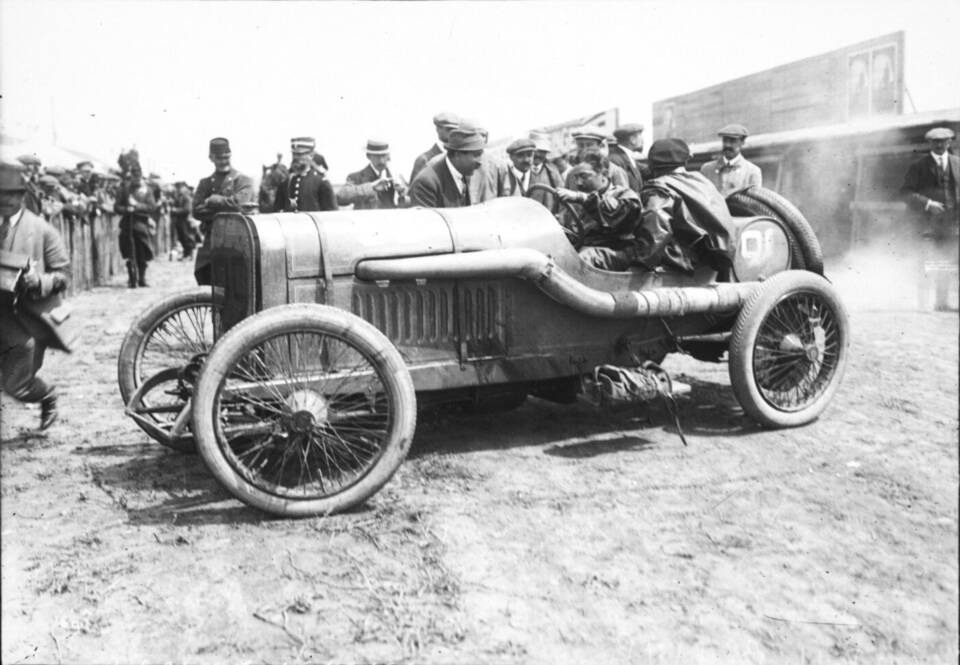
Georges Boillot Peugeot 1912 French Grand Prix.jpg · Agence Rol / Bibliotheque nationale de France · Public domain (PD-France)
Research pending
A matching completed auction sale has not been verified for this exact year, body, trim, engine, transmission and market.
Joyride shows this gap instead of substituting an asking price, unsold bid or mismatched special vehicle.
More than a set of wheels.
Peugeot drivers Georges Boillot, Jules Goux and Paolo Zuccarelli worked with Swiss draughtsman Ernest Henry on a lighter, faster alternative to the giant racers of the day. Their L76 won the 1912 French Grand Prix at Dieppe with Boillot. The car’s lasting importance is its combination of dual overhead camshafts, four valves per cylinder and a compact combustion chamber—ideas that helped shape later high-performance engines.
Look a little closer.
The “76” in L76 points to its original 7.6-litre engine—not a model year.
Photos show an example of the model or generation. The pictured vehicle’s year, equipment, or modifications can differ from the specification described here.
The combination mattered more than any one invention
Other engineers had tried individual pieces such as overhead cams or four valves, but the L76 brought twin overhead cams, four inclined valves and a compact chamber together in one successful racer. Lighter valve parts could survive higher engine speeds, while the chamber shape improved airflow and combustion.
Source: Motor Sport Magazine · Genesis of the modern combustion engine ↗Indianapolis needs a footnote
Jules Goux won the 1913 Indianapolis 500 in an L76-derived Peugeot whose displacement had been reduced to about 7.3 litres for the race rules. That victory belongs to the L76 family, but its engine specification is not identical to the 7,598 cc 1912 French Grand Prix car profiled here.
Source: Peugeot Rallye · L76 history and 1913 Indianapolis displacement ↗Look beyond the headline engine
The June 22, 1912 race preview describes the engine and disc clutch carried together on a cradle attached to the chassis by three ball joints. A four-speed gearbox sent drive rearward through a propeller shaft, and the complete rear axle with brake drums was reported to weigh 104 kg. The same article describes the large Peugeots at 1,400 kg, conflicting sharply with the 895 kg figure in a later technical summary. The measurements may use different definitions or contain an error; there is not enough evidence here to settle that. Joyride therefore keeps the mass disagreement visible rather than presenting either figure as a verified race weight.
Source: La Vie Automobile · June 22, 1912, pp.390–396, contemporary race preview reproduced by Motor Racing History ↗Where these facts come from
- Motor Sport Magazine · Genesis of the modern combustion engine
- La Vie Automobile, June 22 1912 · contemporary French Grand Prix technical preview
- Peugeot Rallye · La Peugeot L76
- Supercars.net · 1912 Peugeot L76 technical record
Selected facts checked for this edition. Some source pages link to broader model families. Last reviewed October 1, 2026.