
Peugeot Bébé BP1
Bugatti drew a tiny Peugeot that was light enough to feel lively and cheap enough to bring motoring within reach of more families.
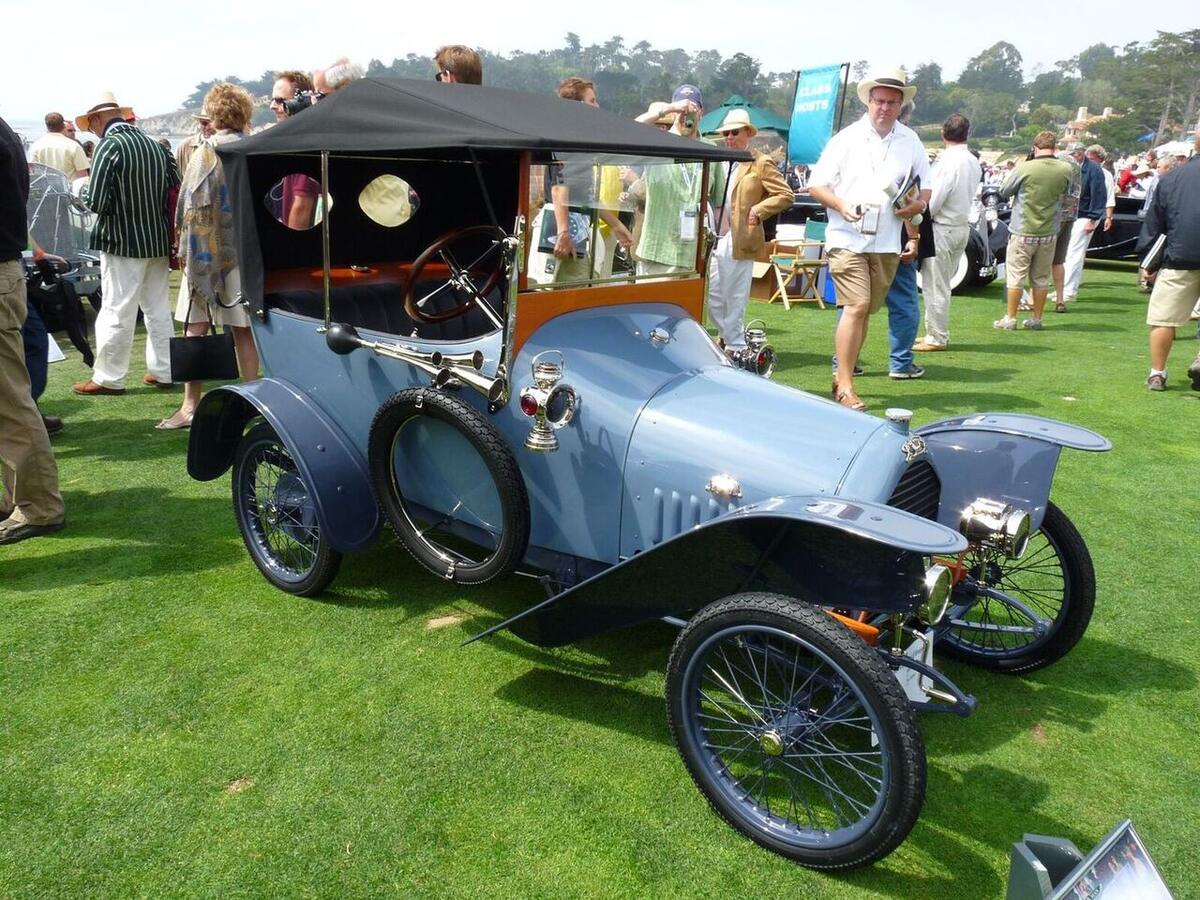
1914 Peugeot Bébé BP1 · Craig Howell · CC BY 2.0
Research pending
A matching completed auction sale has not been verified for this exact year, body, trim, engine, transmission and market.
Joyride shows this gap instead of substituting an asking price, unsold bid or mismatched special vehicle.
More than a set of wheels.
Peugeot and Ettore Bugatti agreed to work together in 1911 after Bugatti offered his compact Type 19 design. The resulting BP1 reached customers in 1913 as the second-generation Bébé Lion-Peugeot. It was only 2.62 metres long and weighed about 350 kilograms, yet its four-cylinder engine could carry two people at up to 60 km/h. A price below its direct rival helped more than 3,000 examples find buyers before production ended in 1916.
Look a little closer.
Peugeot advertised that it cost only 'one sou per kilometre' to run—an early promise that small cars could be affordable after purchase too.
Photos show an example of the model or generation. The pictured vehicle’s year, equipment, or modifications can differ from the specification described here.
Bugatti Type 19 becomes a Lion-Peugeot
Peugeot's archive says the 1911 agreement began when Ettore Bugatti offered a production-ready small-car prototype carrying his Type 19 development number. Peugeot's production line was set up with Bugatti's help, and the initials BP in BP1 were explained as Bugatti Peugeot number one.
Source: Peugeot/Stellantis · 100 years of the Bébé BP1 ↗Do not mix the two Bébé generations
Peugeot used the Bébé nickname twice. The 1905 Type 69 had a 652 cc single-cylinder engine, while the 1913 BP1 was a different Bugatti-related design with an 855 cc four-cylinder. The BP1 also had two gears; the related B3P1 gained a third, so this profile keeps their transmission specifications separate.
Source: Peugeot/Stellantis · The Lion's Bébé turns 120 ↗Control evidence, not a modern gauge cluster
A photograph of the 1913 Peugeot Bébé displayed at the Toyota Automobile Museum shows the steering wheel and a small wooden dash area with a round fitting or instrument. Its face is not readable at the available view, and the file page does not authenticate the function, chassis identity or restoration originality of every visible part. Joyride therefore treats this as useful driver-control and instrument-placement evidence, not as a readable cluster or proof that every BP1 left the factory exactly this way.
Source: Wikimedia Commons · 1913 Peugeot Bébé driver controls at Toyota Automobile Museum ↗Where these facts come from
- Peugeot/Stellantis · 100 years of the Bébé BP1
- Peugeot/Stellantis · The Lion's Bébé turns 120
- Peugeot/Stellantis · A century of Peugeot small cars
- Wikimedia Commons · 1913 Peugeot Bébé driver controls at Toyota Automobile Museum
Selected facts checked for this edition. Some source pages link to broader model families. Last reviewed October 1, 2026.