
Hispano-Suiza H6 launch chassis
This grand chassis mixed aircraft-style engine thinking with brakes that used the car's own motion to help the driver stop.
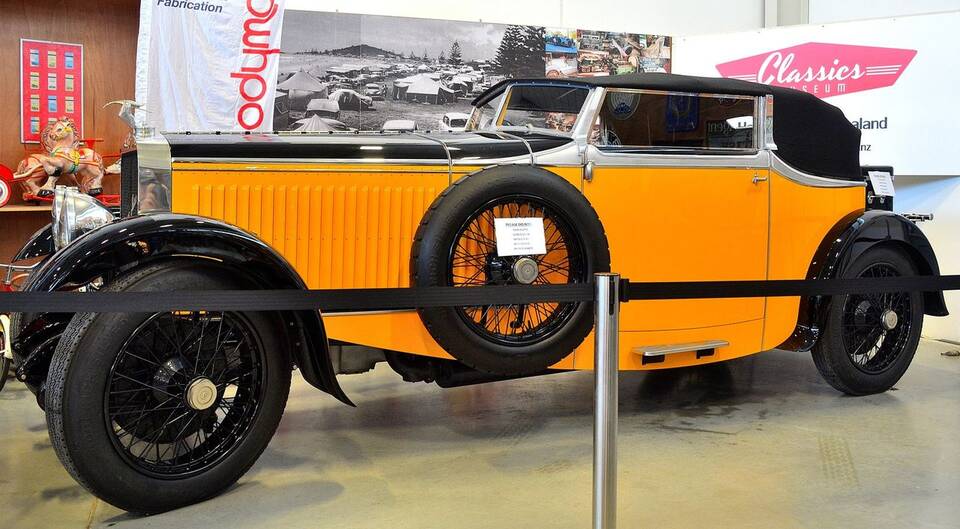
1919 Hispano-Suiza H6 launch chassis · GPS 56 from New Zealand · CC BY 2.0
Research pending
A matching completed auction sale has not been verified for this exact year, body, trim, engine, transmission and market.
Joyride shows this gap instead of substituting an asking price, unsold bid or mismatched special vehicle.
More than a set of wheels.
Swiss engineer Marc Birkigt returned from wartime aircraft-engine work with a new idea for a luxury car. The H6 appeared at the 1919 Paris Salon with a smooth six-cylinder engine, an unusually rigid crankshaft and a mechanical servo that helped apply brakes at all four wheels. Buyers then chose a coachbuilder to create the body, so two H6s could share the same clever machinery while looking completely different.
Look a little closer.
Hispano-Suiza's stork mascot honored the French wartime squadron associated with ace Georges Guynemer and linked the road car to the company's aviation reputation.
Photos show an example of the model or generation. The pictured vehicle’s year, equipment, or modifications can differ from the specification described here.
An aircraft engineer's luxury car
Revs Institute traces the H6's aluminum six-cylinder engine to Birkigt's water-cooled V8 aircraft work. Its February 2024 research note places the H6 at the 1919 Paris Salon, while the museum's collection story calls the design exceptionally advanced for its introduction.
Source: Revs Institute · February 2024 Tappet Clatter ↗Stopping power other makers licensed
The H6's mechanical servo-assisted four-wheel brakes let one pedal operate all four drums with less effort. Revs reports that Rolls-Royce later paid royalties to use the system, a strong sign that the idea mattered well beyond Hispano-Suiza.
Source: Revs Institute · 1928 Hispano-Suiza H6C collection story ↗Where these facts come from
- Revs Institute · 1928 H6C collection story and H6 history
- Revs Institute · February 2024 Tappet Clatter
- Revs Institute · March 2023 Tappet Clatter
- Hispano Suiza · official history
- Museu do Caramulo · Hispano-Suiza H6B
- Hispano-Suiza Club · H6B technical record
Selected facts checked for this edition. Some source pages link to broader model families. Last reviewed September 30, 2026.