
Ford Model 18 V-8 Tudor Sedan
Ford squeezed eight cylinders into an affordable family car by casting the cylinder banks and crankcase as one iron block.
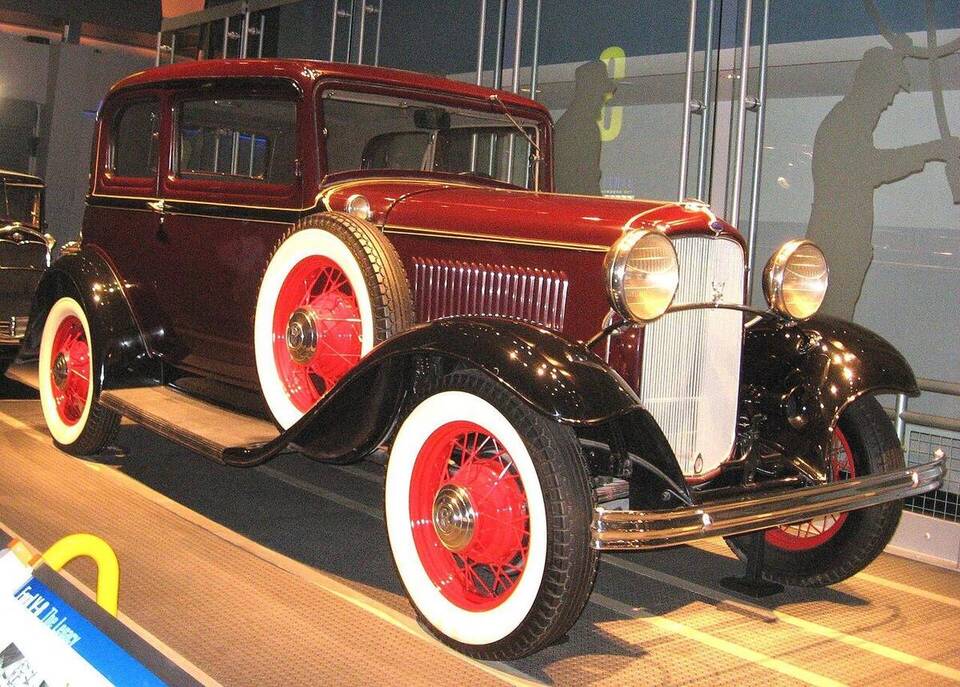
1932-Ford-V8.jpg · IFCAR · Public domain (PD-self)
Research pending
A matching completed auction sale has not been verified for this exact year, body, trim, engine, transmission and market.
Joyride shows this gap instead of substituting an asking price, unsold bid or mismatched special vehicle.
More than a set of wheels.
The 1932 Ford looked lower and more modern than the Model A it replaced, but the headline was its optional V-8. Expensive cars already used eight cylinders; Ford's difficult trick was to make one light, simple and cheap enough for a mass-market car. Henry Ford insisted that the crankcase and both cylinder banks be cast as one piece. The new V-8 went into cars called Model 18, while visually similar four-cylinder cars were Model B. This profile is the two-door Tudor sedan with the V-8, not a four-cylinder Model B and not a De Luxe-trim car. The engine's easy availability later made the 1932 Ford a favorite starting point for hot rodders, so an unmodified Tudor now tells an especially useful engineering story.
Look a little closer.
Ford's first production V-8 block was difficult to cast, but the Rouge eventually produced thousands a day and the basic engine stayed in Ford cars through 1953.
Photos show an example of the model or generation. The pictured vehicle’s year, equipment, or modifications can differ from the specification described here.
The hard part was not drawing a V-8
V-8 engines were known before 1932. Ford's breakthrough was manufacturing one for a low-priced, high-volume car. Traditional engines could use separately cast cylinder banks attached to a crankcase. Ford demanded a single iron casting with both banks and the crankcase together. That saved assembly and helped control cost, but molten metal had to flow through a complicated mold without leaving weak spots. The engineering achievement was therefore as much foundry production as combustion theory.
Source: The Henry Ford · Ford's game-changing V-8 ↗One body, two model identities
A 1932 Ford Tudor can be misidentified because Ford offered the same basic body and chassis with two very different engines. Model B means the carried-over four-cylinder; Model 18 means the new V-8. Standard and De Luxe trim add another layer, with details such as cowl lamps, bright window trim and interior finish. The vehicle name in this profile deliberately keeps all three clues—Model 18, V-8 and Tudor—so a reader does not inherit specifications from its four-cylinder twin.
Source: Wikimedia Commons · 1932 Model 18 Tudor documentation ↗Where these facts come from
- The Henry Ford · Ford's game-changing V-8
- The Henry Ford · 1932 Ford V-8 Engine No. 1
- The Henry Ford · 1932 Ford V-8 Victoria
- Wikimedia Commons · 1932 Model 18 Tudor
Selected facts checked for this edition. Some source pages link to broader model families. Last reviewed October 1, 2026.