
Mercedes-Benz 260 D
A taxi-shaped Mercedes proved that a diesel engine could be economical and dependable in a production passenger car.
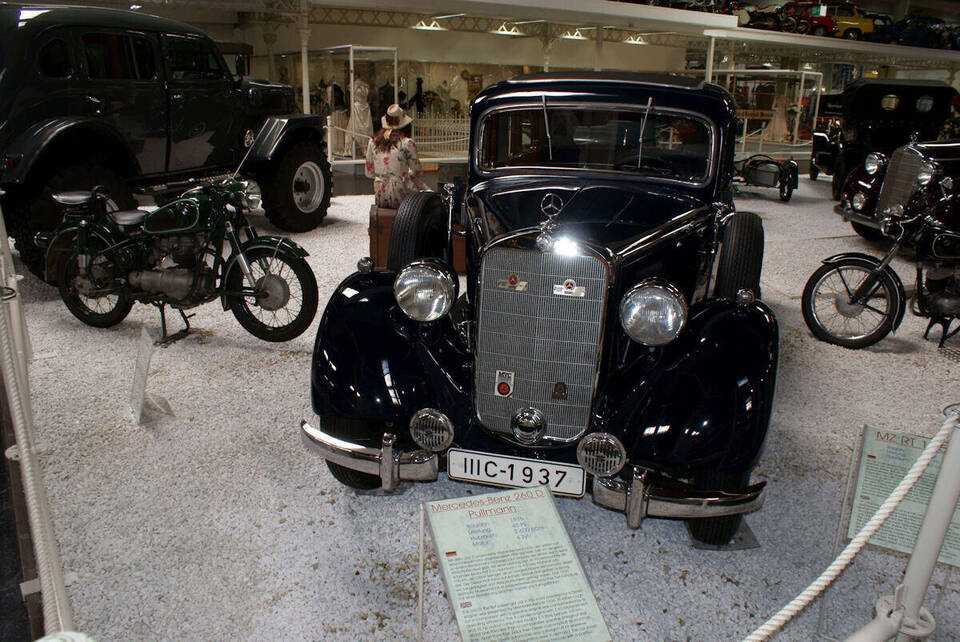
Mercedes-Benz_260D_1936_Pullmann_HeadOn_SATM_05June2013_(14598735664).jpg · Valder137 · CC BY 2.0
Research pending
A matching completed auction sale has not been verified for this exact year, body, trim, engine, transmission and market.
Joyride shows this gap instead of substituting an asking price, unsold bid or mismatched special vehicle.
More than a set of wheels.
Daimler-Benz first tried a 3.8-litre six-cylinder diesel in a passenger chassis, but its vibration was too severe. Engineers developed the smaller four-cylinder OM 138 instead and brought it to production maturity in 1935. Thirteen pre-production cars were built before the 260 D appeared as a six-seat Pullman landaulet at the Berlin show in February 1936. This page stays with that debut form, before the wider body range, facelift and later fully synchronised gearbox.
Look a little closer.
Its original gearbox had three normal forward gears plus a separate overdrive ratio marked “S.”
Photos show an example of the model or generation. The pictured vehicle’s year, equipment, or modifications can differ from the specification described here.
The first engine idea shook too hard
The experimental 3.8-litre six made 80 hp but overwhelmed the Mannheim passenger chassis with vibration. Reducing the idea to a lower-output 2.6-litre four-cylinder produced a package that could survive passenger-car use and reach production maturity.
Source: Mercedes-Benz Public Archive · 260 D model history ↗Economy mattered more than speed
The archive gives 11 litres per 100 km and 90 km/h for the debut specification. That modest pace was acceptable to taxi operators because the spacious body, fuel economy and durability reduced operating costs—the first cars were used almost entirely as taxis.
Source: Mercedes-Benz Public Archive · 260 D technical record ↗Where these facts come from
- Mercedes-Benz Public Archive · 260 D technical record
- Mercedes-Benz Public Archive · 260 D model history
- Mercedes-Benz Public Archive · Berlin 1936 debut
- auto motor und sport · W 138 technical overview
Selected facts checked for this edition. Some source pages link to broader model families. Last reviewed 2026-10-01.