
Nash Ambassador Custom Airflyte
Nash wrapped six-cylinder comfort in a smooth, wheel-shrouded body that looked as if the wind had shaped it.
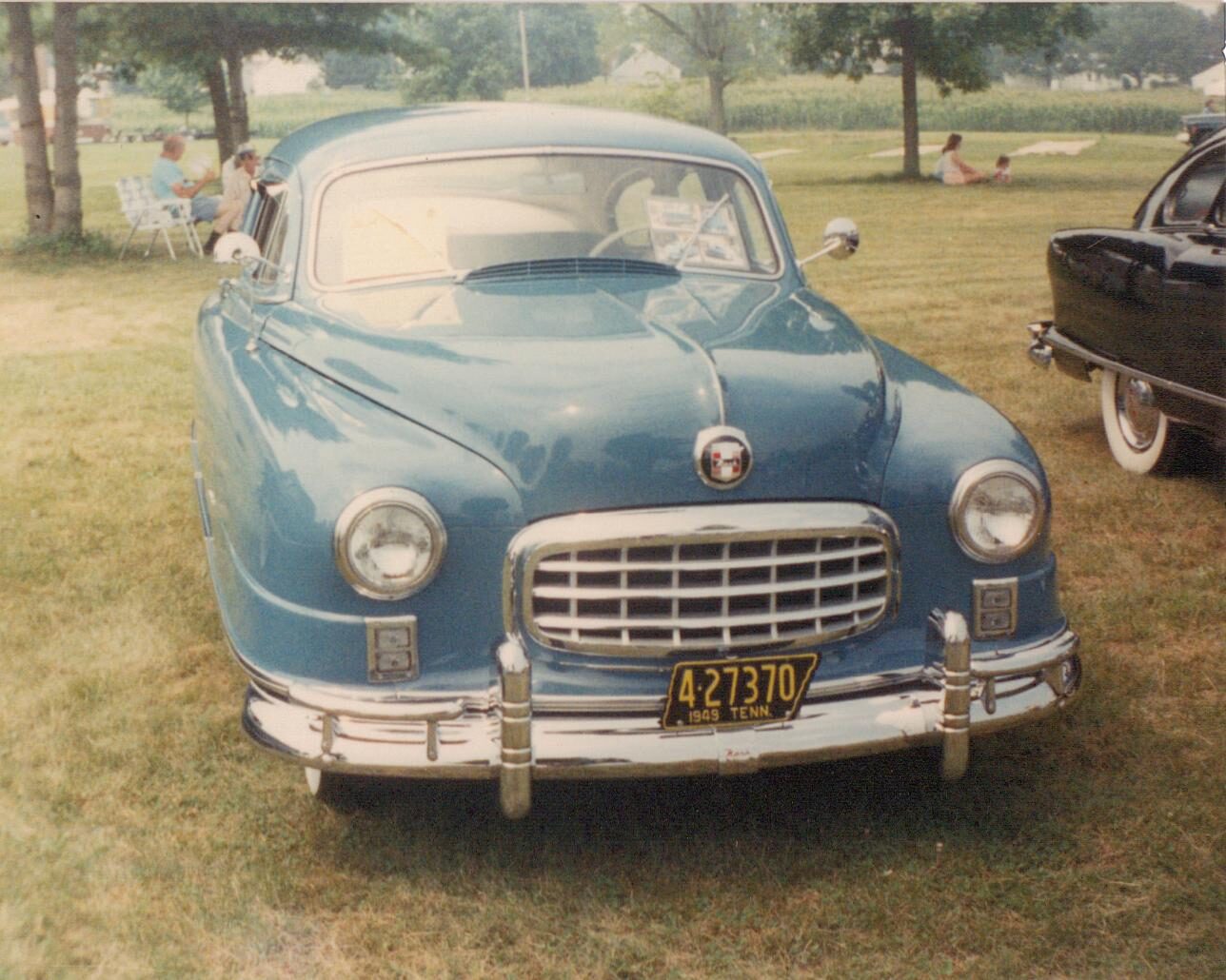
1949 Nash Ambassador · John Lloyd · CC BY 2.0
Research pending
A matching completed auction sale has not been verified for this exact year, body, trim, engine, transmission and market.
Joyride shows this gap instead of substituting an asking price, unsold bid or mismatched special vehicle.
More than a set of wheels.
For 1949, Nash replaced its separate body-and-frame Ambassador with the new unitized Airflyte. Engineer Nils Wahlberg's team used wind-tunnel work to pursue low drag, while the long-wheelbase Ambassador carried Nash's larger overhead-valve six. This profile keeps the four-door Custom sedan separate from the 112-inch-wheelbase Nash 600 and from 1950 cars that could use GM Hydra-Matic.
Look a little closer.
The front wheels are almost hidden, yet Nash shaped the openings so the wheels could still steer inside the smooth fenders.
Photos show an example of the model or generation. The pictured vehicle’s year, equipment, or modifications can differ from the specification described here.
The body became part of the structure
Nash called the new shell Unitized or Airflyte Construction. Instead of setting a complete body on a separate heavy frame, many welded steel pieces shared the load. Period material cited about 8,000 welds and claimed much greater rigidity than conventional construction; that is a manufacturer claim, not a modern laboratory comparison.
Source: Old Car Manual Project · 1949 Nash brochure ↗Streamlining changed the whole silhouette
The roof, hood and rear deck flow into one rounded fastback form, while skirts continue across all four wheel openings. The styling was not just decoration: Nash's engineering group had been studying air resistance for years. The result was also six inches lower than the preceding Nash, yet retained a roomy cabin and reclining seats.
Source: Automotive History Preservation Society · 1949 Nash Airflyte ↗Where these facts come from
- Old Car Manual Project · preserved 1949 Nash brochure
- Automobile-Catalog · 1949 Ambassador four-door factory-data compilation
- Classic Car Database · 1949 Ambassador specification cross-check
- Automotive History Preservation Society · 1949 Airflyte engineering history
Selected facts checked for this edition. Some source pages link to broader model families. Last reviewed October 1, 2026.