
Hudson Hornet Club Coupe
The Hornet put a huge six-cylinder engine into a low 'step-down' body, giving a family-sized coupe an unexpected talent for fast corners and stock-car racing.
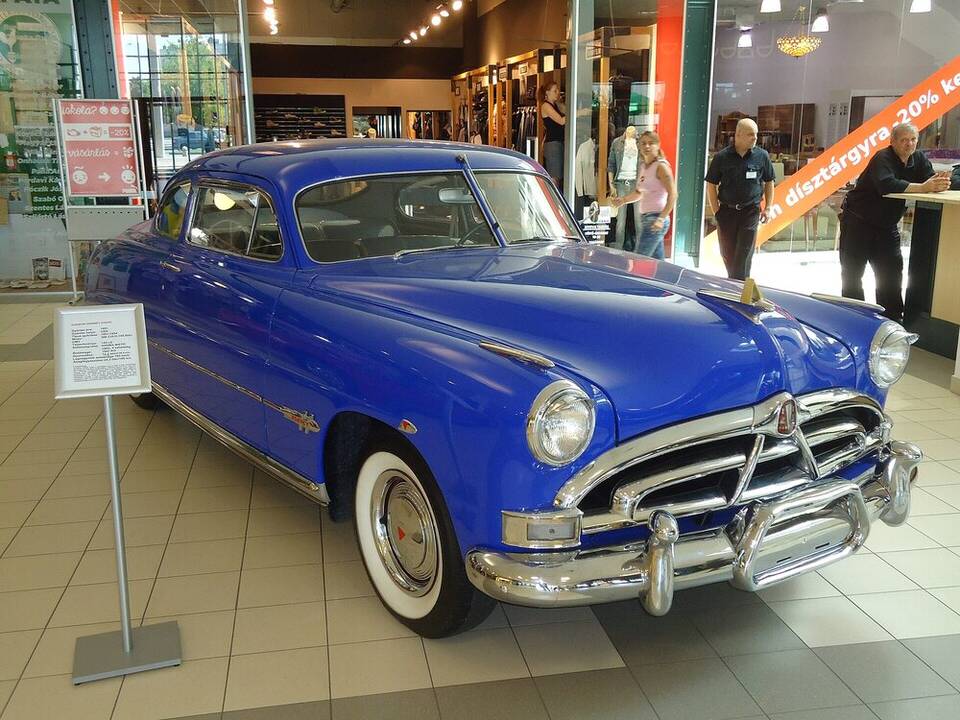
Hudson Hornet coupe 1951 – front right.JPG · Pallerti · CC BY-SA 3.0
Research pending
A matching completed auction sale has not been verified for this exact year, body, trim, engine, transmission and market.
Joyride shows this gap instead of substituting an asking price, unsold bid or mismatched special vehicle.
More than a set of wheels.
Hudson introduced the Hornet for 1951 on the low body-and-frame design first used by the 1948 Commodore. Its floor dropped between perimeter frame rails instead of sitting above them, so passengers stepped down into the car and the center of gravity stayed low. The 308-cubic-inch H-145 six added abundant torque. Racing teams recognized the combination, and Hornets soon became dominant even though the showroom car seated six.
Look a little closer.
A six-passenger coupe with a clock and a 20-gallon fuel tank became a track star because low weight placement and strong torque mattered as much as flashy bodywork.
Photos show an example of the model or generation. The pictured vehicle’s year, equipment, or modifications can differ from the specification described here.
Why 'step-down' was more than a nickname
Hudson routed strong frame rails around recessed footwells, allowing the floor to sit lower than on a normal body-over-ladder-frame car. People literally stepped down into the cabin. The roof and seats could then be lower without stealing headroom, reducing the center of gravity and helping the big coupe turn with unusual confidence.
Source: Museum of American Speed · Hudson Twin H-Power 6 Cylinder ↗Launch car versus the racing legend
The standard 1951 H-145 used a single two-barrel carburetor. Twin H-Power's two one-barrel carburetors became a dealer-installed option during the model year and later a central part of the Hornet legend. Racing engines also received special parts and tuning, so their results should not be treated as ordinary showroom specifications.
Source: Classic Car Database · 1951 Hudson Hornet Series 7A Club Coupe ↗A dashboard built around two circles
A newly reviewed 1951 Hornet cabin photograph makes the driving environment legible: the thin-rim two-spoke wheel sits ahead of a broad metal fascia, with the speedometer and companion circular housing grouped directly in the driver's sightline and the selector on the steering column. The source identifies a 1951 Hornet but not its body style, so the image is shown as year-and-model cabin context rather than proof that every trim detail matches this Club Coupe.
Source: Wikimedia Commons · 1951 Hudson Hornet dashboard ↗Where these facts come from
- Classic Car Database · 1951 Hudson Hornet Series 7A Club Coupe
- Museum of American Speed · Hudson Twin H-Power 6 Cylinder
- Western Antique Aeroplane & Automobile Museum · 1951 Hudson Hornet Club Coupe
- Wikimedia Commons · 1951 Hudson Hornet dashboard
Selected facts checked for this edition. Some source pages link to broader model families. Last reviewed October 3, 2026.