
Messerschmitt KR200 Kabinenroller
Two people sat one behind the other under a clear canopy, making this three-wheeler feel halfway between a scooter and a tiny airplane cockpit.
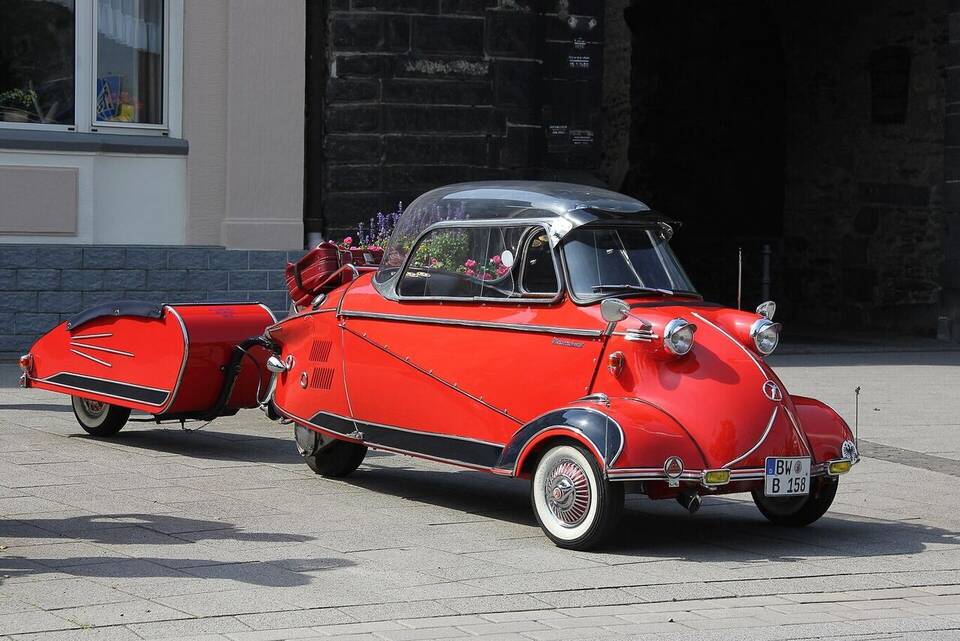
1955 Messerschmitt KR200 Kabinenroller · Lothar Spurzem · CC BY-SA 2.0 DE
Research pending
A matching completed auction sale has not been verified for this exact year, body, trim, engine, transmission and market.
Joyride shows this gap instead of substituting an asking price, unsold bid or mismatched special vehicle.
More than a set of wheels.
Aircraft engineer Fritz Fend first created compact invalid vehicles, then developed the Kabinenroller with Messerschmitt. The improved KR200 arrived in 1955 with a larger 191 cc Sachs engine and a revised body. Its tandem seats kept the body narrow, while a canopy hinged aside to let both occupants climb in.
Look a little closer.
KR stands for Kabinenroller—literally 'cabin scooter.'
Photos show an example of the model or generation. The pictured vehicle’s year, equipment, or modifications can differ from the specification described here.
Why the seats form a line
Putting the passenger behind the driver makes the body exceptionally narrow without forcing either person onto a tiny side seat. The museum's 1955 car preserves the signature tandem seating, cockpit-style roof and direct steering that made the Kabinenroller instantly recognizable.
Source: Rahmi M. Koç Museum · Messerschmitt 1955 ↗A bigger engine than the KR175
The KR200 replaced the earlier 175 cc model. The German Messerschmitt Club dates production from February 1955 to January 1964 and lists the launch car's 191 cc Sachs two-stroke, 10.2 PS output and four-speed gearbox. This profile does not mix in the KR201 roadster body.
Source: Messerschmitt Club Deutschland · KR200 technical data ↗Where these facts come from
- Rahmi M. Koç Museum · Messerschmitt 1955
- Messerschmitt Club Deutschland · KR200 technical data
- Audrain Auto Museum · 1955 Messerschmitt KR-200
- Audrain Auto Museum · KR-200 opening-top display
Selected facts checked for this edition. Some source pages link to broader model families. Last reviewed September 30, 2026.