
Amphicar 770
This little convertible could trade a road for a lake without leaving its wheels behind.
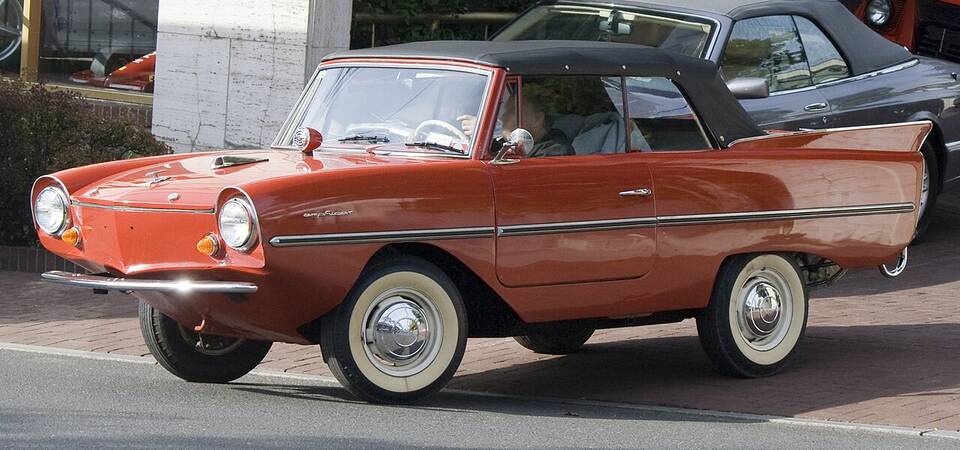
1961 Amphicar 770 · Mr.choppers · CC BY-SA 3.0
What did this one sell for?
Make a guess, then reveal one identity-matched completed auction result. It is a comparison point, not a price promise.
Reveal the auction result
Based on a completed sale at RM Sotheby's, an estimated value for this vehicle is $93,500.
Why this sale: Exact 1961 Amphicar 770, chassis 100053, with 1,147 cc Triumph inline-four and four-speed manual; titled and sold in the United States. Bare-metal restoration with structural repairs by an Amphicar specialist; converted to negative earth with upgraded alternator and Bluetooth-enabled period-look radio; one of the earliest surviving examples and never fitted with a bilge blower.
RM Sotheby's primary result page displays $93,500 and sold status but does not label the amount as hammer or all-in; buyer-premium treatment is unknown. Taxes, transport and later work are excluded. One auction result is a reference, not an appraisal; condition, history, options, location and market timing can change value. Accepted as an exact year/model/drivetrain completed sale. Its U.S. title, restoration, early chassis and electrical/audio modifications are material limits for the broader German launch-series profile.
More than a set of wheels.
The German-built Amphicar combined a small car with a boat. Production began in 1961, and many cars went to the United States. Designer Hans Trippel gave it a welded steel body and a rear engine. The name 770 recalled the maker’s famous promise: roughly seven miles per hour in water and seventy on land.
Look a little closer.
Its propellers are nylon, according to the International Amphicar Owners Club.
Photos show an example of the model or generation. The pictured vehicle’s year, equipment, or modifications can differ from the specification described here.
One engine, two ways to move
The special transmission has four forward road gears and reverse. The water drive has its own forward and reverse selection. Wheels and propellers can operate separately or together, which helps explain how one machine can serve on both surfaces.
Source: International Amphicar Owners Club · History of the Amphicar ↗A body that doubles as a hull
Lane describes a welded steel unitary body: the shell itself is a structural part of the car. Its museum Amphicar is a 1964 example, so the cited figures describe the established 770 design rather than a newly documented 1961 German-market build sheet.
Source: Lane Motor Museum · Amphicar 770 (1964 survivor) ↗A later survivor shows the controls and rear engine
Two licensed photographs document a 1962 Amphicar 770's readable dashboard and rear engine bay. They illuminate the established model layout one year after launch, but are labeled representative because they do not prove that every control, label or service part was unchanged from the 1961 launch-series car.
Source: Joe Ross · 1962 Amphicar dashboard, CC BY-SA 2.0 ↗A launch-year engine bay is now visible
A separately photographed, source-identified 1961 Amphicar 770 shows the rear engine installation and the deep ventilation pressed into the open deck lid. It is exact to the launch year and distinct from the existing 1962 engine view, but its chassis, market specification, restoration history and individual service parts remain unverified.
Source: Valder137 · 1961 Amphicar 770 engine bay, CC BY 2.0 ↗Why two propellers sit beneath the tail
A representative Amphicar 770 rear photograph makes the amphibious hardware visible: twin propellers sit below the body behind the rear wheels, while the deck, lamps and bumper remain recognizably car-like. The source does not establish the survivor's year or originality, so it explains the model's layout without claiming exact 1961 trim.
Source: Stephen Foskett · Amphicar rear, CC BY-SA 3.0 ↗Where these facts come from
- Lane Motor Museum · Amphicar 770 (1964 survivor)
- International Amphicar Owners Club · History of the Amphicar
- Wikimedia Commons · 1962 Amphicar dashboard
- Wikimedia Commons · 1962 Amphicar engine
- Wikimedia Commons · 1961 Amphicar 770 engine bay
- Wikimedia Commons · Amphicar rear and twin propellers
Selected facts checked for this edition. Some source pages link to broader model families. Last reviewed September 30, 2026.