
Hillman Imp De Luxe
Britain's little rear-engined rival to the Mini used a feather-light alloy engine and a useful opening rear window.
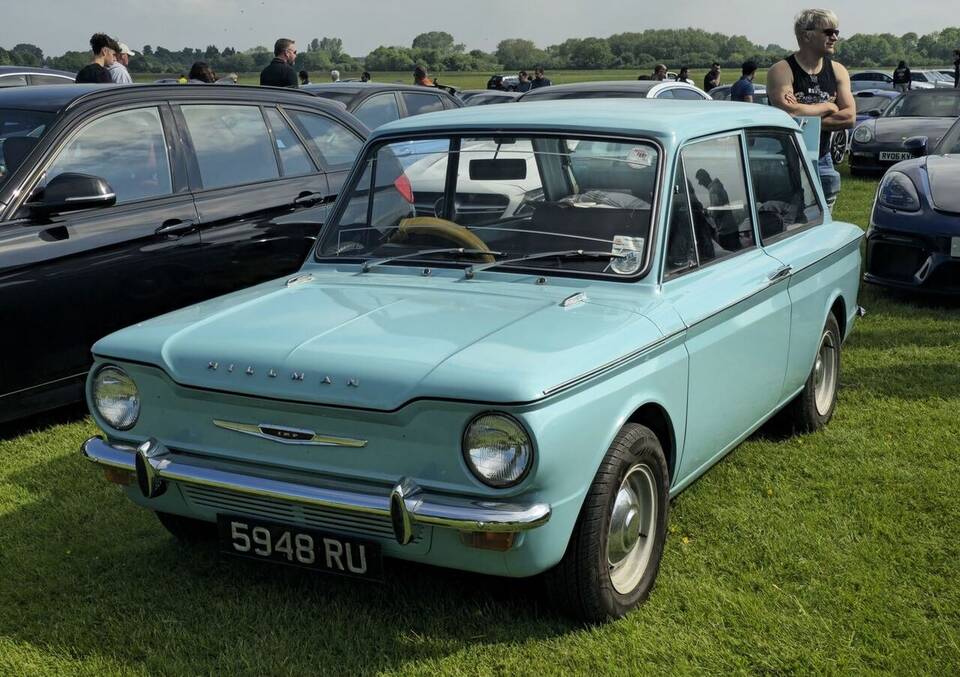
1963 Hillman Imp De Luxe · Calreyn88 · CC BY-SA 4.0
Research pending
A matching completed auction sale has not been verified for this exact year, body, trim, engine, transmission and market.
Joyride shows this gap instead of substituting an asking price, unsold bid or mismatched special vehicle.
More than a set of wheels.
Rootes developed Project Apex into the Hillman Imp, then built a new government-backed factory at Linwood in Scotland to make it. The factory and car were formally launched on 3 May 1963. This De Luxe had better trim than the standard Imp, but shared its adventurous rear-engine layout.
Look a little closer.
The rear glass opened like a small hatch, while the back seat folded; the car therefore had useful luggage spaces at both ends.
Photos show an example of the model or generation. The pictured vehicle’s year, equipment, or modifications can differ from the specification described here.
Fire-pump ancestry, road-car engineering
The Imp's 875 cc engine grew from Coventry Climax's light-alloy FWMA design. Rootes produced the road version with an aluminium block and head, a single overhead camshaft and a high 10:1 compression ratio. Its low mass helped a rear-engined car avoid becoming even more tail-heavy.
Source: National Motor Museum · Hillman Imp ↗A Scottish factory built around one small car
Linwood was created as a modern high-volume plant, and the Duke of Edinburgh drove the first production Imp at its opening. Ambitious output plans were never achieved, while early quality and reliability problems hurt the car. Even so, about 440,000 Imps and derivatives were built through 1976.
Source: National Motor Museum · Hillman Imp ↗The front wheel tells the speedometer
The engine drives the rear wheels, but the launch Imp’s speedometer cable took its drive from a front wheel. The June 1963 launch report also describes a short central gear lever and synchromesh on all four forward gears. These are launch-car details; later Imp dashboards, controls and derivatives need their own year-specific evidence.
Source: Motor Sport · Small-Car Topics, June 1963, launch driving report ↗Where these facts come from
- National Motor Museum · Hillman Imp
- Imp Information · 1963 brochures
- Motor Sport · Small-Car Topics, June 1963
- The Imp Site · Imp De Luxe dimensions
Selected facts checked for this edition. Some source pages link to broader model families. Last reviewed September 30, 2026.