
Rover 2000 (P6)
Rover hid advanced suspension, four disc brakes and a repair-friendly skeleton under very calm saloon styling.
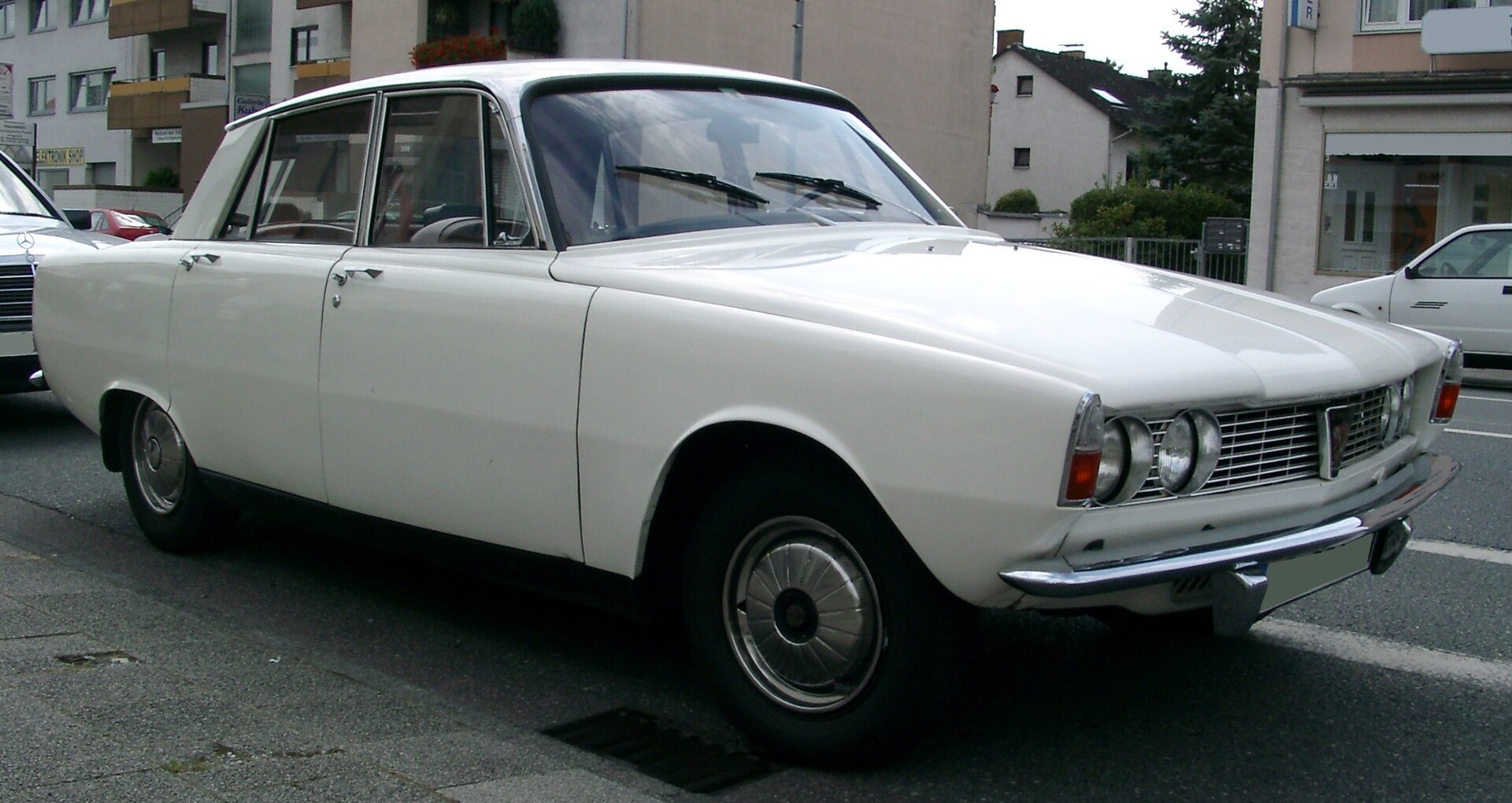
Rover 2000 P6 Series I · Rudolf Stricker · CC BY-SA 3.0
Research pending
A matching completed auction sale has not been verified for this exact year, body, trim, engine, transmission and market.
Joyride shows this gap instead of substituting an asking price, unsold bid or mismatched special vehicle.
More than a set of wheels.
Rover introduced the 2000 on October 9, 1963 after more than five years of work that had originally allowed for a gas turbine. Its strong base unit carried the loads while the doors, wings, bonnet, boot lid and roof were bolted on. An all-new overhead-cam four, de Dion rear suspension and four disc brakes made this a sharp break from the older P4 and helped the P6 win the first European Car of the Year award for 1964.
Look a little closer.
Rover could replace many outer panels by unbolting them from the strong skeleton—almost like changing armour plates.
Photos show an example of the model or generation. The pictured vehicle’s year, equipment, or modifications can differ from the specification described here.
A gas-turbine-shaped saloon
The P6's early layout was planned with Rover's gas-turbine experiments in mind. When a production turbine was not ready, the same spacious base design accepted a conventional engine. The surviving T4 connection explains why the engine bay and unusual front suspension were arranged so differently.
Source: Motor Sport · A fine British sports saloon, November 1963 ↗The body was not the skeleton
The central base unit, bulkheads and deep sills carried the loads. Exterior panels arrived late on the assembly line and could be unbolted after a collision. That separation of structure and skin was both a production idea and a repairability idea.
Source: National Motor Museum · Rover 2000 ↗Where these facts come from
Selected facts checked for this edition. Some source pages link to broader model families. Last reviewed 2026-10-02.