
Studebaker Avanti R2
A supercharger gave this space-age fiberglass coupe one horsepower for every cubic inch of its V8—while front disc brakes helped rein it in.
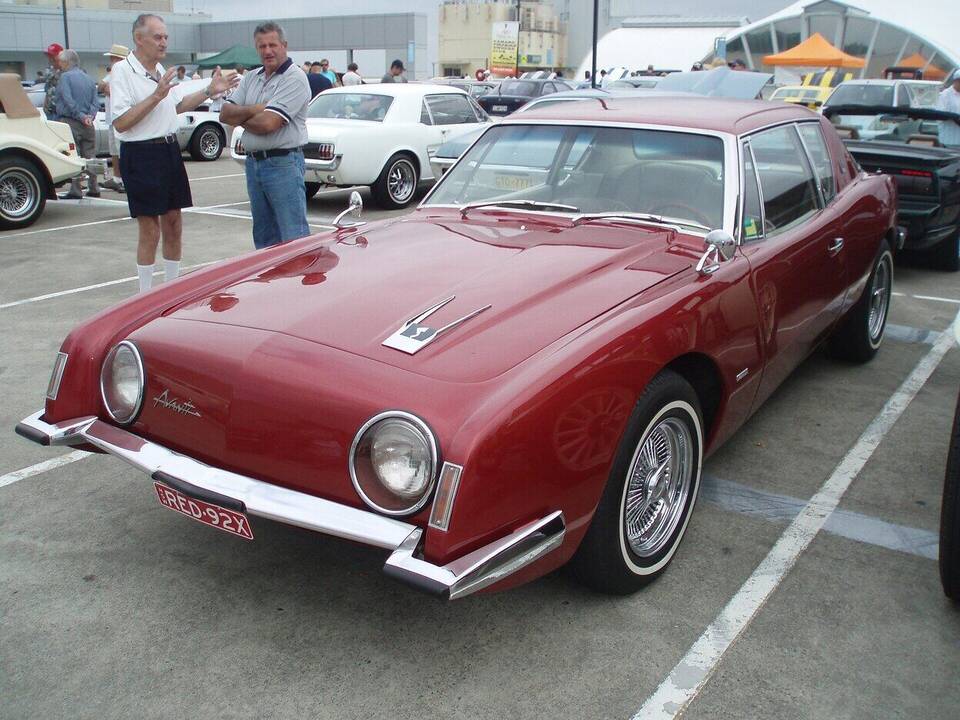
1963 Studebaker Avanti R2 coupe · sv1ambo · CC BY 2.0
What did this one sell for?
Make a guess, then reveal one identity-matched completed auction result. It is a comparison point, not a price promise.
Reveal the auction result
Based on a completed sale at Bring a Trailer, an estimated value for this vehicle is $58,000.
Why this sale: Exact 1963 U.S. Studebaker-built R2 coupe with the factory Paxton-supercharged 289-cubic-inch V8 and four-speed manual transmission; not an R1, R3 development car or later Avanti II. 33k miles shown with mileage exempt on the Missouri title and 44 years of family ownership. The car appears to have been repainted before 1982; a dual brake master cylinder was adapted in 2025, the driver door and window needed adjustment, the driver-seat cushion seam was split and the temperature gauge was inoperative. Cooling, fuel and brake work was documented.
Winning bid; Bring a Trailer's 5% buyer service fee, capped at $7,500, taxes, title, transport and later work are excluded. One auction result is a reference, not an appraisal; condition, history, options, location and market timing can change value. Accepted as the newest exact year, R2 induction and four-speed completed sale located through October 5, 2026. Factory powertrain paperwork and the matching engine stamp support identity; repaint, later safety work and disclosed faults remain material comparison differences.
More than a set of wheels.
Studebaker president Sherwood Egbert wanted an attention-grabbing new car quickly. Raymond Loewy led a small design team, and the Avanti reached its public debut in April 1962 after only about fourteen months. Its smooth nose had no traditional grille, its body was fiberglass and its cabin seated four. The R2 added a Paxton centrifugal supercharger to Studebaker's 289-cubic-inch V8, creating the most widely available high-performance Avanti specification.
Look a little closer.
Its Italian name means ‘forward’ or ‘onward’—a fitting word for a car created on an unusually short schedule.
Photos show an example of the model or generation. The pictured vehicle’s year, equipment, or modifications can differ from the specification described here.
Fourteen months from idea to debut
The Studebaker National Museum says a new car normally required three to five years, while Studebaker gave the Avanti team fourteen months and a tiny budget. The car debuted April 25, 1962, showing how a focused design team and fiberglass body tooling could compress the timetable.
Source: Studebaker National Museum · Studebaker's Last Dance: The Avanti ↗R2 means a specific factory powertrain
The R2 is not just any Avanti with a blower. Studebaker's technical sheets identify the 289-cubic-inch Jet Thrust V8 and its factory supercharged specification. This profile does not borrow the 240 hp R1 figure or the larger, scarce R3's Bonneville-record numbers.
Source: Studebaker · 1963 Avanti R1 and R2 AMA specifications ↗Read the cockpit without changing the engine label
The added 1963 cabin photographs document an R1 with a four-speed and optional air conditioning. They clarify the Avanti body family’s four-seat cockpit, main gauges and center controls, but cannot establish R2 induction, R2-specific instrumentation, or the profile car’s transmission and options.
Source: Wikimedia Commons · 1963 Studebaker Avanti R1 controls ↗Where these facts come from
- Studebaker National Museum · Studebaker's Last Dance: The Avanti
- Studebaker · 1963 Avanti sales brochure
- Studebaker · 1963 Avanti R1 and R2 AMA specifications
- Avanti technical archive · factory-document-derived specifications
- Automobile-Catalog · 1963 Avanti dimensions
Selected facts checked for this edition. Some source pages link to broader model families. Last reviewed September 30, 2026.