
Zastava Jugo 45
The small Zastava Jugo 45 was meant to put a new car within reach of many Yugoslav families. Its name advertised its output—45 metric horsepower—and its simple Fiat-related mechanical parts were designed to be affordable to build and repair.
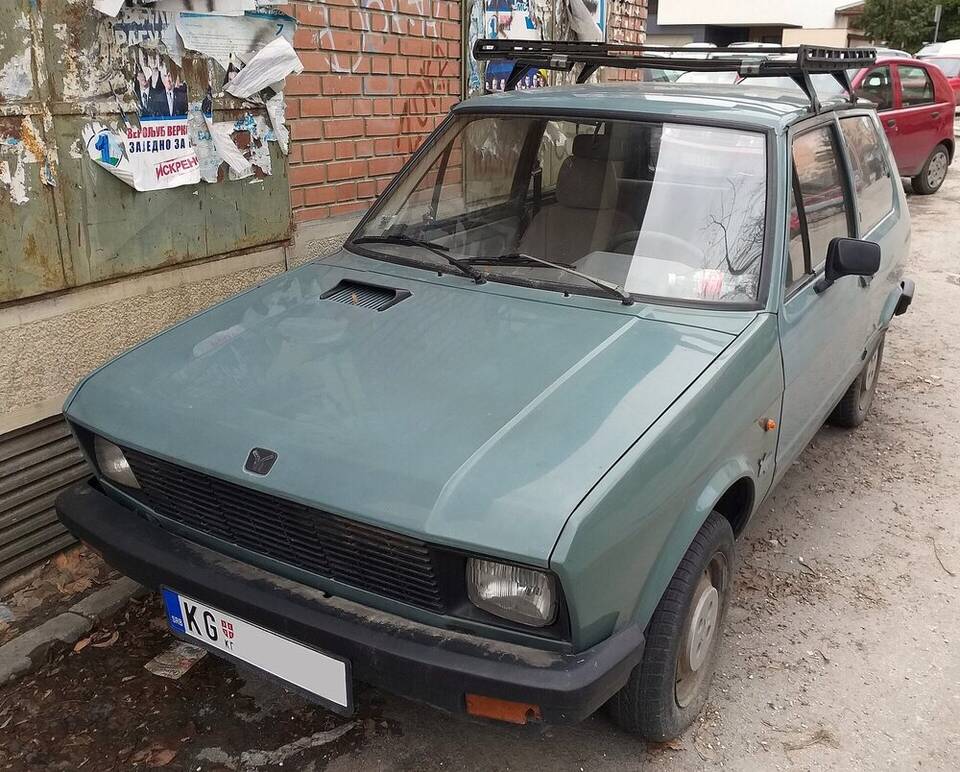
1985 Zastava Jugo 45 · KGC626 · CC BY-SA 4.0
Research pending
A matching completed auction sale has not been verified for this exact year, body, trim, engine, transmission and market.
Joyride shows this gap instead of substituting an asking price, unsold bid or mismatched special vehicle.
More than a set of wheels.
Zastava developed the car in Kragujevac under the project name 102, using Fiat engineering as a starting point but giving the hatchback its own body. Series production began in 1980. By 1985 the car appeared at home as Jugo 45 and in export markets as Yugo 45; it should not be confused with the 1.1-liter American Yugo GV that arrived in the United States that year.
Look a little closer.
The number 45 was not the engine size. It told shoppers the car's approximate metric-horsepower rating; later 55 and 65 versions followed the same naming idea.
Photos show an example of the model or generation. The pictured vehicle’s year, equipment, or modifications can differ from the specification described here.
Jugo at home, Yugo abroad
The domestic spelling Jugo reflected the Serbo-Croatian name, while export material commonly used Yugo. The exact 1985 Yugoslav car here keeps its 903 cc engine and four-speed gearbox. It is not the U.S.-market GV, whose larger 1.1-liter engine and North American safety/emissions changes make it a different variant.
Source: FIA Historic Database — Zastava Yugo 45 ↗Simple engine, very small footprint
Period export-brochure text describes a transverse, water-cooled 903 cc four-cylinder with a 65 mm bore, 68 mm stroke, 9.0:1 compression ratio, cast-iron block, aluminium cylinder head and carburetor. The four-speed manual and front-wheel drive kept the package short. Because the surviving scan is an independently hosted brochure copy, Joyride treats it as period evidence rather than a live factory database.
Source: Yugo Range 1985 brochure scan ↗A manual choke among simple cabin controls
The period Zastava 45/55 service manual labels a separate choke control alongside the bonnet release, gear lever, handbrake and heating controls. The choke gave the driver a direct control for cold starting the carbureted engine. This is a reading of the manufacturer's shared 45/55 manual, publication 603.01.151, marked XII/84, preserved in an independently uploaded scan. It explains the period control scheme, not every switch fitted to a particular 1985 Jugo 45; the scan's damaged text does not justify transferring later Koral or U.S. GV equipment to this car.
Source: Zastava 45/55 service manual, 603.01.151, XII/84 — cabin-control legend (independent scan) ↗A car from an industrial network
The Jugo was built at Zastava's Kragujevac plant, but its production depended on suppliers across Yugoslavia. That made it more than a cheap hatchback: it was also a product of a federation-wide manufacturing system. The precise 1985 technical profile stays with the base 45 rather than later 55, 65, Koral or fuel-injected versions.
Source: iKragujevac — anniversary history of Jugo production ↗Where these facts come from
- FIA Historic Database — Zastava Yugo 45
- Yugo Range 1985 brochure scan
- Automobile-Catalog — 1985 Yugo 45 specification
- iKragujevac — anniversary history of Jugo production
Selected facts checked for this edition. Some source pages link to broader model families. Last reviewed September 30, 2026.