
Citroën XM V6
The XM used electronic sensors to help its gas-and-fluid suspension choose a softer or firmer setting. Citroën’s heritage accounts describe different sensing and adjustment times; they are not a measured whole-car response guarantee.
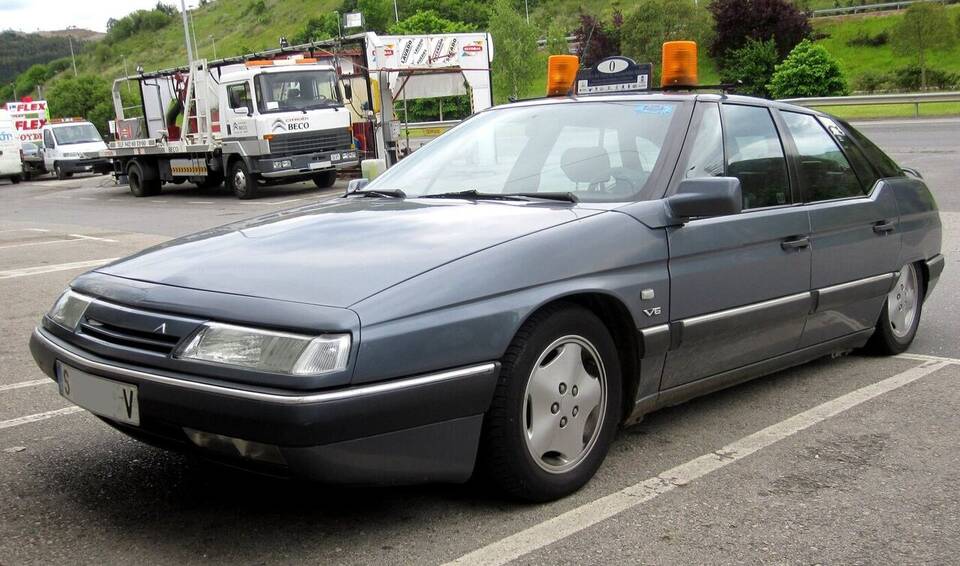
1990 Citroën XM V6 (4601376671).jpg · Spanish Coches · CC BY 2.0
Research pending
A matching completed auction sale has not been verified for this exact year, body, trim, engine, transmission and market.
Joyride shows this gap instead of substituting an asking price, unsold bid or mismatched special vehicle.
More than a set of wheels.
Citroën launched the XM in May 1989 as its CX successor. Bertone's long, faceted hatchback hid Hydractive suspension that combined high-pressure hydraulics with electronic sensing. The first-series Y3 ran to July 1994. This page follows the original manual V6 rather than combining it with later 24-valve, facelift or automatic specifications.
Look a little closer.
A second pane of glass behind the rear seats acted like a thirteenth window, keeping cold air and luggage smells out of the cabin when the hatch opened.
Photos show an example of the model or generation. The pictured vehicle’s year, equipment, or modifications can differ from the specification described here.
Hydraulics learned to make decisions
XM added electronic control to gas-and-fluid suspension. Citroën’s German retrospective describes sensor-based setting selection in about one millisecond; its Italian account describes stiffness adjustment in Auto mode in under 0.05 seconds. These accounts do not establish an identical measurement boundary, so neither timing is presented as a guaranteed complete mechanical response.
Source: Citroën/Stellantis · XM electronically controlled suspension history ↗V6 figures with their source limits
Citroën’s 2019 Italian retrospective describes the two-valve-per-cylinder ZPJ V6 at 170 metric horsepower and distinguishes it from the four-valve ZPJ4. The existing catalogue citation reports 123 kW / 167 PS / 165 hp, but the reason for its difference from 170 is unresolved. Do not assume simple unit conversion or identical market, emissions and rating conditions; an exact period specification is still needed.
Source: Citroën/Stellantis · XM: 30 anni di innovazioni (2019 retrospective) ↗Where these facts come from
- Citroën/Stellantis · XM electronically controlled suspension history
- Citroën Origins · XM
- Citroën/Stellantis · XM: 30 anni di innovazioni (2019 retrospective)
- Automobile-Catalog · 1989 XM V6 manual
Selected facts checked for this edition. Some source pages link to broader model families. Last reviewed October 1, 2026.