
Toyota Aristo 3.0V
Toyota's first Aristo wrapped a powerful twin-turbo inline-six in a roomy four-door luxury sedan. This page follows the Japanese launch 3.0V, model E-JZS147-BEPVZ, rather than the naturally aspirated 3.0Q, the four-wheel-drive V8 added in 1992, or the later Lexus GS sold in North America.
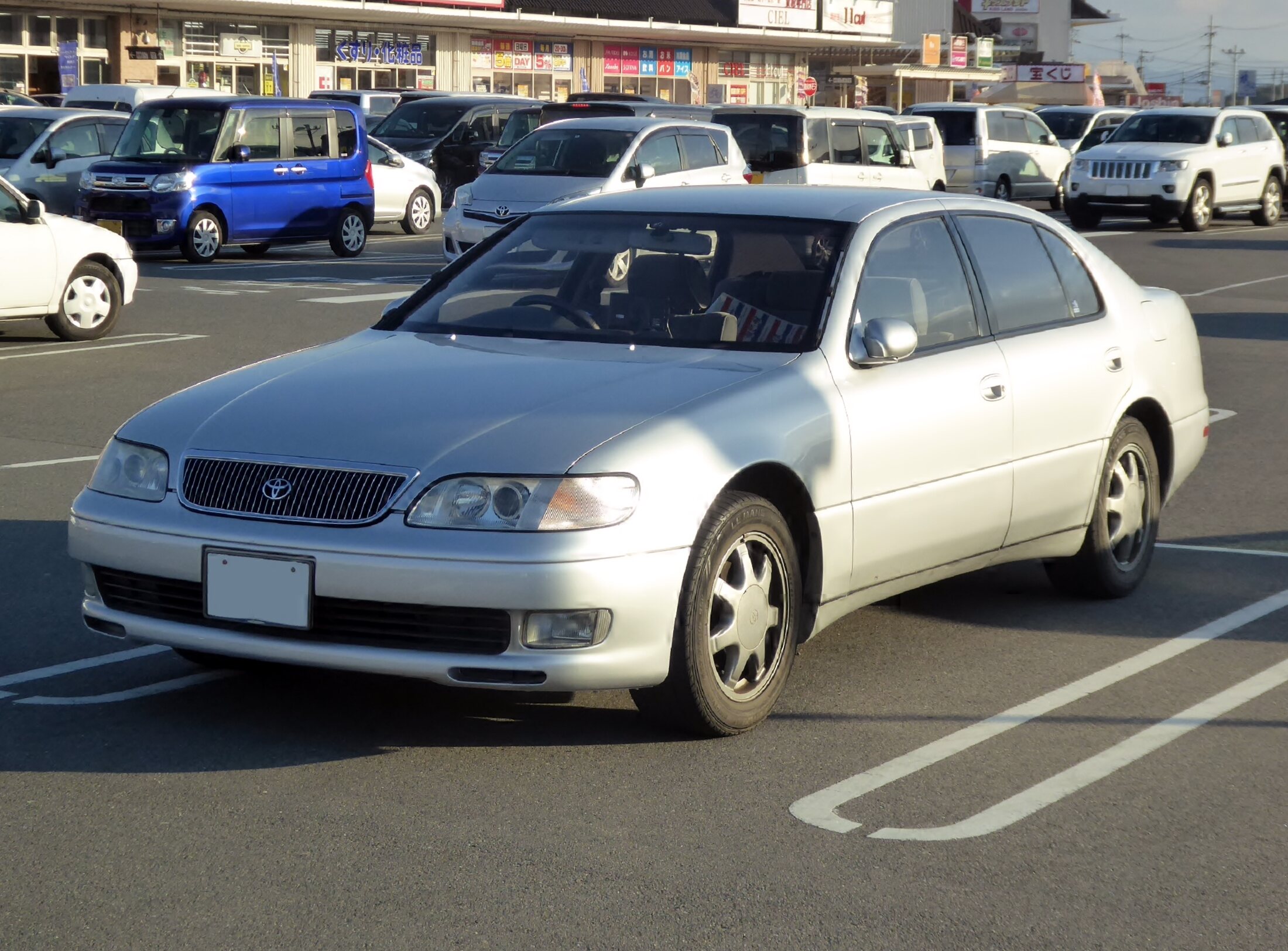
Toyota Aristo 3.0V JZS147 front three-quarter · Tokumeigakarinoaoshima · CC BY-SA 4.0
Research pending
A matching completed auction sale has not been verified for this exact year, body, trim, engine, transmission and market.
Joyride shows this gap instead of substituting an asking price, unsold bid or mismatched special vehicle.
More than a set of wheels.
Toyota announced the new Aristo on October 11, 1991 and began Japanese sales on October 31. Italdesign's prototype supplied the starting shape, which Toyota refined into a wedge-profile sedan with a large cabin. The 3.0V combined Toyota's new 2JZ-GTE engine, standard Piezo TEMS adaptive damping and traction control; the Torsen limited-slip differential was optional, not standard.
Look a little closer.
Aristo comes from a Greek-rooted word meaning best. Toyota later sold the same broad first-generation family in North America as the Lexus GS, but that export identity began in 1993 and does not replace this Japanese 1991 3.0V specification.
Photos show an example of the model or generation. The pictured vehicle’s year, equipment, or modifications can differ from the specification described here.
3.0V and 3.0Q are different cars under the skin
Both launch grades used 2,997 cc inline-six engines, but the 3.0V received the twin-turbo 2JZ-GTE rated at 280 PS. The 3.0Q used the naturally aspirated 2JZ-GE rated at 230 PS. Keeping the grade in the profile title prevents the shared body and displacement from hiding a major powertrain difference.
Source: Toyota launch release · Aristo debuts ↗Sequential turbos, optional differential
Toyota described a two-way twin-turbo system: one ceramic turbocharger operates at low speed and both work at medium and high speed. Traction control was standard on the 3.0V, but Toyota separately listed the Torsen limited-slip differential as an option, so it must not be presented as equipment on every car.
Source: Toyota launch release · Aristo characteristics ↗Where these facts come from
- Toyota launch release · Aristo debuts
- Toyota 75 Years · first-generation Aristo
- Toyota GAZOO catalog · 1991 Aristo 3.0V
Selected facts checked for this edition. Some source pages link to broader model families. Last reviewed 2026-10-06.