
Renault Clio Williams
Blue paint and gold wheels announced a 2.0-litre engine, wider stance and rally-minded chassis tuning.
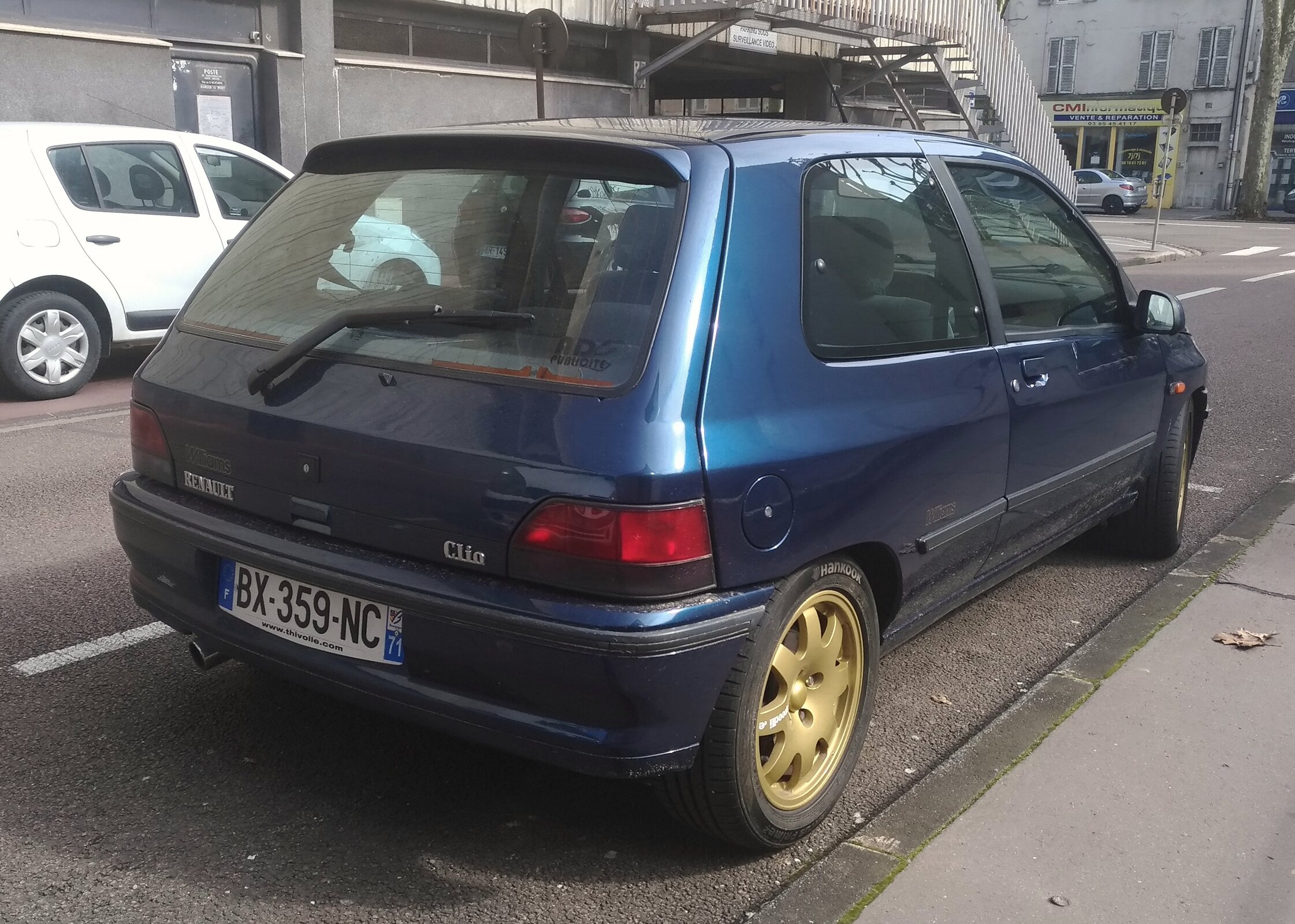
1993 Renault Clio Williams · Guillaume Vachey / Crash71100 · CC0 1.0
Research pending
A matching completed auction sale has not been verified for this exact year, body, trim, engine, transmission and market.
Joyride shows this gap instead of substituting an asking price, unsold bid or mismatched special vehicle.
More than a set of wheels.
Renault introduced the Clio Williams in 1993, naming it after the Williams-Renault Formula One partnership while developing the road car through Renault Sport. The launch version combined a 2.0-litre F7R engine with a strengthened, widened chassis and its famous Sport Blue and gold-wheel appearance. The original 1993 cars were numbered before later Williams 2 and Williams 3 versions followed.
Look a little closer.
The Williams name celebrated Renault's Formula One partnership, but Renault Sport developed the production hatchback.
Photos show an example of the model or generation. The pictured vehicle’s year, equipment, or modifications can differ from the specification described here.
A Formula One name on a rally-shaped hatch
The badge celebrated Renault's Williams Formula One partnership, but the road car was developed by Renault Sport around rally homologation needs. The name supplied glamour; the wider, tougher small hatch supplied the substance.
Source: Renault Group · the Clio story ↗Why the 2.0 mattered
Compared with the earlier 1.8-litre Clio 16S, the 2.0-litre F7R added torque as well as a 150-PS headline. In a light hatchback, that broader shove is as useful as peak power.
Source: Automobile-Catalog · 1993 Clio Williams ↗Where these facts come from
Selected facts checked for this edition. Some source pages link to broader model families. Last reviewed October 3, 2026.