
Toyota Progrès NC300
Toyota packed big-car quietness and craftsmanship into a sedan only 4.5 metres long.
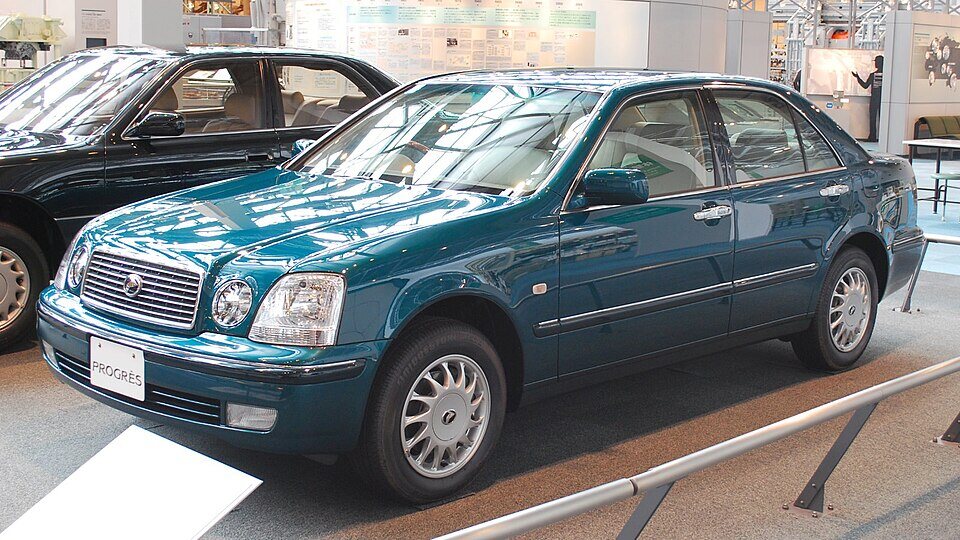
Early-series Toyota Progrès representative · Mytho88 · CC BY-SA 3.0
Research pending
A matching completed auction sale has not been verified for this exact year, body, trim, engine, transmission and market.
Joyride shows this gap instead of substituting an asking price, unsold bid or mismatched special vehicle.
More than a set of wheels.
The Progrès arrived in Japan in May 1998 with the idea of a 'small luxury car.' It shared its basic platform with much larger Toyota sedans, but its body was about 300 mm shorter than a contemporary Crown. This profile follows the original three-litre NC300, before direct fuel injection replaced its 2JZ-GE engine.
Look a little closer.
Progrès is a French word meaning progress.
Photos show an example of the model or generation. The pictured vehicle’s year, equipment, or modifications can differ from the specification described here.
Luxury measured by space and calm, not bulk
A long 2,780 mm wheelbase left useful cabin room inside the compact outside dimensions. Toyota's historical account says its quietness and ride comfort could stand beside larger luxury cars, while four-wheel double-wishbone suspension controlled the wheels.
Source: Toyota 75 Years · Progrès vehicle lineage ↗A compact car used as a safety showcase
The first Progrès introduced curtain shield airbags intended to reduce head injury in a side impact. Toyota also used it to introduce Navi AI-Shift in Japan, allowing an automatic transmission to use navigation-map information when choosing a gear.
Source: Toyota 75 Years · ABS and airbag development ↗Where these facts come from
- Toyota 75 Years · Progrès vehicle lineage
- Toyota Certified Used Cars · May 1998 Progrès NC300 specifications
- Toyota 75 Years · ABS and airbag development
- Toyota · original Progrès launch release scan
Selected facts checked for this edition. Some source pages link to broader model families. Last reviewed September 30, 2026.