
Honda Insight
Honda's first production hybrid paired a featherweight aluminum body with a tiny engine and a slim electric helper motor.
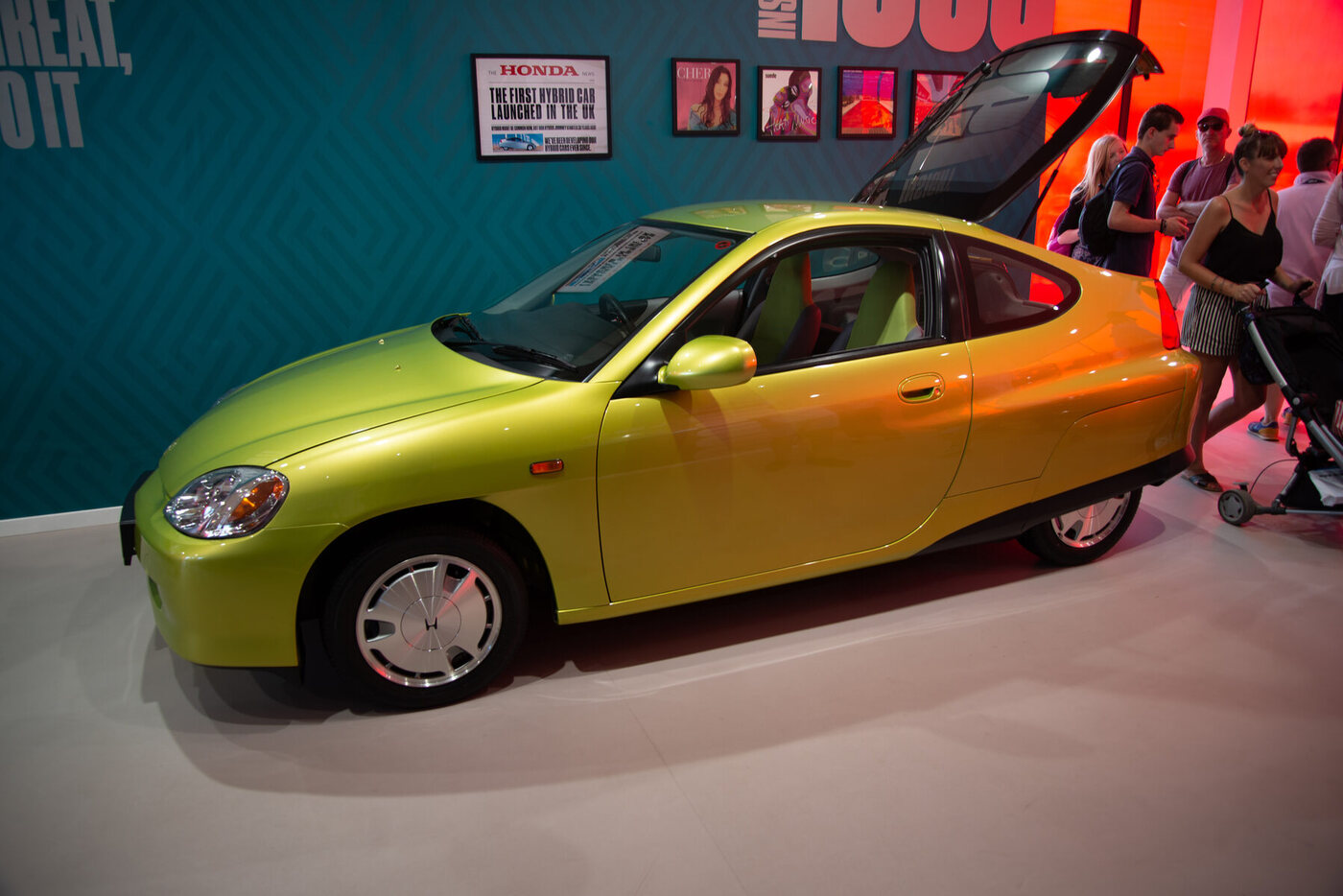
1999 Honda Insight ZE1 museum display · Irmantas Baltrusaitis · CC BY-SA 4.0
Research pending
A matching completed auction sale has not been verified for this exact year, body, trim, engine, transmission and market.
Joyride shows this gap instead of substituting an asking price, unsold bid or mismatched special vehicle.
More than a set of wheels.
Honda introduced the Insight in Japan on November 1, 1999 as a two-seat personal hybrid. The Japanese launch car offered both a five-speed manual and a Honda Multi-Matic S continuously variable transmission; this page follows the lighter 820 kg manual. It is separate from Joyride's 2000 U.S.-market Insight, whose model-year, certification and EPA figures differ.
Look a little closer.
The rear wheels are partly covered because smooth airflow mattered so much that even the tires were developed to cut rolling resistance by roughly 40 percent.
Photos show an example of the model or generation. The pictured vehicle’s year, equipment, or modifications can differ from the specification described here.
The Japanese launch offered two gearboxes
The five-speed manual achieved 35.0 km/L in Japan's 10–15 test and weighed 820 kg. The Multi-Matic S CVT version returned 32.0 km/L and weighed 850 kg, so Joyride labels the manual instead of blending both figures.
Source: Honda · 1999 Insight fact book specifications ↗Lightness was a system, not one material
Honda used aluminum extrusions and castings for the structure, aluminum and plastic outer panels, a 20 kg battery assembly and low-rolling-resistance tires. The steel-body comparison was about 40 percent heavier, showing how the hybrid system and body were designed together.
Source: Honda · ultra-low-consumption technology release ↗Where these facts come from
- Honda · 1999 Japanese Insight launch
- Honda · 1999 Insight fact book specifications
- Honda · ultra-low-consumption technology release
Selected facts checked for this edition. Some source pages link to broader model families. Last reviewed September 30, 2026.