
Bugatti Veyron 16.4
The Veyron joined sixteen cylinders, four turbochargers and four driven wheels in one road car. A seven-speed twin-clutch gearbox changed gears in under 150 milliseconds while active aerodynamics reshaped the car for speed or braking.
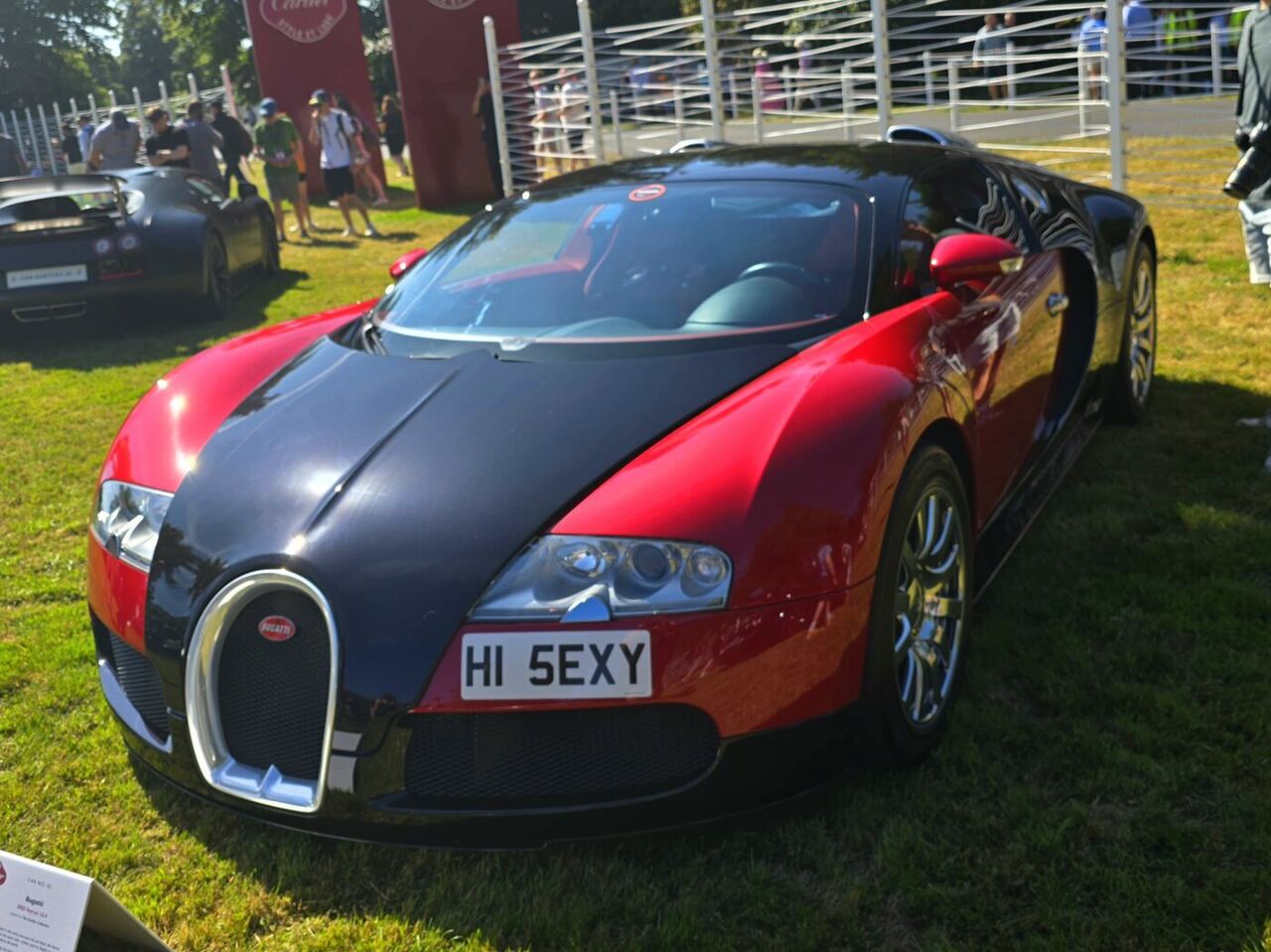
2005 Bugatti Veyron 16.4 cover · Calreyn88 · CC BY-SA 4.0
Research pending
A matching completed auction sale has not been verified for this exact year, body, trim, engine, transmission and market.
Joyride shows this gap instead of substituting an asking price, unsold bid or mismatched special vehicle.
More than a set of wheels.
Bugatti began series production of the Veyron 16.4 in 2005 after years of solving problems that no normal road car faced. The target was not only 1,001 PS but stability beyond 400 km/h, cooling for the immense engine and brakes that could repeatedly slow the car. A production-intent Veyron passed 400 km/h on April 29, 2005; production started in September. This profile is the original 1,001-PS closed car, before the open Grand Sport and 1,200-PS Super Sport.
Look a little closer.
To enter the highest-speed mode, the driver used a separate Speed Key; the car then lowered itself, reduced rear-wing angle and closed diffuser flaps after a safety check.
Photos show an example of the model or generation. The pictured vehicle’s year, equipment, or modifications can differ from the specification described here.
Two keys for two speed worlds
The Veyron did not allow its 407 km/h configuration through the normal ignition key alone. A separate Speed Key selected a low-drag setup after the driver checked conditions: ride height dropped, the wing moved to two degrees and diffuser flaps closed. Above 220 km/h in normal running, active aerodynamics already adjusted the body for stability.
Source: Bugatti Newsroom — 407 km/h: A Milestone in Automotive History ↗Stopping was an aerodynamic event
Under hard braking at very high speed, the rear wing could swing to a 113-degree angle in 0.4 seconds and act as an airbrake. Carbon-ceramic brakes and dedicated cooling did the rest. Bugatti reported a 60-mph-to-zero distance of 31.4 metres in 2.3 seconds, a manufacturer result with its own conditions rather than a universal promise.
Source: Bugatti Newsroom — Final Bugatti Veyron 16.4 sold ↗The cooling problem behind the headline
Making 1,001 PS was only useful if the car could survive it. Bugatti had to manage heat from four turbochargers, charge air, engine oil, transmission and differentials while keeping the cabin usable. The many inlets and radiators are therefore part of the powertrain, not decorative openings.
Source: Bugatti Newsroom — Engineering genius behind the Veyron ↗Where these facts come from
- Bugatti Newsroom — Final Bugatti Veyron 16.4 sold
- Bugatti Newsroom — 407 km/h: A Milestone in Automotive History
- Bugatti Newsroom — Veyron on the track of the Targa Florio
- Bugatti Newsroom — A Safe Bet for a World Record
- Bugatti Newsroom — Engineering genius behind the Veyron
Selected facts checked for this edition. Some source pages link to broader model families. Last reviewed October 1, 2026.