
Renault Clio IV Dynamique ENERGY TCe 90
The 2012 Clio IV ENERGY TCe 90 put Renault's first production three-cylinder engine into a practical five-door hatchback, pairing a tiny turbocharged engine with stop-start and energy-recovery technology.
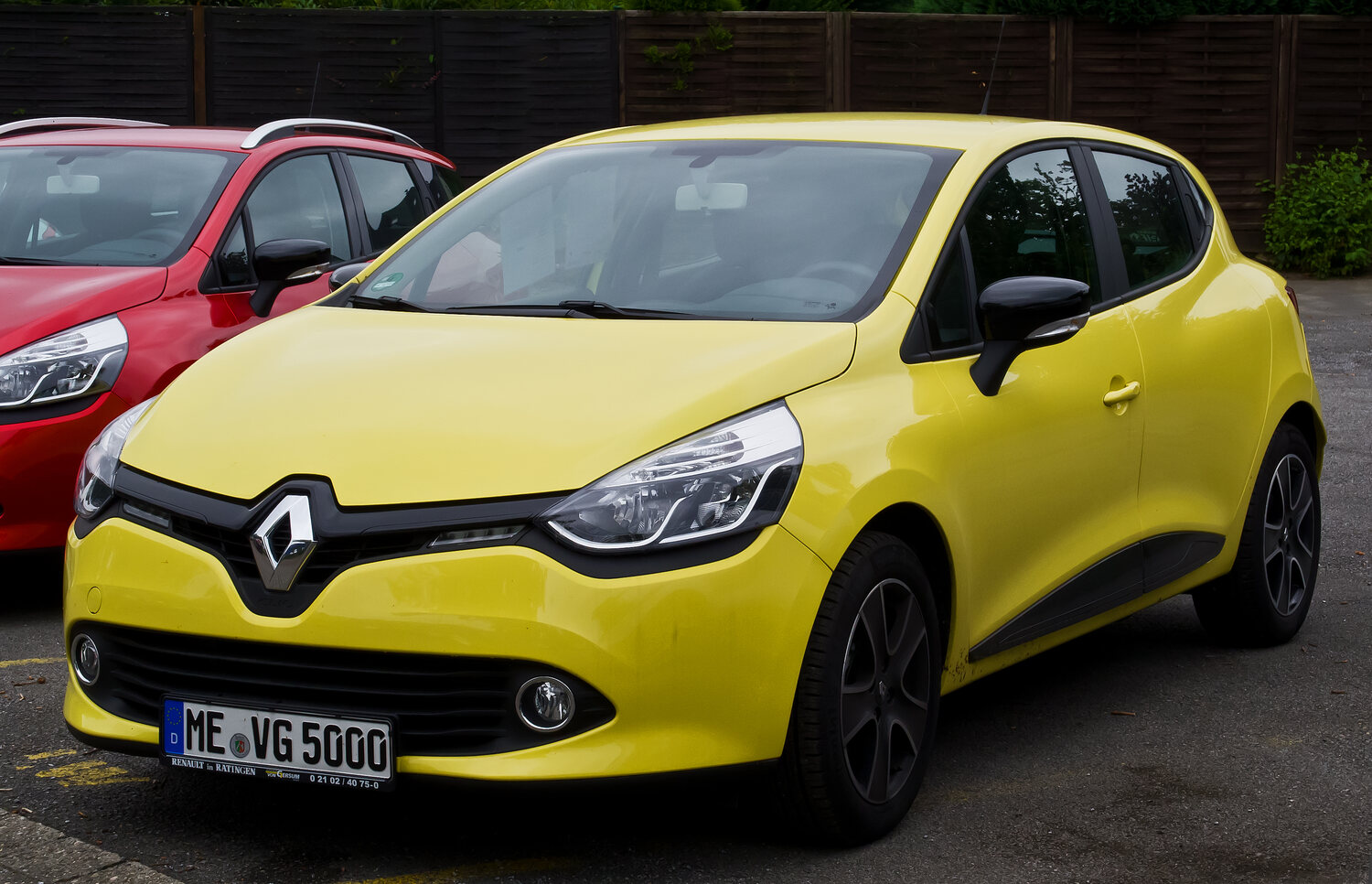
Renault Clio IV Dynamique ENERGY TCe 90 · M 93 · CC BY-SA 3.0 DE
Research pending
A matching completed auction sale has not been verified for this exact year, body, trim, engine, transmission and market.
Joyride shows this gap instead of substituting an asking price, unsold bid or mismatched special vehicle.
More than a set of wheels.
Renault introduced the fourth-generation Clio in 2012 as a five-door-only hatchback at launch. This page follows the Irish-market Dynamique specification in Renault Ireland's October 2012 brochure: an 898 cc ENERGY TCe 90 petrol engine, five-speed manual gearbox and front-wheel drive. The cover is a later 2014 German Dynamique ENERGY TCe 90, so it supports the visible generation, trim and powertrain family but not Irish-market equipment or a 2012 build date.
Look a little closer.
The exact-trim photograph shows a Clio IV Dynamique ENERGY TCe 90 Start & Stop eco² registered in Germany in 2014. It is a strong visible match for the launch-body trim and engine family, but it does not prove Irish-market equipment, a 2012 build, hidden mechanical condition or laboratory fuel economy.
Photos show an example of the model or generation. The pictured vehicle’s year, equipment, or modifications can differ from the specification described here.
How a tiny engine acts bigger
Renault combined a low-inertia turbocharger with variable valve timing so the 898 cc three-cylinder could build useful pulling force without waiting for very high engine speed. The company quoted 135 Nm at 2,500 rpm and said friction was 20 percent lower than in an equivalent four-cylinder architecture. Those features explain the engineering idea; they do not guarantee a particular driver's real-world acceleration or economy.
Source: Renault Group · ENERGY TCe 90, Renault's first three-cylinder engine ↗Efficiency was a team effort
The engine worked with stop-start, braking-energy recovery, thermal management and a variable-capacity oil pump. Renault Ireland's launch brochure recorded 4.5 L/100 km and 105 g/km CO2 on the period NEDC laboratory cycle for this specification. Those are standardized comparison results, not a promise of what every journey will use.
Source: Renault Ireland · The New Clio brochure, October 2012 ↗Where these facts come from
- Renault Ireland · The New Clio brochure, October 2012
- Renault Group · ENERGY TCe 90, Renault's first three-cylinder engine
- Renault Germany · New Clio launch and five-door body
Selected facts checked for this edition. Some source pages link to broader model families. Last reviewed 2026-10-07.