
Jaguar I-PACE
The I-PACE EV400 was Jaguar's first production electric car. Two compact motors gave it all-wheel drive, while the low 90 kWh battery helped this five-seat crossover feel more like a sporty Jaguar than a tall utility box.
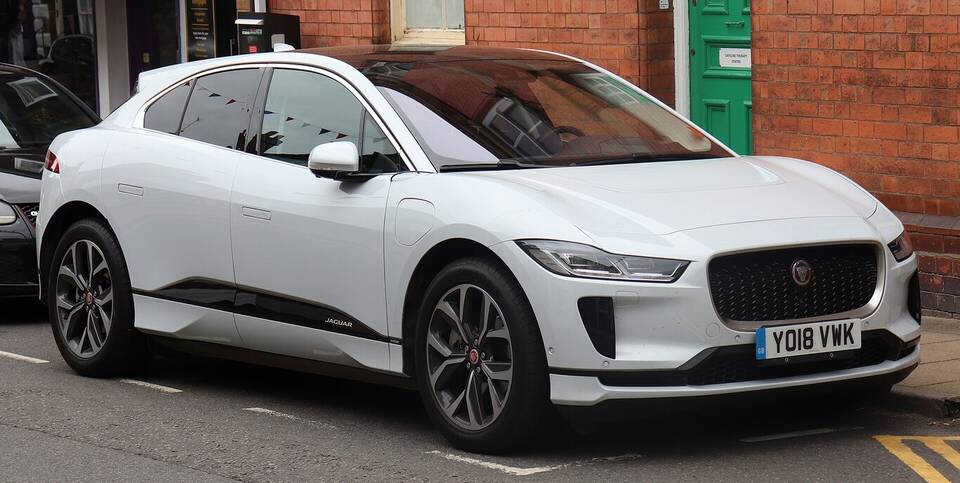
2018 Jaguar I-PACE EV400 AWD · Vauxford · CC BY-SA 4.0
Research pending
A matching completed auction sale has not been verified for this exact year, body, trim, engine, transmission and market.
Joyride shows this gap instead of substituting an asking price, unsold bid or mismatched special vehicle.
More than a set of wheels.
Jaguar opened orders in March 2018 after engineering the I-PACE in Britain and arranging production at Magna Steyr in Austria. It combined quick acceleration with useful family space and a cab-forward shape. The company quoted 470 km on the newer WLTP laboratory cycle, not as a promise that every real trip would travel that far.
Look a little closer.
Jaguar tested development cars as cold as −40°C and used a heat pump to reduce the electricity needed for cabin warmth in freezing weather.
Photos show an example of the model or generation. The pictured vehicle’s year, equipment, or modifications can differ from the specification described here.
Fast and spacious were designed together
The launch specification combined 400 PS and 696 N·m with five seats, 890 mm of rear legroom and 656 liters of cargo space. Jaguar claimed 0–100 km/h in 4.8 seconds. Those figures explain the I-PACE idea: electric performance without giving up a useful rear seat or hatchback cargo bay.
Source: Jaguar Media — Jaguar charges ahead with new all-electric I-PACE ↗What is inside each drive unit
Jaguar designed two permanent-magnet synchronous motors, each wrapped around a single-speed epicyclic transmission and differential. Double-wishbone front suspension, integral-link rear suspension, 50:50 weight distribution and the battery's low position were meant to keep the tall car controlled. Regeneration could provide up to 0.4 g of slowing before the friction brakes were needed.
Source: Jaguar Media — I-PACE: the art of electric performance ↗Charging claims have conditions
At launch Jaguar said a 100 kW DC charger could take the battery from 0 to 80 percent in about 40 minutes, while a 7 kW AC wall box needed just over ten hours to reach 80 percent. Those are manufacturer figures under suitable charging conditions; temperature, charger power and the battery's starting state can change the result.
Source: Jaguar Media — Jaguar charges ahead with new all-electric I-PACE ↗Where these facts come from
- Jaguar Media — Jaguar charges ahead with new all-electric I-PACE
- Jaguar Media — I-PACE: the art of electric performance
Selected facts checked for this edition. Some source pages link to broader model families. Last reviewed September 30, 2026.