
Honda Dream CB72 Super Sport
Honda turned race-developed high revs into a 250 that could commute, tour and thrill—then tuned the crank differently for Japan and America.
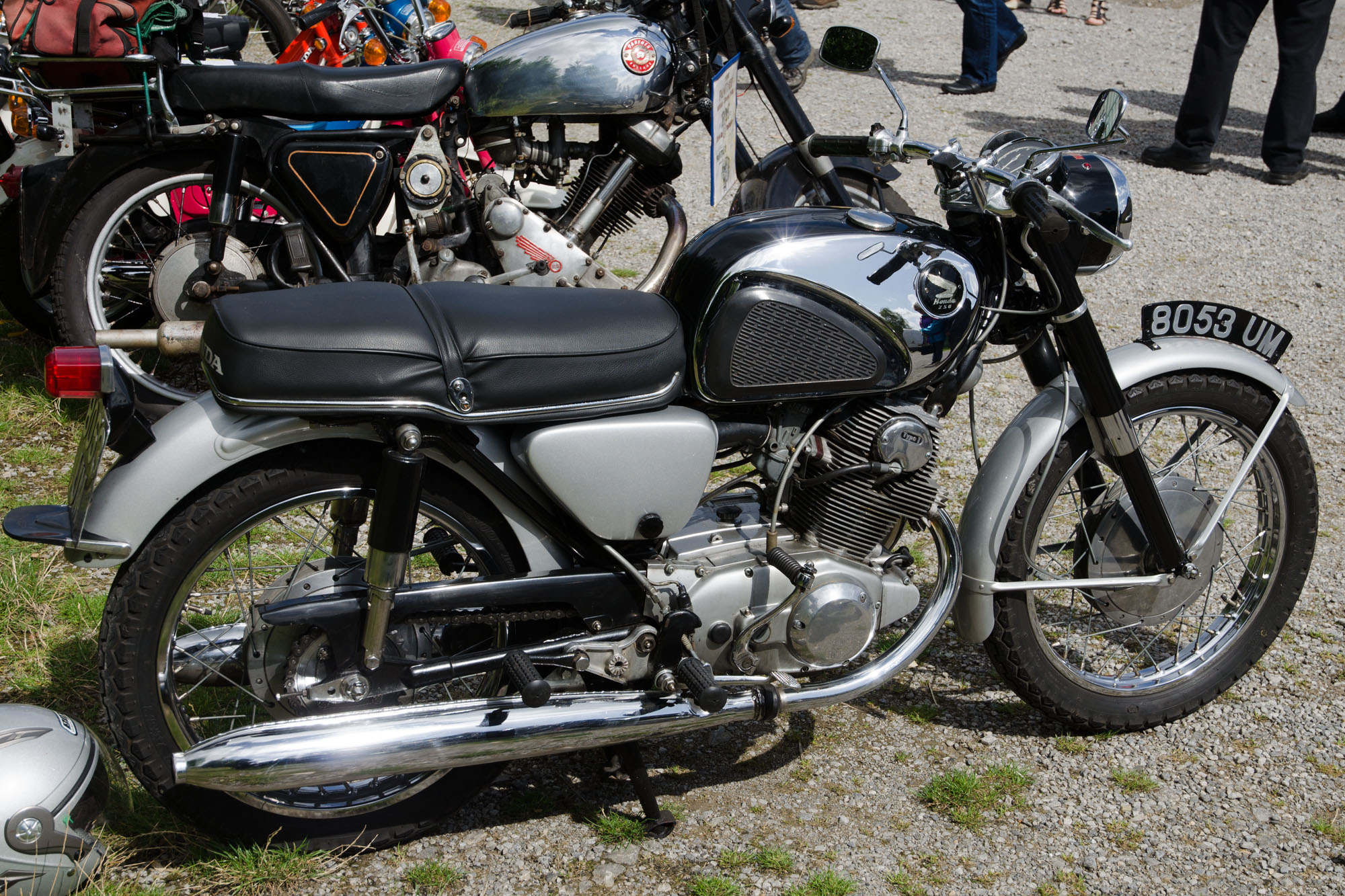
Honda CB72 250cc (1961).jpg · SG2012 · CC BY 2.0
Research pending
A matching completed auction sale has not been verified for this exact year, body, trim, engine, transmission and market.
Joyride shows this gap instead of substituting an asking price, unsold bid or mismatched special vehicle.
More than a set of wheels.
American Honda asked for a stronger high-speed sports machine, while Japanese riders were buying lively two-strokes. Honda answered with the Dream CB72 Super Sport, drawing on handling and high-rpm lessons from Mount Asama and the Isle of Man TT. The bike appeared at the All Japan Motor Show in October 1960 and entered mass production in November. Japan received a 360-degree-crank version shaped for low- and mid-range response; the later U.S. Hawk 250 used a smoother high-revving 180-degree crank. That market-specific engineering is central to the CB72 story.
Look a little closer.
Its speedometer and tachometer sat side by side with needles that swept in opposite directions.
Photos show an example of the model or generation. The pictured vehicle’s year, equipment, or modifications can differ from the specification described here.
One model, two crankshaft personalities
Honda deliberately did not give every CB72 the same firing arrangement. The Japanese 360-degree crank made the motorcycle easier to use and stronger through low and middle engine speeds, while the U.S. 180-degree crank reduced vibration and encouraged high-rpm running. A specification that looks like a small internal detail therefore reveals how Honda tuned one global model for different roads and buyers.
Source: Honda CB Stories · Honda's First 250cc Supersport Bike ↗The sports chassis mattered as much as the engine
Honda replaced the pressed-steel structure and leading-link fork of its more conservative Dreams with a stiffer tubular backbone and telescopic fork. A large twin-leading-shoe front drum, high footrests and a crouched riding position completed the transformation. Contemporary tests praised stability and cornering, showing that the CB72's importance was not just its 24 PS headline.
Source: Hagerty UK · Fast, Fine-Handling, and Stylish, the Honda CB72 Had It All ↗Where these facts come from
- Honda CB Stories · Honda's First 250cc Supersport Bike
- Honda · 1960 Dream CB72 Super Sport model page
- HondaGO · Dream CB72 Super Sport
- Hagerty UK · Fast, Fine-Handling, and Stylish, the Honda CB72 Had It All
Selected facts checked for this edition. Some source pages link to broader model families. Last reviewed October 2, 2026.