
Kawasaki H1 500 Mach III
Three two-stroke cylinders turned a $999 road bike into one of 1969's most startling production machines.
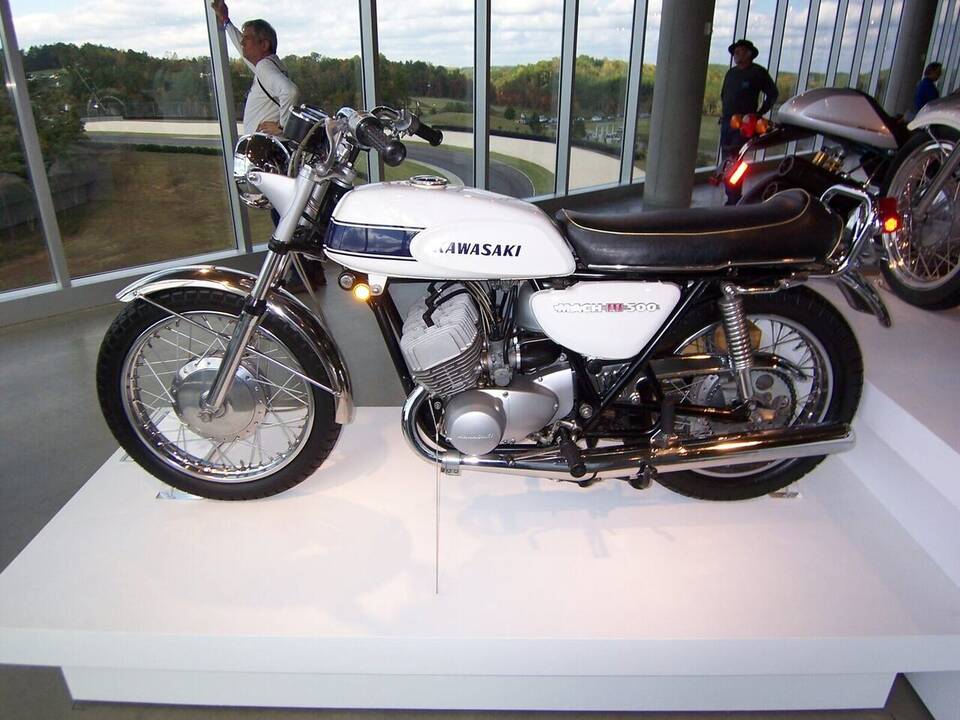
1969 Kawasaki 500 H1 Mach III museum motorcycle · Mike Schinkel · CC BY 2.0 Generic
Research pending
A matching completed auction sale has not been verified for this exact year, body, trim, engine, transmission and market.
Joyride shows this gap instead of substituting an asking price, unsold bid or mismatched special vehicle.
More than a set of wheels.
Kawasaki introduced the H1 500 Mach III in 1969 for the performance-hungry U.S. market. Its air-cooled triple made 60 bhp from about half a litre. This page stays with the original drum-brake H1; later H1 and KH500 versions gained changes including a front disc brake. The cover is documented as a 1969 H1, but its original sale market and restoration history are not stated.
Look a little closer.
At a Kawasaki press demonstration, development rider Tony Nicosia ran a 12.96-second quarter mile at 100.7 mph on a new production H1—the first recorded sub-13-second production-bike pass in Kawasaki's account.
Photos show an example of the model or generation. The pictured vehicle’s year, equipment, or modifications can differ from the specification described here.
Why three cylinders?
Kawasaki's engineers wanted more port area and smaller power pulses than a two-cylinder engine of the same size. The 1969 road test explained that the triple layout allowed a lighter clutch and transmission to carry the power.
Source: Cycle World · 1969 Kawasaki 500 Mach III road test ↗Electronic sparks at high speed
The contemporary test says the engine needed 500 precisely timed sparks per second at 10,000 rpm. Kawasaki therefore developed capacitive-discharge ignition producing 25,000 volts instead of relying on ordinary breaker points.
Source: Cycle World · 1969 Kawasaki 500 Mach III road test ↗Where these facts come from
- Kawasaki · The Legend of the Mach III
- Cycle World · 1969 Kawasaki 500 Mach III road test
- Kawasaki · 1969 H1 owner parts archive
Selected facts checked for this edition. Some source pages link to broader model families. Last reviewed September 29, 2026.