
Mazda 323 1.3
This compact hatchback looked modern but still used a driveshaft to push from the rear wheels.
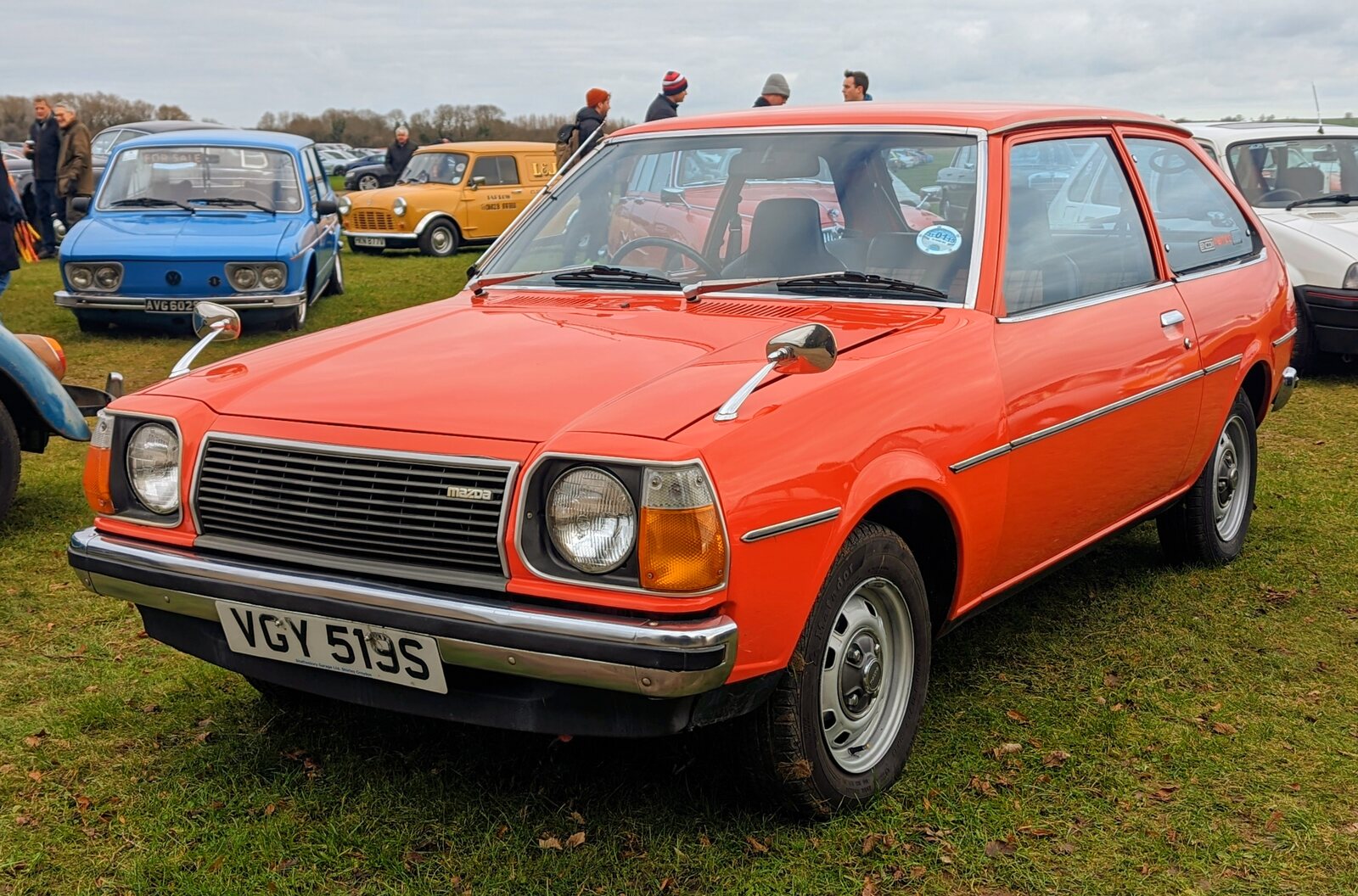
1978 Mazda 323 1300 DL three-door · Calreyn88 · CC BY 4.0
Research pending
A matching completed auction sale has not been verified for this exact year, body, trim, engine, transmission and market.
Joyride shows this gap instead of substituting an asking price, unsold bid or mismatched special vehicle.
More than a set of wheels.
Mazda's compact Familia became the 323 in Europe and the GLC in North America. This packet covers the 1978 German-market 323 1.3 three-door, but does not guess whether an individual car was ES, DL or GL. Unlike most small hatchbacks that followed, this generation kept its engine in front and sent power to the rear wheels.
Look a little closer.
The same family wore Familia, 323 and GLC badges in different markets.
Photos show an example of the model or generation. The pictured vehicle’s year, equipment, or modifications can differ from the specification described here.
One family, several names
Familia, 323 and GLC are not automatically three unrelated cars. Mazda used different badges to speak to different markets: the long-running Familia name in Japan, a simple number in Europe and the Great Little Car initials in North America. That makes market identity essential. A European 323 fact or photograph should not be silently presented as proof of every Japanese Familia or American GLC specification.
Source: Mazda 100th Anniversary Virtual Museum ↗A hatchback that pushed from behind
The 323 looked like the practical small hatchbacks that were spreading through Europe, yet this generation retained a front-engine, rear-wheel-drive layout. That meant a propshaft and rear axle occupied some of the space beneath the cabin. Later small cars often switched to front-wheel drive to package the cabin more efficiently, so this 1978 Mazda captures a short period when modern hatchback usefulness met older mechanical architecture.
Source: Mazda 100th Anniversary Virtual Museum ↗Where these facts come from
- Mazda Motor Corporation · January 1977 Familia AP/323 introduction
- Mazda Motor Corporation · generation, oil-crisis context and Familia/323/GLC naming
- Automobile-Catalog · exact 1978 Europe 1.3 three-door engine, output, torque, gearbox and driven wheels
- Automobile-Catalog · body dimensions and wheelbase
- August 1978 German Mazda 323 brochure record
Selected facts checked for this edition. Some source pages link to broader model families. Last reviewed October 4, 2026.