
Peugeot 104 Saloon
The little 104 squeezed four side doors, five usable seats and a full front-wheel-drive powertrain into what Peugeot called Europe's shortest four-door car.
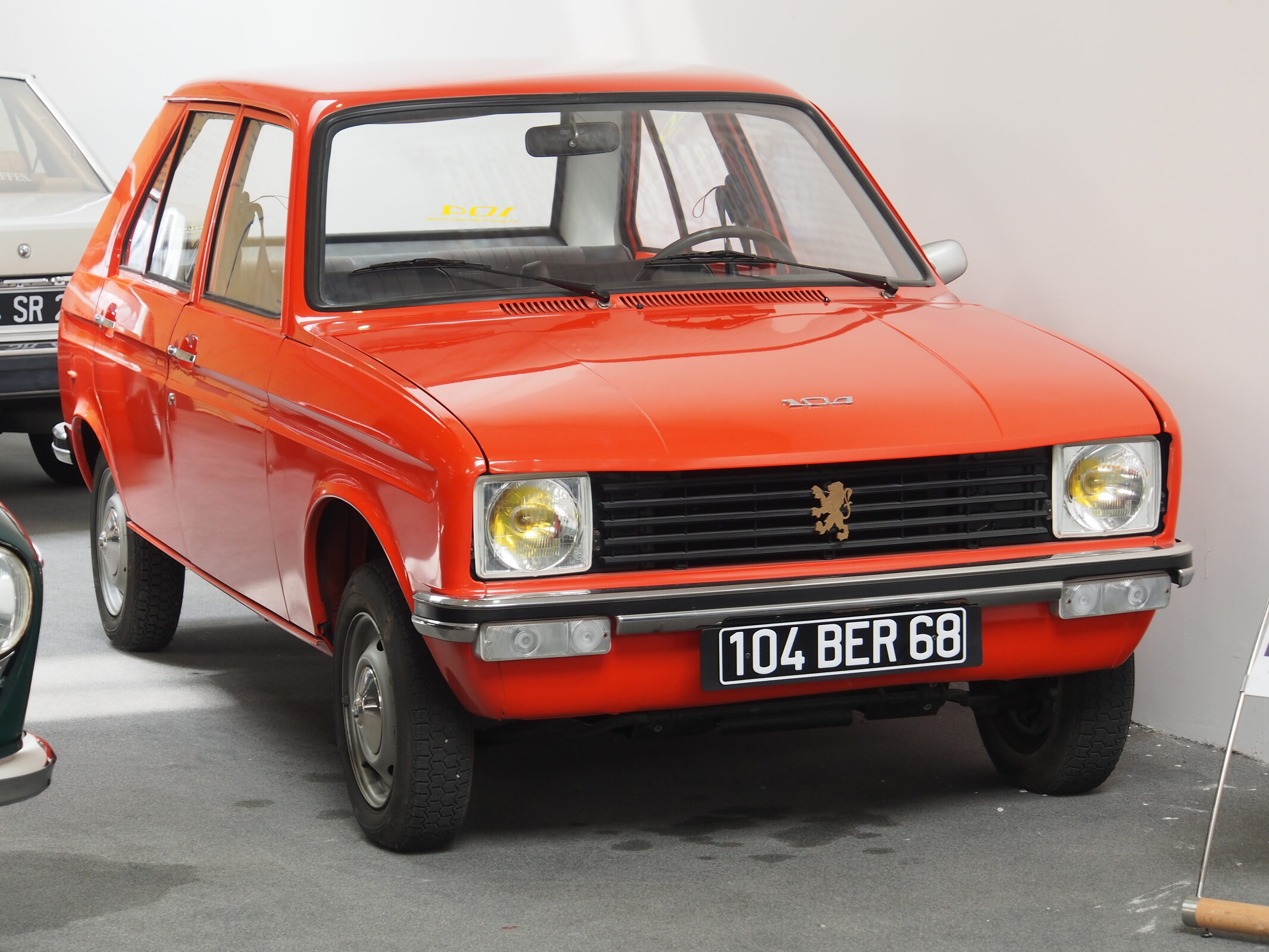
1972 Peugeot 104.jpg · Alf van Beem · CC0
Research pending
A matching completed auction sale has not been verified for this exact year, body, trim, engine, transmission and market.
Joyride shows this gap instead of substituting an asking price, unsold bid or mismatched special vehicle.
More than a set of wheels.
Peugeot launched the 104 in 1972 as the smallest model in its range. Its crisp Pininfarina-era shape looked like a hatchback, but the original four-door car had a separate luggage lid; the large rear hatch arrived later. A long wheelbase for its 3.58-meter length, a transverse lightweight engine and independent suspension made the cabin feel grown-up. More than 1.6 million 104s were built during a sixteen-year career.
Look a little closer.
The first 104 looked like a hatchback but was not one: lift the small lid and the rear window stayed in place.
Photos show an example of the model or generation. The pictured vehicle’s year, equipment, or modifications can differ from the specification described here.
A long cabin inside a very short car
At only 3.58 meters long, the 104 earned Peugeot's 'shortest four-door in Europe' claim. The wheels were pushed toward the corners and the 2.42-meter wheelbase was unusually generous for the footprint. That is the packaging trick: shorten the overhangs rather than the room between the axles.
Source: Stellantis Media · 40 years of Peugeot 104 ↗The engine leaned to make space
Peugeot's new light-alloy four-cylinder was mounted transversely and tilted 72 degrees toward the rear. That compact stack occupied less than the full nose height while a five-bearing crankshaft added durability. It was an engineering answer to a packaging question: how do you give a tiny car a low hood and a roomy passenger compartment at once?
Source: Stellantis Media · 40 years of Peugeot 104 ↗Where these facts come from
- Stellantis Media · 40 years of Peugeot 104
- Peugeot brand history · 1972 Peugeot 104
- Automobile-Catalog · 1972 Peugeot 104 L
Selected facts checked for this edition. Some source pages link to broader model families. Last reviewed October 1, 2026.