
Renault Juvaquatre AEB2
Renault’s first all-steel monocoque family car used less separate framework, independent front wheels and a compact one-litre engine.
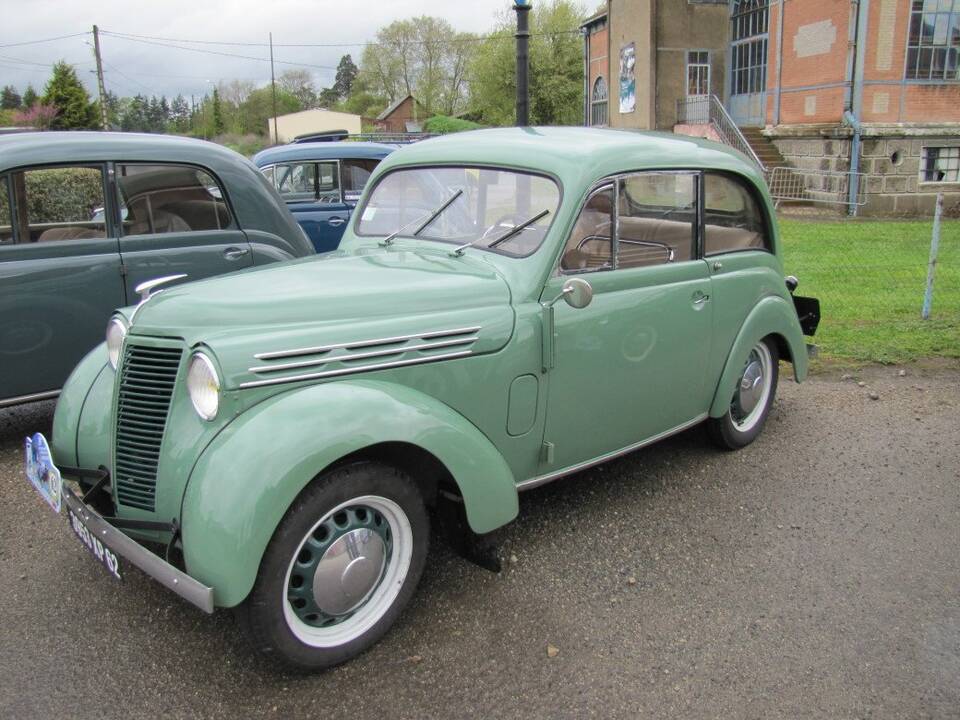
Coachaeb2.jpg · Marc Sliwowski · CC BY-SA 3.0
Research pending
A matching completed auction sale has not been verified for this exact year, body, trim, engine, transmission and market.
Joyride shows this gap instead of substituting an asking price, unsold bid or mismatched special vehicle.
More than a set of wheels.
Renault unveiled the Juvaquatre as a new 6 CV family car at the October 1937 Paris Motor Show and introduced the two-door coach in spring 1938. It was a structural turning point: instead of placing a body on a separate chassis, Renault welded an all-steel body into a load-carrying shell. The front wheels were independently suspended while the engine still drove the rear wheels. War interrupted passenger-car production, but the name returned after the war mainly on practical vans and estates, eventually becoming the Dauphinoise before production ended in 1960.
Look a little closer.
In March 1938 a Juvaquatre covered 5,380 km in 50 hours at Montlhéry, averaging 107.820 km/h including stops—faster than Renault’s listed 100 km/h production-car maximum because the record run had special conditions.
Photos show an example of the model or generation. The pictured vehicle’s year, equipment, or modifications can differ from the specification described here.
One name, several very different jobs
The 1938 AEB2 was a small family coach, but the long-lived Juvaquatre later became better known to many French tradespeople as a van and estate. The profile therefore fixes its identity to the first production two-door car instead of mixing twenty-two years of bodies and engines.
Source: The Originals Renault Museum · Juvaquatre AEB2 ↗Why monocoque construction mattered
A separate chassis carries loads like a ladder under the body. In a monocoque, the welded body shell shares that work. Renault used the change to reduce mass, increase rigidity and improve comfort, making it a manufacturing and driving milestone rather than just a new shape.
Source: The Originals Renault Museum · Juvaquatre AEB2 ↗Where these facts come from
- The Originals Renault Museum · Juvaquatre AEB2
- Losange Magazine · Renault Juvaquatre Break 1955 (model history)
Selected facts checked for this edition. Some source pages link to broader model families. Last reviewed October 1, 2026.