Choose your next drive.
Choose a year and version. Each car has its own performance calibration.
4 cars available · more are being prepared.
1987 Ferrari F40
European launch · 2.9 L twin-turbo V8 · five-speed manual
Keyboard: W/↑ throttle · S/↓/Space brake & reverse · A/D or ←/→ steer · C camera · P/Esc pause · T retry lap · R reset session
Performance, model and recording sources
Ferrari historical claims: 351.5 kW at 7,000 rpm, 324 km/h and 0–100 km/h in 4.1 s. Simulation mass is an estimated 1,250 kg running mass; Ferrari's quoted 1,100 kg is not treated as measured running weight. Braking uses an unverified 0.95 g estimate. Ferrari F40 historical specifications · Performance source
| Measure | Target | Simulation |
|---|---|---|
| 0–100 km/h | 4.1 s | 4.10 s |
| Top speed | 324.0 km/h | 324.0 km/h |
| 100–0 km/h | Estimate; no verified target | 41.4 m |
Power, mass, rolling resistance and aerodynamic drag govern acceleration. Launch force is calibrated to the stated target. Efficiency, gear bands, grip and torque delivery remain approximations; full engine curves, turbo response, tyre behaviour, fade and weather are still in development. Matching these straight-line targets does not validate complete vehicle dynamics. The tight practice oval cannot demonstrate maximum speed.
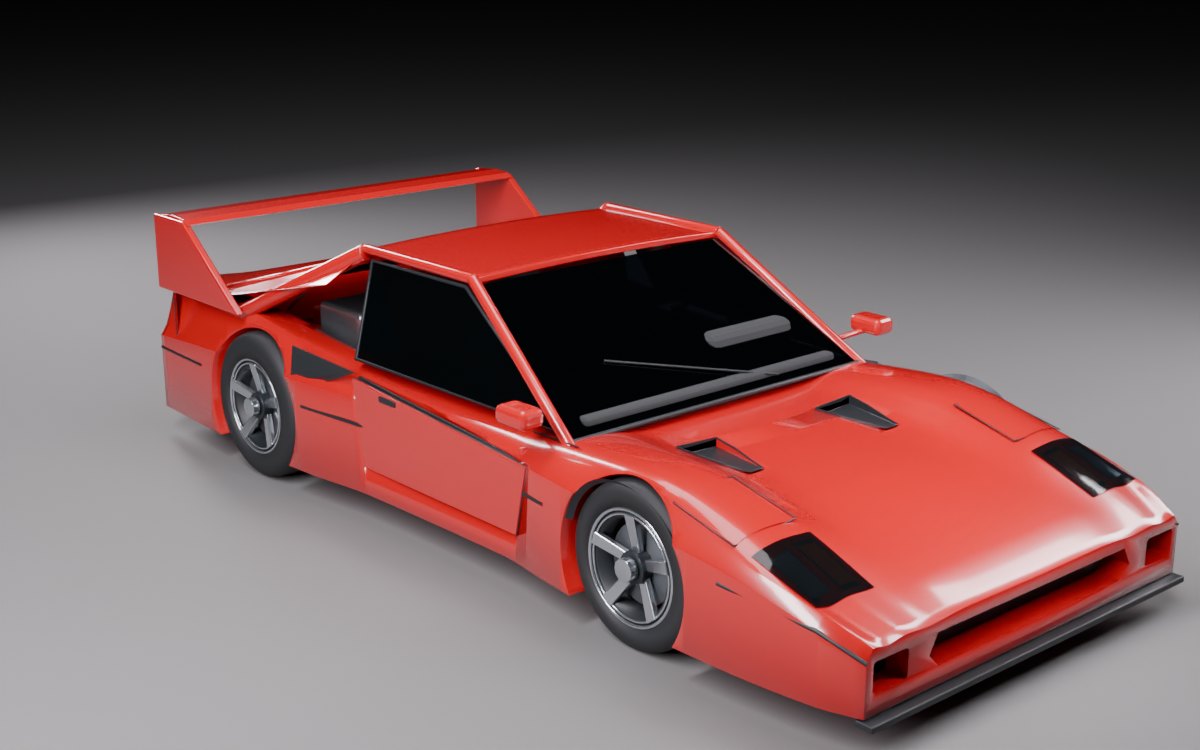
3D model: Joyride · original procedural geometry · Source · Joyride original work. Upper-side-inlet transition pass 26 is an original geometry study, not the finished F40 and not yet photorealistic. Main body dimensions, wheelbase, tracks and the 1.124 m roof top are checked; local surfaces, panel gaps, bonnet ramps, lamp sections, glazing, lighting and cabin sizes remain estimates. Both shallow inlet cards are now real body openings backed by editable five-station visible transition meshes with 20 vertices and 16 wall quads per side. Their 104 mm visible depth, 0.44 throat-area ratio and 4 mm edge radius are photographic/form estimates, not Ferrari measurements; parts evidence supports separate left/right inlet assemblies and filter/cover/pipe relationships, but no factory section, hidden routing, airflow map, scan or calibrated launch-car camera solution was available. Paint coat plus separate laminated-windscreen and Perspex transmission/roughness/IOR values are scalar PBR studies without texture maps. Pop-up headlamp, door and rear-cover pivots, opening angles and local assemblies remain photographic studies rather than factory-measured parts. Seven source-informed gauge faces remain static and partially qualified. No front-cover articulation or accepted authentic stock-road-car/horn sound yet. Browser/device use is not verified on a physical mobile device.
Related V8 recording · Porsche Cayenne; authentic F40 sound is still in development. Recorded by Soundholder. Pitch and HUD RPM use approximate automatic gear bands. Recording source · License.
Drive clockwise. Boundary and steering assists keep this practice course approachable. Halfway and finish results stay in this session. Retry lap preserves session bests; Respawn or changing vehicles resets them. The start lights and launch response are game feedback. The cabin study camera is provisional. Wheel animation and physical-device review are still in development.